


Chinese elm Identification (Ulmus parvifolia)

To recognize Chinese elm, look first for its small, alternate leaves, usually 1 to 2 inches (2.5 to 5 cm) long, oval with a pointed tip and clearly uneven leaf bases.

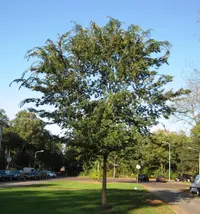
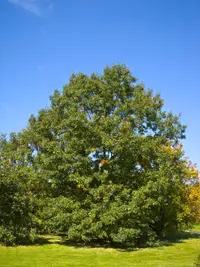
Also check the trunk and main branches for mottled, exfoliating bark and a broad, rounded crown with many fine twigs.

Ulmus parvifolia Identification

Check Your Plant with Botan

Take a photo and use Botan to confirm your plant identification.

Clear images work best. Avoid photos taken too close or too far away

Check the bark, leaves, and branching pattern of Ulmus parvifolia.

  • Leaves are small, simple, and alternate, usually 3/4-2 inches (2-5 cm) long, oval with a pointed tip.
  • Leaf edges are finely toothed, and the leaf base is often uneven, with one side slightly lower than the other.
  • Twigs form a dense, twiggy crown with many short side shoots, giving the canopy a fine-textured look.
  • Older trunks and branches often show patchy, exfoliating bark that reveals mottled gray, orange, brown, and green areas.

The mottled peeling bark and small uneven-based leaves are especially useful checks.

Ulmus parvifolia shows clear age-related changes in bark, branching, flowers, and fruit.

  • Young plant: Young plants are upright and twiggy, with smooth gray-brown stems and small alternate leaves, often about 1-2 inches (2.5-5 cm) long.
  • Mature plant: Mature trees develop a broader rounded crown and a sturdier trunk; bark exfoliates in thin flakes, exposing mottled gray, orange, and brown patches.
  • Flowering stage: Chinese elm flowers are tiny and lack showy petals, appearing in small clusters along twigs, so the branch structure remains more noticeable than color.
  • Fruiting stage: After flowering, flat round samaras hang singly or in small groups; these wafer-like winged fruits make the canopy look finely speckled.

Several Chinese elm cultivars can be separated at a glance by bark pattern, crown shape, and leaf size.

  • 'Drake': Broadly vase-shaped to rounded, often 40 to 50 feet (12 to 15 m) tall, with small dark green leaves and mottled gray, orange, and brown exfoliating bark.
  • 'Allee': More upright and strongly vase-shaped than the typical form, with a narrower crown and smooth bark that exfoliates in pale gray, cream, orange, and olive patches.
  • 'Catlin': A dwarf form with much smaller leaves and a dense twiggy outline, usually staying shrub-sized or forming a very small tree.
  • 'Frosty': Leaves are edged or flecked with creamy white variegation, making it visibly different from the plain green typical form.

In spring, Ulmus parvifolia leafs out with small, fresh green leaves. Tiny greenish flowers can appear around late summer to early fall, though they are not showy. By fall, foliage often turns yellow, orange, or rusty red before dropping. After leaf fall, the mottled bark and fine twiggy branching are easier to see, which helps with winter identification.

A few other elms are often mistaken for Chinese elm.

Siberian elm(Ulmus pumila)

Both have small, serrated leaves and a fine twiggy crown. Siberian elm usually has larger leaves, often 1 to 3 inches (2.5 to 7.5 cm), and bark that stays more furrowed, not patchy and exfoliating in mottled plates.

Japanese zelkova(Zelkova serrata)

This tree can suggest an elm at a glance because of its vase shape and alternate, toothed leaves. Zelkova lacks the clearly uneven leaf base typical of elms, and its bark is smoother gray rather than flaking into orange, gray, and green patches.

Ulmus parvifolia is native to eastern Asia, including China, Korea, Japan, and Vietnam. In the wild it occurs in mixed forests, open woodland, valley margins, streamside areas, and rocky slopes. This range and habitat can help with identification because it is not a North American native elm. Reports of spontaneous trees in disturbed urban sites or old plantings outside Asia usually point to an introduced species rather than a local wild elm.

Does Your Plant Match?

Upload a photo to Botan to identify it or confirm your ID before you spend time on the wrong plant.

FAQ

The standout feature is its mottled, exfoliating bark on older trunks and branches, peeling to reveal gray, orange, green, and brown patches. For Chinese elm identification, pair that bark with small, finely serrated leaves.

Everything About Chinese elm

More Plant Identification Guides

Know What Plant You Have

Identify it from a photo with Botan, then get plant details, care information, and common problems for that species.

Botan app identifying a plant from a photo
Can Plants Grow With Artificial Light?

6 min read · 15 Sept 2026

Can Plants Grow With Artificial Light?

Plants can grow under artificial light when the setup provides a suitable spectrum, enough intensity, and sufficient daily exposure. This guide explains how artificial lighting compares with sunlight, which options work indoors, and how to match a setup to houseplants.

Plant Care

Can Plants Grow With Artificial Light?
Best Fertilizer for Grass in Summer: How to Choose the Right One

6 min read · 18 Aug 2026

Best Fertilizer for Grass in Summer: How to Choose the Right One

The right fertilizer in summer can make a lawn thrive. The wrong one can damage it. Here, you’ll learn the best NPK ratios by grass type, when and how to apply your formula, and how to recognize the signs of over- or under-fertilizing.

Plant Care
Best Fertilizer for Grass in Summer: How to Choose the Right One
Top 15 Fast-Growing Trees For Your Garden

13 min read · 28 Jul 2026

Top 15 Fast-Growing Trees For Your Garden

Learn which of the 15 fastest-growing trees will suit your area. We’ll share detailed information on each: growth rate, mature spread, key tree demands, and main vulnerabilities. Read on and make the best choice possible.

Plant Recommendations
Top 15 Fast-Growing Trees For Your Garden