Select proper substrate
Use fresh, healthy birch logs cut in late winter, 10–25 cm in diameter, with intact bark and no visible fungal decay, as this provides the most reliable nutrition and structure for growing birch polypore.

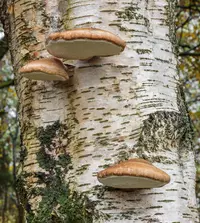
Birch polypore, Fomitopsis betulina, is a bracket fungus that forms smooth, hoof-shaped shelves on the trunks of birch trees. It is not a leafy plant but a wood-decaying fungus. The fruiting bodies are usually pale beige to brown, with a rounded edge and firm, corky texture. They persist on dead or dying birches for months, sometimes years. This fungus occurs widely across temperate regions of Europe, North America, and parts of Asia wherever birch forests grow. It is not typically cultivated indoors, and attempts to care for birch polypore require access to suitable birch logs and consistently cool, moist outdoor conditions.

Care Difficulty
Hard Care

Light Preference
Partial Shade

Water Requirements
Keep Soil Moist

Temperature Preference
Cold Hardy

Hardiness Zone
2–7

Soil Texture
Loamy, Peaty, Organic-rich

Soil pH
Strongly acidic (4.5–5.5), Acidic (5.5–6.5)

Soil Drainage
Moist but well-drained

Fertilization
Minimal (feed rarely)
Scan your plant to receive care tips personalized for your specific plant
Available on iOS and Android
This bracket fungus prefers conditions that mimic light on a birch trunk in mixed woodland.
Moist, but not waterlogged, birch wood is critical for sustained Fomitopsis betulina development.
This species is adapted to cool, temperate forests and tolerates a wide temperature span.
Humidity matters mainly during cultivation stages for this wood-decay fungus, which prefers consistently moist air around developing fruiting bodies.
This species does not grow in soil in nature, but similar principles apply when preparing artificial substrates for Fomitopsis betulina culture.
This bracket fungus is not naturally suited to standard container culture, but it can be grown in specialized blocks or bags rather than traditional pots.
This wood-decay fungus grows on nutrient-rich birch and usually needs no added fertilizer in cultivation.
Pruning is generally unnecessary for this bracket fungus, which forms persistent, woody fruiting bodies on birch trunks.
Cultivated Fomitopsis betulina is usually managed by relocating inoculated logs rather than repotting in containers.
This fungus is typically propagated by introducing spawn to fresh birch wood rather than by home spore work.
Once established in hardy birch wood, this fungus tolerates normal outdoor winter conditions in temperate climates without special care.

Plant Health Check
Not sure what's wrong with your plant? Check your plant's health inside the app.
This polypore is highly specialized to colonize and decompose the wood of birch trees, playing a major role in returning locked-up carbon and nutrients from birch trunks back to the forest soil.
Mature fruiting bodies develop a hard, hoof-like shape with a smooth, pale upper surface and a fine porous underside, which can release billions of microscopic spores over their lifespan.
Fruit bodies identified as this species were found among the belongings of Ötzi the Iceman, a 5,300-year-old mummy discovered in the Alps, indicating that humans have interacted with this fungus since prehistoric times.

Genetic and morphological studies have shown that this species, once grouped broadly under the name Piptoporus betulinus, is distinct and strongly associated with birch-dominated ecosystems across the temperate and boreal zones of the Northern Hemisphere, making it a useful indicator of birch presence in forest surveys.
Growth is moderate. After spores infect a suitable birch wound, small brackets may appear within 1–2 years. Individual fruiting bodies usually expand over a single season, then are replaced by new ones on the same trunk or log.
Keep your plants happy and healthy with plant identification, disease detection, and easy care guidance.