Wind-hardening seedlings
Expose young plants gradually to stronger wind over several weeks by moving containers or reducing shelter, which encourages thicker stems and better anchorage before outplanting.

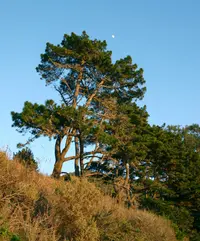
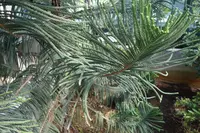
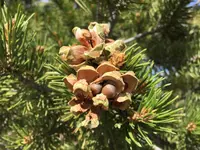
Monterey pine, Pinus radiata, is a fast-growing coniferous tree valued for timber, windbreaks, and ornamental planting. It has a straight trunk, dense crown, and long dark green needles in clusters of three.
In nature it occurs in a few coastal areas of central California and on parts of the coast of Mexico, but it is widely planted in mild climates worldwide.
The species is relatively easy to establish where winters are mild and soils are well drained, though it can be prone to certain pests and fungal diseases. Understanding how to care for Monterey Pine starts with choosing a sunny site, suitable soil, and adequate space for its mature size.

Care Difficulty
Moderate Care

Light Preference
Full Sun

Water Requirements
Low Water

Temperature Preference
Warm Climate

Hardiness Zone
8–10

Soil Texture
Sandy, Loamy, Rocky

Soil pH
Strongly acidic (4.5–5.5), Acidic (5.5–6.5)

Soil Drainage
Well-drained

Fertilization
Minimal (feed rarely)
Scan your plant to receive care tips personalized for your specific plant
Available on iOS and Android
This coastal pine thrives in open, bright sites with strong direct sun from an early age.
This species prefers evenly moist but not saturated soil, especially during establishment.
This pine is adapted to mild, coastal-type climates with moderate temperature swings.
Humidity is rarely critical for Pinus radiata, which adapts well to typical outdoor air conditions in temperate regions.
Pinus radiata prefers loose, well-drained mineral soils that do not stay wet for long periods.
This species can be grown in containers for a limited time, mainly as a young tree or bonsai-style specimen.
Pinus radiata benefits from moderate feeding in poor or depleted soils but often needs little input in fertile ground.
Pruning Pinus radiata is mainly structural and corrective, not a frequent grooming task.
Monterey pine is usually field-grown and transplanted when young, as it resents frequent root disturbance.
Pinus radiata is mainly propagated from seed; vegetative methods are used mostly in commercial forestry.
Pinus radiata is only moderately frost-tolerant and needs consideration in colder regions.

Plant Health Check
Not sure what's wrong with your plant? Check your plant's health inside the app.
This species is naturally native only to a small coastal strip of central California and two nearby islands, yet it has become one of the most widely planted commercial conifers in the world.
Many of its woody cones are serotinous, meaning they stay closed for years and only open widely after exposure to the heat of fire, releasing seeds into freshly cleared, nutrient-rich soil.
Large plantation areas, especially in countries like New Zealand and Chile, are often dominated by a narrow set of clonal lines, leading to high productivity but also increased vulnerability to pests and diseases that can exploit this genetic uniformity.

The species has become invasive in some Southern Hemisphere regions, where its rapid growth, prolific seed production, and tolerance of poor soils allow it to outcompete native vegetation and transform coastal and grassland ecosystems.
Brown needles usually result from drought stress, hot dry winds, salt exposure, or root damage. Check soil moisture, mulch the root zone, avoid lawn fertilizer near roots, and prune only dead branches to limit further stress.
Keep your plants happy and healthy with plant identification, disease detection, and easy care guidance.