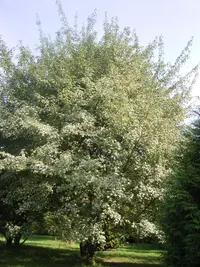
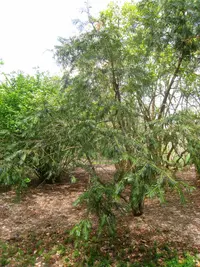
Wind exposure planning
Site young trees where larger structures or older trees break prevailing winds, or use temporary windbreak fencing for the first 2–3 winters to reduce desiccation and leader breakage.


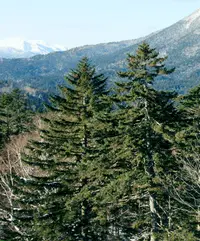
Lutz's spruce (Picea × lutzii) is a naturally occurring hybrid conifer between Sitka spruce and white spruce. It forms a tall, straight tree with dense, stiff needles and a classic spire-like crown. In nature it occurs mainly in coastal and subarctic regions of Alaska, where the ranges of its parent species overlap.
This spruce is hardy and wind tolerant, but young trees can be sensitive to heat and drought. It prefers cool climates, steady soil moisture, and well-drained, slightly acidic soil. Once established, it grows steadily with relatively low maintenance, which helps simplify how to care for Lutz's spruce in suitable outdoor conditions.

Care Difficulty
Moderate Care

Light Preference
Full Sun

Water Requirements
Moderate Water

Temperature Preference
Cold Hardy

Hardiness Zone
3–7

Soil Texture
Sandy, Loamy, Rocky

Soil pH
Strongly acidic (4.5–5.5), Acidic (5.5–6.5)

Soil Drainage
Moist but well-drained

Fertilization
Minimal (feed rarely)
Scan your plant to receive care tips personalized for your specific plant
Available on iOS and Android
This hybrid spruce needs consistent outdoor light conditions that mimic cool, northern climates.
This conifer prefers evenly moist, cool soil but reacts poorly to prolonged saturation.
This spruce is adapted to cold climates and prefers cool to moderately warm conditions.
This spruce tolerates a wide humidity range and rarely needs special humidity management outdoors.
Soil preparation is important for healthy root development and long-term stability.
This species can be grown in containers only for the short to medium term, mainly as a juvenile landscape plant.
This hybrid spruce benefits from modest, targeted feeding rather than heavy fertilization.
Picea × lutzii needs only light structural pruning to stay healthy and well-shaped.
This spruce is usually grown in the ground, with transplanting focused on young container-raised or balled-and-burlapped plants.
Picea × lutzii is usually propagated by specialists, as garden-scale propagation is slow and somewhat unreliable.
This cold-hardy spruce generally needs minimal winter attention once established in the landscape.

Plant Health Check
Not sure what's wrong with your plant? Check your plant's health inside the app.
This spruce is a natural hybrid between Sitka spruce (Picea sitchensis) and white spruce (Picea glauca), occurring mainly where their ranges overlap along the coastal regions of Alaska and western Canada.
It typically shows cold hardiness that is intermediate between its parent species, allowing it to grow from cool, moist coastal sites into somewhat colder inland locations compared with Sitka spruce.
Needle length, cone size, and crown shape in this hybrid often fall between those of Sitka and white spruce, and individual trees can lean more toward one parent or the other, which makes field identification challenging even for specialists.

Genetic studies using molecular markers have confirmed the hybrid origin of this spruce and revealed that hybridization and backcrossing are ongoing in some contact zones, creating a complex genetic gradient rather than a single, uniform hybrid type.
Growth is generally slow to moderate. Young trees often add about 20–30 cm per year, sometimes more in ideal coastal climates. Rate depends strongly on genetics, site conditions, soil moisture, and overall Picea × lutzii care.
Keep your plants happy and healthy with plant identification, disease detection, and easy care guidance.