Windbreak placement
Site plants behind a fence, hedge, or building in windy regions, because young specimens can suffer from winter wind desiccation and benefit from this sheltered microclimate.

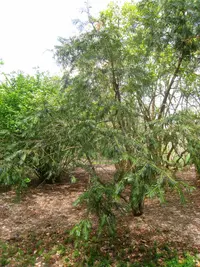
Fortune's yew plum (Cephalotaxus fortunei) is an evergreen coniferous shrub or small tree grown mainly for its fine, dark green, needle-like foliage. It has a dense, rounded to upright habit and keeps its color year-round, making it useful for shaded structure in gardens and landscapes.
This species is native to China and nearby regions, where it grows in woodland and mountain environments. It tolerates shade better than many conifers and copes with a range of soils, which makes it relatively forgiving once established. Gardeners who learn how to care for Fortune's Yew Plum usually find it slow-growing but long-lived, with few serious pest or disease problems.
It generally prefers partial shade, consistent moisture, and well-drained, slightly acidic soil for best appearance and vigor.

Care Difficulty
Easy Care

Light Preference
Partial Shade

Water Requirements
Moderate Water

Temperature Preference
Cold Hardy

Hardiness Zone
5–9

Soil Texture
Sandy, Loamy, Clay

Soil pH
Acidic (5.5–6.5), Slightly acidic (6.5–7.0)

Soil Drainage
Moist but well-drained

Fertilization
Minimal (feed rarely)
Scan your plant to receive care tips personalized for your specific plant
Available on iOS and Android
This shade-tolerant conifer prefers bright conditions without intense afternoon sun.
This species prefers evenly moist but not saturated soil with good drainage.
This hardy conifer withstands a wide temperature range once established outdoors.
Cephalotaxus fortunei handles typical outdoor humidity but benefits from slightly moist air in hot, dry regions.
Cephalotaxus fortunei prefers loose, moisture-retentive but well-drained soil to support steady, resilient growth.
This species is suitable for container growing, especially on patios or in small gardens.
This slow-growing conifer needs modest feeding, especially when young or container-grown.
Cephalotaxus fortunei responds well to light, timed pruning to maintain structure and plant health.
This species is usually grown in the ground, so focus on careful transplanting rather than frequent repotting.
Cephalotaxus fortunei is commonly propagated by semi-ripe cuttings or seeds under controlled conditions.
This conifer is broadly cold hardy, so established in-ground plants usually need minimal winter care.

Plant Health Check
Not sure what's wrong with your plant? Check your plant's health inside the app.
This species belongs to an old conifer family, Cephalotaxaceae, which diverged early from the yew family and retains primitive features such as relatively broad, flat needles arranged in two ranks along the shoot.
Instead of woody cones, it produces fleshy, olive-like seed structures with a single large seed that ripens from green to yellowish or brownish, functioning ecologically more like a fruit than a typical conifer cone.
Fortune's yew plum is adapted to grow under forest canopies in its native China and can continue producing new shoots and healthy foliage under much lower light than many other conifer shrubs.

Pollen and seed fossils attributed to this genus show that close relatives of Fortune's yew plum once had a much wider distribution across the Northern Hemisphere, indicating that the species is part of a relict group that survived mainly in East Asian refuges after past climatic changes.
This species is evergreen and keeps its foliage year-round. Individual needles can yellow and drop as part of normal renewal, but the plant does not have a bare winter period like deciduous shrubs.
Keep your plants happy and healthy with plant identification, disease detection, and easy care guidance.