Establish Deep Roots
During the first 2–3 years, apply water less often but for longer sessions to encourage deep root growth that improves drought tolerance and wind stability.

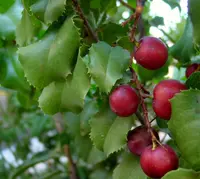
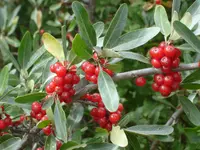
Hollyleaf cherry, Prunus ilicifolia, is an evergreen shrub or small tree native to coastal and chaparral regions of California and northern Baja California. It typically forms dense, rounded crowns with stiff, glossy, spiny-edged leaves that resemble those of holly.
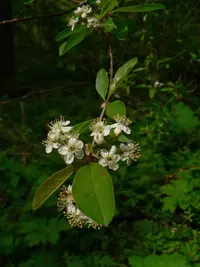
The plant produces small white flowers followed by dark purple to black fruits that attract birds and wildlife. It is naturally adapted to dry summers, poor soils, and full sun, which makes it relatively low-maintenance once established.
Because it tolerates drought, wind, and pruning, it suits hedges, screens, and habitat plantings in mild climates. Gardeners who want to learn how to care for hollyleaf cherry mainly need to consider space, sun exposure, and soil drainage.

Care Difficulty
Easy Care

Light Preference
Full Sun

Water Requirements
Low Water

Temperature Preference
Warm Climate

Hardiness Zone
7–10

Soil Texture
Sandy, Loamy, Rocky

Soil pH
Slightly acidic (6.5–7.0), Neutral (7.0)

Soil Drainage
Well-drained

Fertilization
Minimal (feed rarely)
Scan your plant to receive care tips personalized for your specific plant
Available on iOS and Android
This drought-adapted evergreen shrub or small tree thrives in bright outdoor conditions with strong sun exposure.
This species is highly drought tolerant once established but benefits from thoughtful watering during its first years.
This California native shrub tolerates a wide temperature range but performs best in mild, Mediterranean-type climates.
This species is adapted to dry, Mediterranean-type air and usually does not need humidity management.
Prunus ilicifolia thrives in well-aerated, mineral-based soil that drains quickly but does not dry out instantly.
This shrub can be grown in containers, but long-term culture is best in large, stable pots due to its eventual size and woody roots.
Native to nutrient-poor soils, hollyleaf cherry usually needs little or no fertilizer once established.
Prunus ilicifolia responds well to light structural pruning to maintain size and health.
This shrub is best planted directly in the ground, with transplanting done thoughtfully to limit stress.
Prunus ilicifolia is most often propagated from seed, with some use of semi-hardwood cuttings by experienced growers.
In its suitable climate range, this evergreen shrub is generally cold hardy and needs minimal winter care.

Plant Health Check
Not sure what's wrong with your plant? Check your plant's health inside the app.
This evergreen shrub or small tree is native almost exclusively to coastal California and northern Baja California, where it is a characteristic species of chaparral and coastal scrub, adapted to dry summers and nutrient-poor soils.
The stiff, spiny-margined leaves closely resemble those of holly, an example of convergent evolution where unrelated plant lineages independently develop similar protective leaf shapes to reduce browsing by herbivores.
The fleshy fruits are eaten by many birds and mammals, which disperse the seeds in their droppings, making the species an important food and seed-source component in coastal and chaparral ecosystems.

Indigenous peoples of coastal California used the fruits for food after careful processing to remove toxic compounds, and also used the hard, dense wood for small tools, reflecting a long cultural relationship with this shrub in its native range.
This species is an evergreen shrub or small tree, keeping its foliage year-round in mild climates. Old leaves are shed gradually as new ones form, so it does not go bare in winter under normal conditions.
Keep your plants happy and healthy with plant identification, disease detection, and easy care guidance.