Spore-Friendly Harvest
Cut mature puffballs cleanly at the base and leave a few older, darkening specimens in place so they can break down and release spores to maintain future flushes.

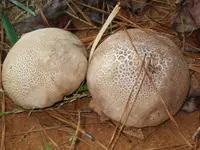
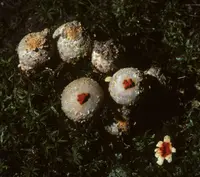
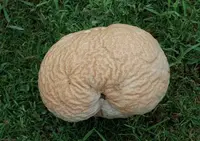
The purple-spored puffball, Calvatia cyathiformis, is a saprobic fungus rather than a leafy plant. It grows on soil or turf, often in lawns, pastures, and open woodlands. Young fruiting bodies are usually smooth, rounded, and whitish to tan, becoming more flattened with age.
Inside, the spore mass turns dark purple-brown as it matures, and this color is a key identification feature. It is widespread in parts of North America and other temperate regions, usually appearing in late summer to fall after rain. Those who want to care for Purple-Spored Puffball should understand it relies on decaying organic matter, moist but not waterlogged soil, and undisturbed ground to complete its life cycle.

Care Difficulty
Moderate Care

Light Preference
Partial Shade

Water Requirements
Regular Water

Temperature Preference
Cool Climate

Hardiness Zone
3–9

Soil Texture
Loamy, Silty, Organic-rich

Soil pH
Slightly acidic (6.5–7.0), Neutral (7.0)

Soil Drainage
Moist but well-drained

Fertilization
Minimal (feed rarely)
Scan your plant to receive care tips personalized for your specific plant
Available on iOS and Android
Calvatia cyathiformis develops best in open, lightly shaded habitats with gentle, indirect sun.
Calvatia cyathiformis relies on consistently moist but not saturated soil to form healthy fruiting bodies.
This species fruits most reliably in mild to warm conditions with moderate seasonal variation.
Humidity is not a major factor for Calvatia cyathiformis cultivation.
This fungus develops best in loose, free-draining, organic-rich ground rather than compacted or waterlogged sites.
This species is not well suited to container growing because it relies on extensive soil contact and natural microbial communities.
Calvatia cyathiformis is a wild puffball fungus that usually grows well without added fertilizer in natural or lawn settings.
Pruning is generally not applied to Calvatia cyathiformis, as individual puffballs are short-lived fungal fruiting bodies rather than long-term woody or leafy plants.
This puffball is not suited to typical repotting, but transplanting mycelium-colonized soil is sometimes attempted by enthusiasts.
Propagation of Calvatia cyathiformis is unpredictable, relying mostly on spore dispersal into suitable soil and climate conditions.
This species is naturally cold hardy in temperate regions and generally needs no special winter care once established in soil or turf.

Plant Health Check
Not sure what's wrong with your plant? Check your plant's health inside the app.
The gleba, or spore-bearing tissue, of this puffball turns a distinct deep purple-brown as it matures, which is unusual among puffball species that more often have olive or brown interiors.
It is considered edible only when the interior is still uniformly firm and white; once the inside begins to yellow or show purple coloration, it is no longer recommended for consumption.
This fungus commonly appears in short turf such as grazed pastures, lawns, and sports fields, where it fruits on nutrient-rich, compacted soils from late summer into fall.

Mature fruiting bodies of this puffball can release hundreds of millions of microscopic spores in a single season, which disperse by air currents after the outer skin ruptures or is compressed by raindrops or passing animals.
Young specimens with firm, pure white flesh inside are considered edible by many foragers, but identification errors are common. Only eat after expert confirmation, cook thoroughly, and avoid any specimen with yellowing, graying, or purplish interior.
Keep your plants happy and healthy with plant identification, disease detection, and easy care guidance.