Spore collection setup
Place a clean plastic sheet or tray under mature puffballs just before they open so spores can be collected cleanly and redistributed to other suitable sites without disturbing surrounding soil too much.

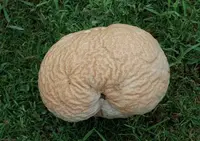
Brain puffball (Calvatia craniiformis) is a large puffball mushroom, not a leafy plant, known for its rounded, brain-like surface and dense white interior when young. It develops on soil rather than wood and eventually turns yellowish to brown as it matures and releases spores.
This species is native to North America and is usually found in fields, open woods, and grassy disturbed areas. It tends to appear in late summer to fall, often singly or in small groups.
For those who want to care for Brain puffball in a garden or controlled setting, it helps to know that it prefers undisturbed, well-drained soil with moderate moisture and partial to full sun exposure.

Care Difficulty
Moderate Care

Light Preference
Partial Shade

Water Requirements
Moderate Water

Temperature Preference
Cool Climate

Hardiness Zone
5–9

Soil Texture
Loamy, Silty, Organic-rich

Soil pH
Slightly acidic (6.5–7.0), Neutral (7.0)

Soil Drainage
Moist but well-drained

Fertilization
Minimal (feed rarely)
Scan your plant to receive care tips personalized for your specific plant
Available on iOS and Android
This puffball fungus favors bright, indirect light with some protection from intense midday sun.
This species prefers evenly moist, well‑drained soil rather than constant saturation.
This puffball develops best in mild to warm conditions with protection from hard frost and extreme heat.
Humidity is not a key factor for Calvatia craniiformis, which naturally fruits in open, variable outdoor air.
This fungus fruits best in loose, well-drained, organic-rich ground rather than in tightly compacted or waterlogged sites.
This species is not suitable for long-term container growing, as it relies on a broad, complex soil ecosystem to form natural fruiting bodies.
Fertilization needs for Calvatia craniiformis are low, as this fungus usually thrives in undisturbed, nutrient-rich soil.
Pruning is not applicable for Calvatia craniiformis because it is a puffball fungus, not a woody or leafy plant.
Calvatia craniiformis is seldom container-grown; management focuses on where and how it appears rather than classic repotting.
Propagation of Calvatia craniiformis is challenging and typically left to natural spore dispersal rather than controlled methods.
Outdoor populations of Calvatia craniiformis in temperate climates tolerate normal winter conditions and need no special care.

Plant Health Check
Not sure what's wrong with your plant? Check your plant's health inside the app.
This puffball produces a large, irregularly folded fruiting body whose convoluted surface resembles brain tissue, leading to common names like brain puffball and skull-shaped puffball.
The interior is firm and white when immature, but it gradually turns yellowish, then olive to brown as spores mature, providing a simple visual cue for spore development stage.
When fully mature, the outer skin cracks or ruptures and releases a powdery mass of spores that can be dispersed by wind or physical disturbance over relatively large areas.

Some mycologists note that this species often fruits singly or in small groups in open woodlands and pastures, making it a useful indicator of undisturbed, reasonably healthy soil fungal communities in those habitats.
The young, firm, white interior is considered edible when correctly identified and fully cooked. Once the inside yellows or darkens, discard it. Misidentification with toxic look-alike puffballs or immature amanitas is a serious safety risk.
Keep your plants happy and healthy with plant identification, disease detection, and easy care guidance.