Calostoma ravenelii Care

Calostoma ravenelii

About Calostoma ravenelii

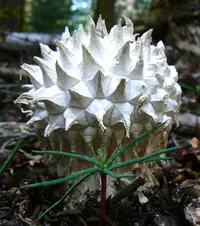
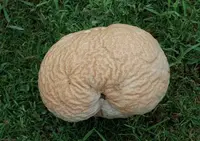
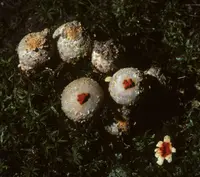
Calostoma ravenelii is not a typical leafy plant but a terrestrial fungus, often called stalked puffball-in-aspic. It produces rounded, orange to red fruiting bodies on a pale stalk that emerge from the forest floor.

This species grows in mixed or deciduous woodlands, mainly in eastern North America, where it associates with tree roots in a mycorrhizal relationship, exchanging nutrients with its host trees. Because it depends on specific woodland conditions and fungal partners, it is not easy to cultivate, and attempts to care for Calostoma ravenelii at home usually fail.

In nature it favors undisturbed, moist, well-drained forest soils with ample leaf litter and dappled light under established trees.

Main Plant Requirements

Care Difficulty

Hard Care

Light Preference

Shade

Water Requirements

Keep Soil Moist

Temperature Preference

Cool Climate

Hardiness Zone

Unknown

Soil Texture

Loamy, Sandy, Organic-rich

Soil pH

Strongly acidic (4.5–5.5), Acidic (5.5–6.5)

Soil Drainage

Moist but well-drained

Fertilization

Minimal (feed rarely)

Get Personalized Care Plan

Scan your plant to receive care tips personalized for your specific plant

Available on iOS and Android

How to Care for the Calostoma ravenelii

This ectomycorrhizal fungus prefers shaded woodland conditions rather than direct open sun.

  • Provide dappled or filtered light under trees, similar to a deciduous forest floor receiving 1–3 hours of weak, indirect sun per day.
  • Choose a site with partial to full shade where leaf litter stays slightly moist; avoid exposed southern or western aspects with harsh afternoon sun.
  • Excessive sun can dry the substrate and suppress fruiting bodies of Calostoma ravenelii, while deep, constant shade with some ambient light still supports its development.

Moist, humus-rich forest soil is essential for stable development of this fungus.

  • Aim for consistently moist but not saturated soil; leaf litter and organic matter should feel damp 2–3 cm down without standing water present.
  • Increase attention during hot, dry periods, using mulch or additional leaf litter to slow evaporation rather than direct heavy watering at the fruiting bodies.
  • Overly wet, poorly drained soil can lead to anaerobic conditions and decline of the host tree roots, while prolonged dryness causes shriveling and disappearance of visible structures of Calostoma ravenelii.

This species is adapted to mild to warm forest conditions with cool to cold winters.

  • Optimal fruiting usually occurs around 60–80°F (16–27°C), often in late summer to fall when soil moisture and temperature are both moderate.
  • It tolerates winter lows below 32°F (0°C) in dormant mycelial form, but fruiting bodies are sensitive and may be damaged by hard frost events.
  • Sustained heat above 86°F (30°C) combined with dry conditions can halt fruiting, so shaded microsites and adequate soil moisture help buffer extreme summer temperatures.

This mycoheterotrophic fungus does not rely on managed humidity and is not suitable for typical indoor cultivation.

In nature, Calostoma ravenelii develops in forest floors rather than in prepared horticultural substrates.

  • It associates with ectomycorrhizal trees in moist, leaf-litter-rich forest soil that is friable and organically rich.
  • Water drains freely through the loose litter and upper mineral layer, preventing prolonged saturation around developing fruiting bodies.
  • Soil reaction is usually slightly acidic, roughly pH 5.0–6.5, as found under many mixed hardwood forests.
  • Artificial mixes cannot easily replicate the required tree root and fungal network, so site choice in suitable woodland is more important than substrate modification.

This species is not suitable for container growing, as it depends on complex relationships with forest soils and host tree roots.

This ectomycorrhizal fungus relies mostly on its forest hosts, so Calostoma ravenelii needs little to no direct fertilization.

As a wild fungus with short-lived fruiting bodies, Calostoma ravenelii does not benefit from conventional pruning.

This species is not suited to normal pot culture, so any handling focuses on minimally disturbing its mycorrhizal habitat rather than classic repotting.

  • Avoid lifting or moving the fungal colony, since disturbance disrupts the fine mycelial network in the soil.
  • If relocation is necessary for study, move a small soil block containing the mycelium and associated tree roots together.
  • Time any move for cool, moist weather to reduce stress and desiccation of the mycelium.
  • Keep the soil block shaded and evenly moist after relocation to support re‑establishment.

Reproducing Calostoma ravenelii in cultivation is difficult, as it depends on specific tree partners and soil fungi interactions.

This temperate woodland fungus is naturally cold hardy and generally needs no special winter care when left in its native habitat.

Care Tips

Protect mycelial network

Mark and avoid disturbing the soil where fruiting bodies appear, since the hidden mycelium relies on intact leaf litter and tree roots to keep producing new mushrooms each season.

Maintain leaf litter

Leave a continuous layer of natural leaf litter and small twigs over the colony area to protect moisture, buffer temperature swings, and support the mycorrhizal relationship with nearby trees when caring for Calostoma ravenelii.

Gentle harvesting

If collecting specimens, cut the fruiting bodies at the base with a clean knife and leave part of each cluster intact so the fungal network can keep reproducing.

Microhabitat shading

In sites that receive brief direct sun, place low, breathable barriers such as branch trimmings or a slatted board to create dappled shade without compacting the soil surface.

Seasonal site monitoring

During dry or unusually hot periods, check the colony frequently and, if legal and appropriate, provide light, infrequent canopy-level watering to the surrounding trees rather than directly onto the mushrooms to support the shared habitat.

Common Pests and Diseases

Fly larvae

This pest develops inside decaying fruiting bodies and can cause rapid breakdown and collapse of the visible structure. Symptoms include soft, mushy tissue and small feeding tunnels within the fungus.

Solution

Remove and dispose of heavily infested fruiting bodies to interrupt the life cycle, and avoid leaving cut or damaged specimens on the ground where adults can lay eggs. In areas monitored for study or display, fine mesh covers over young fruiting bodies can reduce new infestation without chemicals.

Fungal parasitism

This disease occurs when other fungi colonize the sporocarp (fruiting body), leading to distortion, discoloration, or premature decay. Symptoms include irregular growth, patchy mold-like overgrowth, or rapid collapse of the structure.

Solution

Collect and discard affected fruiting bodies to limit spread of parasitic spores in the immediate area. Avoid disturbing the surrounding leaf litter and ectomycorrhizal roots so the underground mycelium remains healthy enough to produce unaffected fruiting bodies later.

Mite feeding damage

These insects are actually tiny arachnids that graze on the surface tissues and spores, causing a dull, abraded appearance and fine pitting on the peridium (outer layer). Symptoms include a dusty or scraped look and sometimes very fine webbing on older structures.

Solution

Gently remove and discard fruiting bodies with heavy mite presence to reduce local populations. If observation is desired, keep the area slightly less humid and avoid dense coverings that trap still air, since drier, better-ventilated conditions discourage high mite buildup without harming the underground fungus.

Interesting Facts

Gelatinous spore columns

Its fruiting body produces distinctive gelatinous, yellow to orange spore columns that ooze through the top opening of the cap, a feature rare among gasteroid fungi. These sticky spore masses help spores adhere to passing animals and water droplets for dispersal.

Mycorrhizal forest partner

This species forms ectomycorrhizal associations with hardwood trees, especially oaks, in acidic, often sandy soils of eastern North American forests. The fungus exchanges mineral nutrients for sugars from its host roots, contributing to forest nutrient cycling.

High-elevation specialist

It is most often recorded in montane and upland habitats of the Appalachian and Piedmont regions, frequently above lowland elevations. This distribution suggests adaptation to cooler, moist forest microclimates with well-drained but humus-rich soils.

Botan icon

Did you know?

Molecular phylogenetic studies have shown that Calostoma ravenelii, despite its odd, gasteroid appearance, actually belongs within the Boletales, making it a highly derived relative of more typical bolete mushrooms with stalks and pores rather than a close relative of puffballs or stinkhorns.

FAQs about Calostoma ravenelii

This fungus is not considered edible. It has little to no culinary value, and its safety has not been established. It is best treated as inedible and left undisturbed for observation rather than harvest.

Grow Healthy Plants with Botan Care

Keep your plants happy and healthy with plant identification, disease detection, and easy care guidance.

Botan plant care app — identify plants on mobile

Explore More Plants