Support Young Trunks
Stake young plants with a sturdy post on the windward side and use soft, flexible ties so the trunk can move slightly while still being protected from snapping in strong winds.

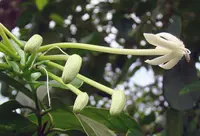
Posoqueria latifolia, commonly called needle flower, is a tropical evergreen tree or large shrub known for its very long, slender flower tubes and strong evening fragrance. The blooms open into star-shaped white flowers, followed by small rounded fruits.
In nature it grows in lowland rainforests of Central and South America, where conditions are warm, humid, and shaded by taller trees. It tends to form a neat, rounded crown and can become quite tall in the ground, but stays smaller in containers.
Its preference for constant warmth, high humidity, and evenly moist but well-drained soil makes it more suitable for mild climates, greenhouses, or experienced indoor growers. Understanding how to care for needle flower is important before choosing it for a home or garden.

Care Difficulty
Moderate Care

Light Preference
Partial Shade

Water Requirements
Regular Water

Temperature Preference
Tropical / Frost Sensitive

Hardiness Zone
10–12

Soil Texture
Loamy, Sandy, Organic-rich

Soil pH
Acidic (5.5–6.5), Slightly acidic (6.5–7.0)

Soil Drainage
Moist but well-drained

Fertilization
Light (every 4–6 weeks)
Scan your plant to receive care tips personalized for your specific plant
Available on iOS and Android
This tropical shrub thrives in bright, warm conditions with protection from harsh midday sun.
This species prefers evenly moist, well-drained soil rather than extremes of wet or dry.
This plant grows best in stable, warm, frost-free conditions typical of tropical and subtropical climates.
This tropical shrub prefers consistently moist air and reacts quickly to prolonged dryness.
This species performs best in deep, moisture-retentive but well-aerated soil.
This species adapts well to large containers outdoors in warm climates.
Posoqueria latifolia responds well to light, consistent nutrition during the warm growing season.
Pruning helps maintain a healthy structure and flowering performance in Posoqueria latifolia.
This species is usually grown as a landscape tree, so focus on careful transplanting rather than frequent repotting.
Posoqueria latifolia is usually propagated from seeds, with vegetative methods used less often.
This tropical tree is frost-sensitive and benefits from targeted winter protection in cooler climates.

Plant Health Check
Not sure what's wrong with your plant? Check your plant's health inside the app.
The tree opens its tubular white flowers mainly at night and releases a strong, sweet fragrance that can be detected several meters away, an adaptation that attracts nocturnal moth pollinators.
The long, slender corolla tubes resemble white needles and can exceed 15 cm in length, which makes nectar accessible primarily to visitors with very long mouthparts such as sphinx moths.
After flowering, it produces egg-shaped, woody fruits that can reach the size of a small lime and may persist on the tree for months, providing a food source for various tropical animals when ripe.

In some parts of Central and South America, this species is traditionally planted near homes and paths because its intense night fragrance is valued as a natural evening scent in warm, still air.
Lack of blooms usually comes from insufficient light, nutrient imbalance from high nitrogen, or the plant being too young. Occasional cool stress or pruning at the wrong time can also remove flower buds and delay flowering.
Keep your plants happy and healthy with plant identification, disease detection, and easy care guidance.