Early trellis training
Install a sturdy trellis or wire support at planting time and gently tie young shoots with soft ties so the vine learns its climbing direction and does not develop tangled, hard-to-redirect older wood.

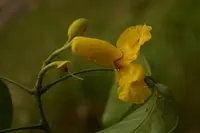
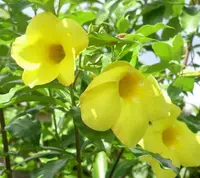
Callichlamys latifolia is a vigorous woody climber in the bignonia family, grown mainly for its large, glossy leaves and showy yellow trumpet-shaped flowers. It naturally occurs in tropical regions of South America, where it scrambles over trees and shrubs in warm, humid forests.
In cultivation it is usually trained on trellises, arbors, or fences, forming a dense green screen when conditions are suitable. The plant prefers bright light, consistent moisture, and well-drained soil, which makes greenhouse or frost-free outdoor settings most suitable.
Because it needs warmth, space to climb, and regular pruning to control size, it is moderately challenging for beginners. Understanding how to care for Callichlamys latifolia mainly involves providing stable warmth, support, and protection from frost.

Care Difficulty
Moderate Care

Light Preference
Full Sun

Water Requirements
Moderate Water

Temperature Preference
Tropical / Frost Sensitive

Hardiness Zone
10–12

Soil Texture
Sandy, Loamy, Organic-rich

Soil pH
Acidic (5.5–6.5), Slightly acidic (6.5–7.0)

Soil Drainage
Moist but well-drained

Fertilization
Light (every 4–6 weeks)
Scan your plant to receive care tips personalized for your specific plant
Available on iOS and Android
This vigorous tropical vine needs bright outdoor light to flower well without leaf scorch.
This vine prefers evenly moist, well-drained soil rather than constant wetness or drought.
This species grows best in warm, frost-free climates with stable temperatures.
This climber prefers moderately humid air and benefits from some moisture around the foliage.
This species grows best in loose, well-aerated, slightly acidic to neutral soil that drains quickly but holds some moisture.
This vigorous vine can adapt well to container growing when given enough root space and support.
This vigorous tropical climber benefits from moderate feeding when grown in nutrient-poor or confined soils.
Selective pruning keeps this twining vine manageable and promotes healthy flowering wood.
This species is usually grown in the ground, so focus on careful transplanting rather than frequent container repotting.
This woody climber is most practically propagated by semi-ripe cuttings under warm, humid conditions.
This tropical liana is frost-sensitive and needs protection in regions with cool or freezing winters.

Plant Health Check
Not sure what's wrong with your plant? Check your plant's health inside the app.
This species is a woody climbing vine native mainly to Brazil’s Cerrado and other South American savannas, where it scrambles over shrubs and trees to reach light above the canopy.
It produces large, bright yellow, trumpet-shaped flowers in clusters that are pollinated primarily by bees, which are attracted by both the color and the tubular corolla shape.
As a member of the Bignoniaceae family, it combines woody, twining stems with opposite leaves and showy flowers, an evolutionary strategy that maximizes light capture while using other plants for structural support.
This species is a vigorous woody vine that climbs rather than forming groundcover. It uses twining stems to wrap around trellises, fences, or trees, so it needs a vertical structure or support to develop properly.
Keep your plants happy and healthy with plant identification, disease detection, and easy care guidance.