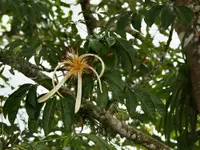
calabash nutmeg Care (Monodora myristica)

Also known as: African Nutmeg

About calabash nutmeg

Calabash nutmeg (Monodora myristica) is an evergreen tropical tree grown mainly for its aromatic seeds, which resemble true nutmeg in flavor and use. It forms a medium to tall tree with a straight trunk, spreading branches, and glossy green leaves.

The plant is native to West and Central African rainforests, where it grows in warm, humid, partially shaded environments. Its showy, pendant flowers and woody, gourd-like fruits add ornamental interest in suitable climates.

For gardeners, it can be moderately challenging, as it needs consistently warm temperatures, shelter from cold, and evenly moist but well-drained soil. Understanding these needs is key to successful care for calabash nutmeg.

Main Plant Requirements

Care Difficulty

Hard Care

Light Preference

Partial Shade

Water Requirements

Regular Water

Temperature Preference

Tropical / Frost Sensitive

Hardiness Zone

11–12

Soil Texture

Loamy, Sandy, Organic-rich

Soil pH

Acidic (5.5–6.5), Slightly acidic (6.5–7.0)

Soil Drainage

Moist but well-drained

Fertilization

Minimal (feed rarely)

Get Personalized Care Plan

Scan your plant to receive care tips personalized for your specific plant

Available on iOS and Android

How to Care for the calabash nutmeg

This tropical tree prefers bright, gentle light similar to high, open forest edges.

  • Provide 4–6 hours of bright, filtered light daily, with morning sun and dappled shade the rest of the day for calabash nutmeg.
  • Tolerates partial shade, but very deep shade leads to sparse foliage and weak flowering over time.
  • Protect from harsh midday sun, which can scorch leaves; in summer, use overhead shade cloth or plant near taller trees to diffuse light.

This species prefers evenly moist, well-drained soil without long dry spells or standing water.

  • Water when the top 3–5 cm of soil feels dry, aiming for consistently damp but not saturated soil around the root zone.
  • In warm growing seasons, increase watering as leaves stay fully expanded; in cooler months, allow slightly more surface drying between waterings.
  • Use deep, slow watering in well-draining loam; yellowing, soft leaves suggest overwatering, while drooping, brittle leaves suggest underwatering.

This lowland tropical tree needs warm, stable temperatures to grow and flower well.

  • Aim for 70–85°F (21–29°C) during active growth, which supports steady leaf and shoot development.
  • Avoid temperatures below 55°F (13°C); brief dips to 50°F (10°C) may be tolerated, but frost quickly damages foliage and young stems.
  • Handles short hot spells up to 95°F (35°C) if soil moisture is maintained and roots are mulched to reduce heat and evaporation stress.

This species prefers moderately humid air and reacts if kept too dry for long periods.

  • Aim for 50–70% humidity, as extended exposure below 40% often leads to leaf-edge browning.
  • Dry indoor air causes curled leaf margins, dull foliage, and stalled new growth in calabash nutmeg.
  • Increase humidity with a nearby humidifier, grouped plants, or a wide pebble tray, rather than misting leaves directly.

This tree grows best in loose, moisture-retentive but well-drained soil with high organic content.

  • Use a loamy mix combining roughly 50% peat-free compost, 30% fine bark, and 20% perlite or coarse sand.
  • Ensure rapid drainage so water runs through within seconds, preventing waterlogging around Monodora myristica roots.
  • Target a slightly acidic to neutral pH of about 6.0–7.0, avoiding strongly alkaline or salty substrates.
  • Break up compaction regularly at the surface to keep air spaces open and avoid dense, sticky, or heavy clay-based soils.

This species can be grown in containers when young or kept pruned, but needs careful pot choice for root and canopy balance.

  • Select a deep, heavy pot to stabilize the woody trunk and prevent tipping as the canopy gains mass.
  • Choose a container material that slows drying slightly, such as thick-walled clay, to buffer moisture swings in bright, warm positions.
  • Raise the pot on feet or blocks so drainage holes stay clear and excess water exits quickly after each watering.

Monodora myristica benefits from moderate, targeted feeding when grown in cultivation, especially in containers.

  • Use a balanced NPK fertilizer at 1/2 strength or well-rotted compost during the warm growing season to support steady growth.
  • Feed every 4–6 weeks from spring through late summer; avoid heavy, frequent applications that can burn roots.
  • Reduce or stop fertilizing in fall and winter when growth slows, particularly for indoor or potted calabash nutmeg specimens.
  • Rinse the soil with plain water occasionally to prevent salt buildup if using synthetic granular or liquid products.

Pruning Monodora myristica is mainly about maintaining structure and removing weak growth rather than heavy shaping.

  • Carry out light pruning at the end of the dry or cool season, just before active growth resumes.
  • Remove dead, diseased, crossing, or storm-damaged branches first to improve airflow and reduce disease risk.
  • Thin crowded interior shoots to allow more light into the canopy and encourage balanced branching and flowering.
  • Use clean, sharp bypass pruners or loppers, making smooth cuts just above a bud or branch collar to aid healing.

This tree is usually grown in the ground, so transplanting young Monodora myristica specimens correctly is more important than frequent repotting.

  • Look for roots circling the nursery pot, slowed growth, or the plant tipping over as signs it needs a larger space.
  • Transplant in late spring or early summer when soil is warm and the tree can root in before any cool season.
  • Move up only 1–2 pot sizes or plant into a prepared ground site with loose, well-drained soil and similar light conditions.
  • Water deeply after planting, mulch 5–8 cm around but not against the trunk, and keep soil evenly moist to limit transplant shock.

Propagation of Monodora myristica is usually done from seed and requires patience and warm, stable conditions.

  • Collect ripe seeds, clean off pulp, and sow fresh in a loose, well-draining mix to improve germination.
  • Provide warm temperatures around 75–85°F and consistent moisture, using a humidity dome or plastic cover if needed.
  • Start seeds in late spring or early summer to match natural growth cycles and give seedlings a long warm season.
  • Transplant seedlings gently once roots fill the starter cell, avoiding root disturbance and keeping them shaded for a few days.

Monodora myristica is a tropical tree with low frost tolerance, so some winter protection is necessary in cooler climates.

  • In USDA zones below 11, grow in containers and move plants indoors or into a heated greenhouse before temperatures drop near 40°F.
  • For in-ground trees in marginal climates, apply a 5–8 cm mulch layer over the root zone to buffer soil temperature.
  • Wrap young trunks and lower branches with breathable frost cloth during brief cold events to limit tissue damage.
  • Indoors, give bright light, reduced watering, and no or minimal feeding until warm, stable outdoor conditions return.

Care Tips

Deep container choice

Select a tall, heavy pot with at least 30–40 cm depth to accommodate the strong taproot and prevent the young tree from becoming top-heavy or tipping over in wind or indoors near drafts.

Early structural training

In the first 2–3 years, remove only crossing or inward-facing branches and lightly tip-prune competing leaders so the tree develops a single, sturdy trunk that can support future canopy and fruit load.

Wind and stake management

For outdoor or patio plants, use 1–2 sturdy stakes and soft ties to steady the trunk in its first seasons, then gradually loosen and remove supports once the stem has thickened to encourage a self-supporting structure.

Root zone protection

Keep a permanent organic mulch ring of 3–5 cm depth around the root zone, stopping 5–8 cm from the trunk, to stabilize soil moisture and temperature and protect fine feeder roots from heat and mechanical damage.

Pollination assistance

If flowering occurs in a sheltered or indoor setting, gently tap or brush between open flowers with a soft artist’s brush in the evening to improve pollination and fruit set when local insect activity is low, which is often necessary when growing calabash nutmeg away from its native habitat.

Common Pests and Diseases

Capsid bugs

These insects feed on young shoots, buds, and developing fruits, causing pitted scars, distortion, and premature fruit drop. This pest is a frequent problem in humid lowland cultivation and young plantations.

Solution

Hand-pick and destroy visible bugs on small trees and prune out heavily damaged shoots to reduce breeding sites. For larger trees, use targeted sprays of neem oil or pyrethrin in the early evening, repeating every 7–10 days while new damage appears, and keep weeds and alternate host plants controlled around the base.

Fruit borers

These insects tunnel into developing fruits, leading to internal decay, premature drop, and poor-quality seeds. Symptoms include small entry holes, frass (powdery waste), and soft, rotting spots on the husk.

Solution

Collect and destroy all infested or fallen fruits to break the life cycle and reduce larvae in the area. Use fine mesh bags around young fruits where tree size allows, and, in orchard settings, apply targeted biological insecticides based on Bacillus thuringiensis (Bt) at early fruit development stages according to label directions.

Leaf spot

This disease causes small brown to dark purple spots on leaves that may enlarge, merge, and lead to premature leaf drop, especially during long wet periods. Symptoms include more severe spotting on shaded inner canopy leaves with poor air movement.

Solution

Prune to open the canopy, remove and dispose of heavily spotted leaves, and avoid overhead watering to keep foliage as dry as possible. In persistent wet conditions or in plantations, apply a copper-based fungicide or chlorothalonil on new flushes of leaves at 10–14 day intervals until conditions dry.

Anthracnose

This disease produces dark, sunken lesions on young twigs, flowers, and fruits, which can lead to blossom blight and poor fruit set. Symptoms include blackened flower clusters and shriveled young fruits that fail to mature.

Solution

Remove and destroy infected twigs, flowers, and small fruits as soon as they are noticed, and maintain good spacing between trees for airflow. During humid flowering periods in production plantings, protect new growth with preventive copper or mancozeb sprays, starting just before flowering and repeating on schedule if wet weather continues, as part of broader Monodora myristica care instructions.

Interesting Facts

Nutmeg-like flavor

The dried seeds of this African rainforest tree are used as a spice with aroma and taste similar to true nutmeg, due to overlapping aromatic compounds such as myristicin and elemicin.

Distinctive hanging flowers

Its nodding, bell-shaped flowers have greenish-yellow sepals and long, ribbon-like, often purple-spotted petals that hang down, adapted to attract specific beetle pollinators in the understory shade.

Large woody capsules

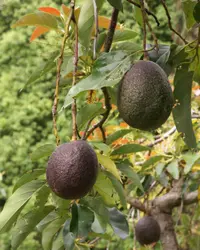
The plant produces hard, woody, roughly spherical fruits that split open to reveal aromatic seeds embedded in a yellowish pulp, which are collected, dried, and traded as a traditional West and Central African spice.

Botan icon

Did you know?

In parts of West and Central Africa, the dried seeds are important in regional cuisine and are sometimes called African nutmeg or ehuru, forming a distinct local spice tradition that is botanically unrelated to true nutmeg from Myristica fragrans.

FAQs about calabash nutmeg

Container growing is possible for young trees if the pot is large, deep, and very well drained. Root systems become extensive with age, so long‑term cultivation usually requires progressively larger tubs or eventual planting into the ground.

Grow Healthy Plants with Botan Care

Keep your plants happy and healthy with plant identification, disease detection, and easy care guidance.

Botan plant care app — identify plants on mobile

Explore More Plants