Golden Trumpet Care (Allamanda cathartica)

Also known as: Yellow Allamanda, Common Trumpetvine
Golden Trumpet

About Golden Trumpet

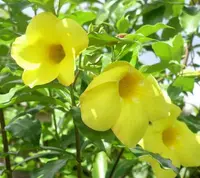
Golden trumpet, Allamanda cathartica, is a tropical evergreen vine or shrub valued for its large, glossy leaves and bright yellow, funnel-shaped flowers. It typically climbs or sprawls, making it suitable for trellises, fences, or large containers in warm climates.

This species is native to northern South America and is commonly grown in tropical and subtropical gardens around the world. It flowers over long periods in suitable conditions, but needs warmth and consistent light to perform well.

Golden trumpet prefers strong light, evenly moist but well-drained soil, and protection from cold. With attention to pruning and support structures, it is relatively straightforward to care for Golden Trumpet in suitable climates.

Main Plant Requirements

Care Difficulty

Moderate Care

Light Preference

Full Sun

Water Requirements

Regular Water

Temperature Preference

Tropical / Frost Sensitive

Hardiness Zone

10–11

Soil Texture

Sandy, Loamy, Organic-rich

Soil pH

Acidic (5.5–6.5), Slightly acidic (6.5–7.0)

Soil Drainage

Moist but well-drained

Fertilization

Moderate (every 2–4 weeks)

Get Personalized Care Plan

Scan your plant to receive care tips personalized for your specific plant

Available on iOS and Android

How to Care for the Golden Trumpet

Allamanda cathartica is a sun-loving vine that flowers best with strong, consistent light.

  • Provide 6–8 hours of direct sun daily, ideally with gentle morning sun and some protection from harsh mid-afternoon summer sun.
  • In hot climates, give Golden Trumpet light afternoon shade or filtered light to reduce leaf scorch and faded blooms.
  • In cooler seasons or coastal areas, choose a south or west exposure so the plant still receives at least 4–6 hours of bright sun for reliable flowering.

Allamanda cathartica prefers consistently moist but fast-draining soil to support vigorous growth and flowering.

  • Water when the top 3–5 cm of soil feels dry, soaking the root zone deeply, then allow excess to drain completely.
  • During hot growing seasons, expect to water more often, while in cooler months reduce frequency as growth slows and soil dries more slowly.
  • Watch for overwatering signs such as yellowing, soft leaves and root rot odor, and underwatering signs like dull, drooping foliage and dry, pulling-away soil.

This tropical vine thrives in warm, stable temperatures and is sensitive to cold and frost.

  • Maintain 70–85°F (21–29°C) for strongest growth and flowering, with slightly cooler nights improving overall vigor.
  • Protect the plant whenever temperatures approach 45°F (7°C), since tissue damage often occurs near this level and frost can kill top growth.
  • In hot regions, brief peaks up to 95°F (35°C) are tolerated if soil moisture is adequate, but extreme heat with dry soil can cause leaf scorch and bud drop.

This species prefers moderately high humidity for best flowering and leaf health.

  • Aim for 50–70% humidity, as very dry indoor air slows growth and can crisp leaf edges.
  • Watch for curling, browning margins, and increased spider mites as signs of low humidity stress.
  • Increase humidity with grouped plants, a nearby humidifier, or a pebble tray, while keeping leaves mostly dry to limit disease.

This vine needs sharply draining, slightly acidic, organic-rich soil to support fast growth and flowering.

  • Use a loose mix of 2 parts peat- or coco-based potting medium, 1 part coarse sand, and 1 part perlite or fine bark to enhance drainage and aeration.
  • Target pH around 6.0–6.5, as mildly acidic conditions help Allamanda cathartica access nutrients efficiently and reduce micronutrient lockout.
  • Ensure water runs through quickly and the mix never stays waterlogged, since saturated, compact soil encourages root rot and weak, yellowing growth.
  • In heavy native soil, raise beds and blend in coarse sand plus composted bark to break up clay and prevent standing water around roots.

This species is suitable for container growing when the pot is chosen to manage its vigorous, climbing habit.

  • Select a large, deep, and weighty container to anchor the plant and prevent tipping once stems and support structure gain height.
  • Use tall or wide pots that allow a broad root zone, which reduces drought stress between waterings and supports continuous flowering.
  • Position a sturdy trellis or support fixed firmly into the container so wind movement does not rock and loosen the root ball.

Allamanda cathartica responds strongly to consistent feeding during warm, active growth.

  • Apply a balanced liquid fertilizer (for example 10-10-10) at half strength every 2–3 weeks in spring and summer.
  • Use slow-release granules in early spring to support season-long growth and flowering in Golden Trumpet.
  • Reduce feeding to once every 6–8 weeks in fall and stop during winter dormancy or very cool conditions.
  • Water before and after feeding to prevent root burn and avoid applying fertilizer to dry or stressed plants.

Allamanda cathartica benefits from planned pruning to manage size and encourage heavy flowering.

  • Carry out main pruning in late winter or very early spring before vigorous new growth starts.
  • Remove dead, diseased, or damaged stems first, then thin crowded, weak, or crossing shoots.
  • Shorten long, wandering vines to shape the plant and direct growth onto a support or trellis.
  • Use sharp, clean bypass pruners and make angled cuts just above a leaf node to promote bushier regrowth.

This vigorous vine often needs periodic transplanting or repotting to support strong growth.

  • Check for roots circling the pot, protruding from drainage holes, or slowed growth as signs it needs a larger container or planting space.
  • Plan repotting or transplanting in spring, when temperatures warm and new growth begins, to allow recovery.
  • Move into a pot 1–2 in wider or a well-drained ground site, using rich, organic soil and firm but gentle backfilling.
  • Water thoroughly after moving, provide light shade for 3–5 days, and avoid heavy pruning at the same time to reduce root stress.

Allamanda cathartica is most commonly propagated from semi-ripe stem cuttings taken in warm seasons.

  • Take 8–12 in semi-ripe cuttings in late spring or summer, removing lower leaves and any flowers or buds.
  • Dip cut ends in rooting hormone, then insert into a moist, free-draining mix such as equal parts perlite and peat or coco coir.
  • Maintain 75–80°F, high humidity, and bright, indirect light; use a clear cover or propagator to limit moisture loss.
  • For seeds, sow fresh seed in warm, consistently moist mix and expect slower, less uniform results than from cuttings.

This tropical vine is frost-tender and needs protection in regions with cold winters.

  • In USDA zones colder than 10, grow in containers and move indoors before temperatures drop below 50°F.
  • Place indoor plants in bright light and keep above 60°F, with slightly reduced watering and no heavy feeding.
  • In mild climates, mulch the root zone with 5–8 cm of organic material to buffer short cool spells and soil temperature.
  • Avoid exposure to freezing wind; any frost-damaged stems can be trimmed back in late winter once danger of hard frost has passed.

Care Tips

Provide sturdy support

Install a strong trellis, fence, or wire system before planting and loosely tie new vines with soft ties as they elongate so the plant forms a stable, well-distributed framework rather than a tangled mass.

Control vine spread

In warm climates where the plant can become invasive, remove ground-layer stems that root where they touch soil and dispose of pruned material in yard waste rather than compost to prevent unwanted spreading.

Monitor for sap toxicity

Wear gloves when pruning or training, avoid contact of the milky sap with skin and eyes, and keep clippings away from pets and children, as the plant tissue is considered toxic if ingested.

Encourage flower renewal

Regularly deadhead spent flowers and trim back weak, thin shoots after major bloom flushes to redirect energy into new, flower-bearing growth and keep the vine productive.

Plan winter protection

In regions with cool winters, grow Golden Trumpet in a large container that can be moved under cover before temperatures drop, checking for pests before bringing it indoors to avoid infestations under shelter.

Common Pests and Diseases

Spider mites

This pest commonly attacks golden trumpet in hot, dry conditions, causing fine webbing and tiny pale stippling on leaves. Symptoms include dull, dusty-looking foliage that may yellow and drop prematurely.

Solution

Rinse foliage thoroughly with a strong but controlled stream of water, including leaf undersides, then repeat every few days to disrupt the mites. For heavier infestations, apply insecticidal soap or neem oil, ensuring full coverage, and increase humidity and air movement to make conditions less favorable for mites as part of ongoing Allamanda cathartica care.

Aphids

These insects cluster on tender shoot tips and flower buds, sucking sap and excreting sticky honeydew that can lead to sooty mold. Distorted new growth and curling leaves are typical symptoms.

Solution

Prune off heavily infested shoot tips, then hose down remaining stems and leaves to remove aphids and honeydew. Follow with insecticidal soap or a light neem oil spray on all soft new growth, repeating weekly until colonies are controlled and beneficial insects can keep numbers low.

Scale insects

This pest appears as small, dome-shaped bumps on stems and leaf veins, often causing yellowing and general decline. Honeydew secretion can encourage black sooty mold on leaves and nearby surfaces.

Solution

Gently scrape or rub off individual scales with a cotton swab dipped in alcohol, focusing on stems and main veins. For larger infestations, use horticultural oil or neem oil to coat stems and leaf undersides, repeating every 7–14 days while also improving plant vigor through correct watering and fertilizing.

Leaf spot

This disease causes brown, tan, or purplish spots on leaves, sometimes with yellow halos, and can lead to premature leaf drop in humid or rainy conditions. Symptoms include a gradual thinning of foliage from the lower parts of the plant upward.

Solution

Remove and dispose of affected leaves promptly and avoid overhead watering to keep foliage as dry as possible. Improve airflow around the plant with careful pruning, and if the problem persists, apply a copper-based or other appropriate fungicide according to label directions during wet periods.

Powdery mildew

This disease produces a white, powdery coating on leaves, young stems, and sometimes flower buds, reducing photosynthesis and vigor. Symptoms include dull, distorted new growth and reduced flowering, especially in warm days with cool, humid nights.

Solution

Increase light and airflow around the plant by thinning overcrowded stems and avoiding heavy late-day watering. Remove heavily infected leaves and apply a labeled fungicide such as sulfur or a potassium bicarbonate product at the first sign of symptoms, repeating as directed until new growth emerges clean.

Interesting Facts

Toxic milky latex

The stems and leaves exude a white latex rich in cardiac glycosides, which are toxic if ingested and can irritate skin, providing the plant with strong herbivore defense.

Continuous tropical flowering

In warm, frost-free climates this vine can flower almost year-round, producing successive flushes of large yellow trumpets rather than a single short blooming season.

Invasive in some regions

Allamanda cathartica has escaped cultivation and become invasive in parts of tropical Africa, Australia, and Pacific islands, where its vigorous growth can smother native vegetation.

Botan icon

Did you know?

Despite being widely grown as an ornamental vine, Allamanda cathartica rarely sets viable seed in many cultivated settings and often relies on vegetative propagation through stem cuttings for horticultural reproduction.

FAQs about Golden Trumpet

Lack of flowering usually relates to insufficient light, low nutrients, or heavy old wood. Ensure strong light, use a balanced fertilizer during active growth, and prune lightly after flowering to stimulate new, flower-producing shoots.

Grow Healthy Plants with Botan Care

Keep your plants happy and healthy with plant identification, disease detection, and easy care guidance.

Botan plant care app — identify plants on mobile

Explore More Plants