Silk floss tree Care (Ceiba speciosa)

Silk floss tree

About Silk floss tree

The silk floss tree, Ceiba speciosa, is a deciduous tree known for its swollen, thorny trunk and showy pink to white flowers. It develops a broad canopy and can become a striking focal point in mild climates.

This species is native to South America, especially Brazil and Argentina, where it grows in warm, seasonally dry regions. In cultivation it prefers full sun, well-drained soil, and moderate watering with good drying between waterings.

Its drought tolerance and relatively low maintenance needs make it manageable for patient growers, though size and sharp trunk spines limit its use in small spaces. Gardeners often look for guidance on how to care for Silk floss tree when grown outside its native range.

Main Plant Requirements

Care Difficulty

Moderate Care

Light Preference

Full Sun

Water Requirements

Moderate Water

Temperature Preference

Tropical / Frost Sensitive

Hardiness Zone

9–11

Soil Texture

Sandy, Loamy, Rocky

Soil pH

Slightly acidic (6.5–7.0), Neutral (7.0)

Soil Drainage

Well-drained

Fertilization

Minimal (feed rarely)

Get Personalized Care Plan

Scan your plant to receive care tips personalized for your specific plant

Available on iOS and Android

How to Care for the Silk floss tree

This sun-loving tree thrives in bright, open positions with warm, long days.

  • Provide full sun for 6–8 hours daily; young Silk floss tree saplings benefit from some light afternoon shade in very hot regions.
  • Allow partial shade (around 3–4 hours of direct morning sun plus bright indirect light) in hotter inland or desert climates to reduce leaf scorch.
  • In cooler areas, choose the sunniest, south-facing spot, since low winter light can slow growth and produce sparse branching if shade is excessive.

This drought-tolerant tree prefers deep, infrequent watering once established.

  • For in-ground trees during the first 2–3 years, water when the top 5–8 cm of soil are dry, soaking the root zone thoroughly each time.
  • Mature Ceiba speciosa in well-drained soil usually needs only occasional deep watering in summer and often none in cool, rainy seasons.
  • Watch for yellowing, soft leaves or trunk cracks as signs of overwatering, and for limp, brown-edged leaves as signs the soil has stayed dry too long.

This subtropical tree prefers warm conditions and is sensitive to hard frost.

  • Optimal growth occurs around 70–85°F (21–29°C), with steady warmth promoting faster trunk thickening and flowering.
  • Avoid exposure below 28–30°F (-2 to -1°C); young trees can be damaged or killed by frost, while older trees tolerate brief light freezes better.
  • In hot regions, trees handle 95–100°F (35–38°C) if soil moisture is adequate, but extended heat plus drought can cause leaf drop in late summer.

This species tolerates a wide humidity range and usually does not need special humidity management indoors or outdoors.

  • Aim for 30–50% relative humidity, similar to most heated or air-conditioned homes.
  • The tree copes well with brief drops below 30%, but prolonged very dry air may increase leaf edge browning on tender foliage.
  • If new foliage shows crisp tips, group plants together or place a shallow water tray nearby to slightly raise local humidity.

Ceiba speciosa prefers sharply drained, moderately fertile soil that stays aerated around the roots.

  • Use a sandy or loamy mix with coarse texture, such as 50–60% potting soil blended with coarse sand or small grit for drainage.
  • Maintain a slightly acidic to neutral pH around 6.0–7.0, avoiding very alkaline mixes that can reduce nutrient availability.
  • Add perlite or pumice to increase pore space and oxygen around the roots, especially in containers or compact native soils.
  • Avoid heavy clay or peat-heavy mixes that stay wet for long periods, as this encourages root rot in this drought-tolerant tree.

This tree can be grown in large containers, especially in cooler climates or where ground planting is not possible.

  • Choose a wide, heavy container that resists tipping as the trunk thickens and the canopy becomes top-heavy.
  • Select a pot deep enough to accommodate a developing taproot while still allowing rapid drainage through the lower profile.
  • Use a rigid material such as thick plastic or ceramic that limits sidewall flexing, which can disturb the expanding trunk base.

Ceiba speciosa benefits from light, controlled feeding during its active growing season.

  • Use a balanced slow-release fertilizer (for example 10-10-10) or well-rotted compost mixed into the topsoil in spring.
  • Feed outdoor trees once at the start of the warm season; container plants can receive diluted liquid feed every 4–6 weeks.
  • Apply liquid fertilizers at 1/2 strength to avoid salt buildup and excessive, weak growth.
  • Stop feeding the Silk floss tree in late summer so growth hardens before cooler weather.

Pruning Ceiba speciosa is mainly done to maintain safe structure and encourage a strong framework.

  • Carry out structural pruning in late winter or very early spring, before active growth resumes.
  • Remove dead, diseased, crossing, or storm-damaged branches first to improve airflow and reduce infection risk.
  • Thin congested interior shoots to shape the crown and support better light penetration, which can improve flowering.
  • Use sharp, clean loppers or a pruning saw, making smooth cuts just outside the branch collar without leaving stubs.

Ceiba speciosa is usually grown in the ground, with transplanting focused on young trees before they develop large taproots.

  • Transplant in late winter to early spring, when growth is slow and temperatures are mild.
  • Look for circling roots in containers, slowed growth, or frequent wilting as signs that a seedling needs a larger pot or planting site.
  • Move up only 1–2 pot sizes or plant into a well-drained, sunny ground location with ample space for future size.
  • Water deeply after transplanting, then keep soil slightly moist for several weeks to reduce root stress and support establishment.

Ceiba speciosa is most commonly propagated from seed rather than vegetative cuttings.

  • Collect ripe pods, then remove and dry the seeds before sowing.
  • Sow seeds in spring in a free-draining mix, barely covered, and keep at 70–80°F for reliable germination.
  • Maintain lightly moist, not waterlogged, conditions and bright light to prevent damping-off disease in seedlings.
  • Pot on young plants carefully once roots fill the starter cell or pot, minimizing disturbance to the developing taproot.

Ceiba speciosa is frost sensitive and needs protection in regions with cold winters.

  • In ground, add a 5–8 cm mulch layer around the root zone, keeping it away from the trunk to limit rot.
  • Wrap young trunks with breathable tree wrap or frost cloth when temperatures approach freezing.
  • Move container-grown trees indoors or into a frost-free greenhouse before nights drop below 40°F.
  • Reduce watering in winter, keeping soil just barely moist so roots stay healthy in cool conditions.

Care Tips

Protect young trunks

Install a light-colored tree guard or shade cloth on the west and south sides of young trunks to prevent sunscald and bark cracking during the first 2–3 summers.

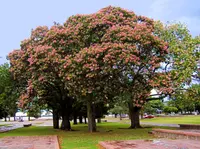
Manage surface roots

Mulch in a wide, shallow ring and avoid frequent shallow watering so roots anchor deeper and are less likely to heave paving or become exposed as the tree matures.

Brace in windy sites

In exposed locations, use 2–3 flexible stakes set outside the root ball with soft ties at one point on the trunk, and remove the support after 1–2 years once the tree stands firmly on its own.

Control thorn hazards

On trees planted near walkways, selectively remove or clip back lower thorns with clean, sharp pruners while young, leaving upper trunk thorns intact for overall bark health.

Plan for size

When growing Silk floss tree, position it at least 15–20 ft from buildings, driveways, and power lines to allow safe crown spread and reduce the need for heavy structural pruning later.

Common Pests and Diseases

Scale insects

These insects attach to young branches and stems, sucking sap and weakening growth, especially on container or landscape trees in warm climates. Symptoms include rough, crusty bumps, sticky honeydew, and sooty mold on bark or nearby surfaces.

Solution

Prune and destroy heavily infested twigs, then wipe or gently scrub reachable areas of bark with a soft brush and mild soapy water to remove scales and honeydew. For persistent problems, use a horticultural oil spray during mild weather to coat the bark and target the insects while avoiding applications during extreme heat or drought stress as part of broader Ceiba speciosa care instructions.

Spider mites

These pests thrive on young foliage and tender shoots during hot, dry weather, causing fine stippling, bronzing, and eventual leaf drop. Symptoms include delicate webbing on leaves and between small branches when populations are high.

Solution

Increase humidity around container plants, then hose down the canopy with a strong but controlled stream of water to dislodge mites and webs. If needed, apply insecticidal soap or a labeled miticide to the undersides of leaves and repeat at intervals, avoiding use during full midday sun to reduce leaf burn.

Caterpillars

These insects feed on tender leaves and new growth, sometimes stripping portions of the canopy on young or stressed trees. Symptoms include irregular holes, chewed edges, and frass (droppings) on leaves or beneath the tree.

Solution

Hand-pick visible caterpillars on small trees and dispose of them, and prune away heavily damaged shoots where practical. For larger infestations, apply a biological control such as Bacillus thuringiensis (Bt) to young foliage, following label directions and timing treatments when caterpillars are actively feeding.

Powdery mildew

This disease may appear in humid but not overly wet conditions, forming white, powdery patches on leaves and young shoots. Symptoms include distorted new growth and reduced vigor if the problem persists.

Solution

Improve air circulation by thinning crowded branches and keeping the canopy open, and avoid overhead watering that keeps foliage damp in the evening. Remove and discard affected leaves where practical, and use a sulfur or potassium bicarbonate fungicide labeled for powdery mildew if the disease persists or affects large areas of the canopy.

Leaf spot

This disease causes tan, brown, or dark spots on foliage, sometimes with yellow halos, leading to premature leaf drop on stressed or overwatered trees. Symptoms include scattered lesions that may coalesce into larger dead areas on leaves.

Solution

Rake and dispose of fallen leaves to reduce inoculum, and water at the soil level rather than overhead to keep foliage dry. If leaf spot recurs, improve drainage and spacing, and apply a copper-based fungicide during the early stages of infection according to label directions, focusing on young, susceptible leaves.

Interesting Facts

Trunk armed with spines

The trunk and larger branches often develop stout, conical spines that help protect the tree from herbivores and may shade the bark, which is important for a young tree that stores water in its green, photosynthetic stem.

Bottled water storage

In its native South American habitats with distinct dry seasons, the tree develops a swollen, bottle-shaped trunk that functions as a water reservoir, an adaptation that helps it survive prolonged drought.

Silky kapok fibers

The woody seed pods split open when mature to reveal masses of fine, silky fibers that help disperse the seeds by wind; these fibers have historically been used as lightweight stuffing for pillows and life vests.

Botan icon

Did you know?

In suitable outdoor conditions, this species can flower while leafless, covering the bare branches in large pink, white, or variegated blooms that create a striking display and make pollination by insects and bats more efficient due to the high visibility of the flowers.

FAQs about Silk floss tree

Lack of flowering usually relates to immaturity, insufficient light, or stress from recent transplanting or heavy pruning. This species often needs several years of stable, warm conditions and a distinct dry rest period before it flowers reliably.

Grow Healthy Plants with Botan Care

Keep your plants happy and healthy with plant identification, disease detection, and easy care guidance.

Botan plant care app — identify plants on mobile

Explore More Plants