Jerusalem artichoke Identification (Helianthus tuberosus)

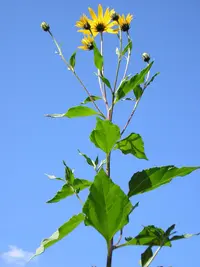
Recognize Jerusalem artichoke by its tall, upright stems, usually 6 to 10 feet (1.8 to 3 m), rough ovate leaves with pointed tips, and leaves that are opposite low on the stem but alternate higher up.

At flowering, it carries small sunflower-like heads with yellow rays and a darker yellow center.

Helianthus tuberosus Identification

Identify a Plant by Photo

Upload a plant photo and check the identification in seconds.

Clear images work best. Avoid photos taken too close or too far away

Use these quick checks to spot Helianthus tuberosus by eye.

  • Tall, upright stems often grow 3-10 feet (0.9-3 m) and branch more near the top.
  • Leaves are simple, rough, and pointed, usually 4-8 inches (10-20 cm) long with coarse toothed edges.
  • Lower leaves are opposite in pairs; upper leaves switch to an alternate arrangement along the stem.
  • Flower heads are daisy-like, yellow, and usually 2-4 inches (5-10 cm) across with a darker center.

Check both leaf arrangement and the small yellow sunflower heads for the clearest match.

Helianthus tuberosus shows clear stage-by-stage changes in height, leaf arrangement, and flowering structure.

  • Seedling: Seedlings show a few broad, rough first leaves on a slim upright stem, with simple blades and little branching compared with older plants.
  • Young plant: Young plants become strongly upright and leafy, with coarse stems and larger pointed leaves; lower leaves often appear opposite before upper leaves alternate.
  • Mature plant: Mature plants form tall cane-like clumps, often 6-10 feet (1.8-3 m) high, with stout stems, sparse upper branching, and narrower upper leaves.
  • Flowering stage: At flowering, branch tips carry small sunflower-like heads with yellow rays around a darker center, making the upper plant look more open and tiered.

In spring, Jerusalem artichoke emerges from the ground with fresh green stems and opposite lower leaves. By summer, the plant is tall and leafy, making patches easy to spot. Late summer into fall brings the clearest clue: small sunflower-like yellow flower heads at the stem tips. After frost, the top growth dies back, leaving dry brown stalks and a bare winter patch.

A few tall yellow daisies can be mistaken for Jerusalem artichoke.

common sunflower(Helianthus annuus)

Similar flower heads and rough stems cause confusion. It usually has broader, mostly alternate leaves and one dominant stem with larger terminal heads, not many smaller heads along branched upper stems.

maximilian sunflower(Helianthus maximiliani)

Another tall sunflower with narrow leaves and yellow rays. Its leaves are much slimmer, often folded, and mostly alternate; Helianthus tuberosus has broader, often opposite lower leaves.

false sunflower(Heliopsis helianthoides)

The yellow daisy-like flowers are similar at a glance. False sunflower forms tighter clumps, has opposite leaves through more of the stem, and lacks the coarse, tuber-forming habit.

Helianthus tuberosus is native to much of central and eastern North America. Wild plants are most often found in prairies, open woodland edges, thickets, roadsides, streambanks, and other disturbed ground. That setting helps with identification because true wild stands usually appear in sunny, open places with spreading colonies. Finding a sunflower-like plant in moist low ground or along a river corridor in its native range can support an ID, though it is also widely introduced beyond that area.

Confirm It from a Photo

Use Botan to compare your photo and help confirm the plant, so you can move forward with fewer identification mistakes.

FAQ

When dormant, the above-ground stems die back completely. What remains are underground tubers with thin, knobby skin and buds or “eyes,” which can help with Jerusalem artichoke identification outside the growing season.

More Plant Identification Guides

Find the Plant. Get the Details.

Identify a plant from a photo with Botan, then review its profile, care information, and common problems.

Botan app identifying a plant from a photo
Best Fertilizer for Grass in Summer: How to Choose the Right One

6 min read · 18 Aug 2026

Best Fertilizer for Grass in Summer: How to Choose the Right One

The right fertilizer in summer can make a lawn thrive. The wrong one can damage it. Here, you’ll learn the best NPK ratios by grass type, when and how to apply your formula, and how to recognize the signs of over- or under-fertilizing.

Plant Care
Best Fertilizer for Grass in Summer: How to Choose the Right One
Plant Pot Sizes: How to Choose the Right Plant Container

7 min read · 20 Aug 2026

Plant Pot Sizes: How to Choose the Right Plant Container

Plant pot sizes can be confusing because the number on the label only tells you part of the required information. A container may look spacious but actually be too shallow. So, how to choose pot size for plant species?

Beginner Guides
Plant Pot Sizes: How to Choose the Right Plant Container
Dill Companion Plants – What to Grow Next to Dill

9 min read · 17 Jul 2026

Dill Companion Plants – What to Grow Next to Dill

Dill is an easy-to-grow plant that gets along well with many vegetables. This guide describes 15 plants that can be planted alongside it, a few to avoid, and mistakes that can quietly sabotage the entire process.

Plant Recommendations
Dill Companion Plants – What to Grow Next to Dill