
wild mint Identification (Mentha arvensis)

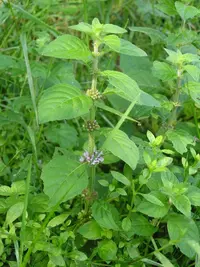
To recognize wild mint, look for opposite pairs of oval to lance-shaped leaves on a square stem, usually 1 to 3 inches (2.5 to 7.5 cm) long.

Mentha arvensis also shows dense whorls of small flowers packed in the leaf axils along the stem, rather than a single terminal flower spike.

Mentha arvensis Identification

Check Your Plant ID

Use a clear photo to confirm what plant you have.

Clear images work best. Avoid photos taken too close or too far away

Use these quick visual cues to check for Mentha arvensis.

  • Stems are square in cross-section and usually branch from the base, forming low clumps.
  • Leaves grow in opposite pairs, are oval to lance-shaped, and have toothed edges.
  • Leaves are usually 1 to 4 inches (2.5 to 10 cm) long, with short stalks and pointed tips.
  • Small pale lavender to pinkish flowers sit in tight round clusters at the leaf nodes, not in a long terminal spike.

Crush a leaf only if needed; visual structure is the main check here.

Mentha arvensis shows several visible stage changes that can help confirm identification.

  • Seedling: Seedlings show opposite first leaves on a short upright stem; leaves are small, simple, and already mint-like, but stems are less branched.
  • Young plant: Young plants form several leafy stems from the base, with opposite ovate leaves and a spreading habit, usually reaching about 6-12 inches (15-30 cm) tall.
  • Mature plant: Mature plants appear denser and more branched, with square stems and broader, clearly toothed leaves; leaf pairs are well spaced along the stem.
  • Flowering stage: At flowering, small pale lilac to whitish flowers cluster in tight whorls at leaf axils rather than only at stem tips, changing the plant's outline.

In spring, wild mint sends up fresh leafy stems from spreading underground runners, forming low green patches. By mid to late summer, small pale lavender flowers become visible in dense whorls at the leaf axils. After frost, the top growth dies back, leaving no woody stems through winter.

Several mints can be mistaken for Mentha arvensis at a glance.

spearmint(Mentha spicata)

Both have opposite, toothed leaves on square stems. Spearmint usually has terminal flower spikes, while wild mint bears dense whorls in the leaf axils.

peppermint(Mentha × piperita)

Similar leaves and strong mint scent cause confusion. Peppermint often has darker, smoother leaves and mostly terminal spikes, not axillary flower clusters.

water mint(Mentha aquatica)

Another wet-site mint with rounded leaves and lilac flowers. Water mint typically forms a dense terminal flower head; Mentha arvensis usually flowers in separated axillary whorls.

Mentha arvensis is native across much of temperate Europe and Asia, and it also occurs in northern North America. Its broad range matters less than its setting: this mint is most often found in moist, open to lightly shaded places. Look for it along streambanks, pond edges, wet meadows, ditches, and damp field margins. Finding a mint in consistently wet ground helps narrow identification toward Mentha arvensis rather than species more typical of drier sites.

Not Sure About the ID?

Use Botan to compare a photo and help confirm the plant, which can save time before you buy or label it.

FAQ

Look for a strong mint scent when a leaf is crushed, opposite leaves on a square stem, and small pale lavender to pink flowers packed in whorls at the leaf nodes. These details support identifying wild mint.

More Plant Identification Guides

Scan Your Plant. Get the Details.

Use Botan to identify a plant from a photo, then review plant details, care information, and common problems.

Botan app identifying a plant from a photo
Plants That Repel Bugs – 20 Effective Options

12 min read · 16 Jul 2026

Plants That Repel Bugs – 20 Effective Options

Mosquitoes on the patio? Gnats in the kitchen? Some plants keep them away with the scent of their own leaves. Here are 20 that deal with mosquitoes, flies, aphids, and more, plus where to put them so they help.

Plant Recommendations

Plants That Repel Bugs – 20 Effective Options
How to Winterize Your Garden in 6 Steps

5 min read · 28 Sept 2026

How to Winterize Your Garden in 6 Steps

Learn how to prepare your garden for winter with a practical six-step checklist covering cleanup, tender plant care, watering, mulching, winter protection, and winterizing equipment and containers.

Plant Care
How to Winterize Your Garden in 6 Steps
How To Revive a Dying Plant: 6 Steps To Bring A Plant Back To Life

6 min read · 1 Sept 2026

How To Revive a Dying Plant: 6 Steps To Bring A Plant Back To Life

Drooping leaves and brown tips don't always mean the end, and a weakened plant can often recover with a little help. These six simple steps will help you revive a dying plant and restore its health.

Plant Care
How To Revive a Dying Plant: 6 Steps To Bring A Plant Back To Life