

sweet woodruff Identification (Galium odoratum)

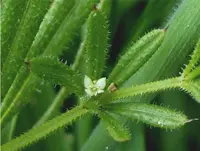
Recognize sweet woodruff by its whorls of 6 to 8 narrow, lance-shaped leaves around slender, square stems, usually spaced evenly up the shoot.

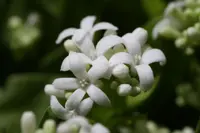
It also forms a low, creeping mat, and carries small, four-petaled white flowers in loose clusters above the leaves.

Galium odoratum Identification

Identify a Plant by Photo

Check your plant ID by uploading a clear photo to Botan.

Clear images work best. Avoid photos taken too close or too far away

Use these visible traits to check for Galium odoratum.

  • Low, mat-forming plant, usually about 4 to 12 inches (10 to 30 cm) tall.
  • Leaves are narrow and lance-shaped, set in star-like whorls around the stem.
  • Each whorl usually has 6 to 8 leaves, often with the widest point above the middle.
  • Stems are slender, upright to slightly leaning, with leaves spaced in regular tiers.
  • Flowers are small, white, and four-petaled, held in loose clusters above the foliage.

Check the leaf whorls and four-petaled white flowers together for the clearest match.

Galium odoratum shows clear visual shifts from low whorled shoots to flowering stems.

  • Young plant: Early shoots form small, upright stems with distinct leaf whorls. The plant still looks open, with patches rather than a continuous carpet.
  • Mature plant: Established growth spreads into a dense mat of square stems, usually 4-8 inches (10-20 cm) tall, with broader-looking whorls and more even spacing.
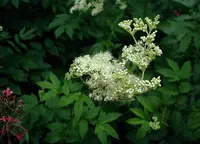
  • Flowering stage: At bloom, stems rise slightly above the leaves and branch near the top, carrying loose clusters of small, white, four-petaled flowers.

In spring, sweet woodruff forms fresh, bright green whorls of narrow leaves along low stems, creating a neat, layered groundcover look. From late spring into early summer, small white star-shaped flowers rise just above the foliage and are one of the clearest seasonal clues. In winter, the top growth usually dies back, so the plant may be absent above ground.

A few low woodland groundcovers can be mistaken for sweet woodruff at a glance.

cleavers(Galium aparine)

Both have whorled leaves and small white flowers. Cleavers has rough, clingy stems and leaves with hooked hairs, while Galium odoratum is smooth and forms tidier mats.

crosswort(Cruciata laevipes)

This also makes low growth with leaves in apparent whorls. Crosswort usually has four broader leaves per node and yellow flowers, not the finer leaves and white starry flowers of Galium odoratum.

Japanese spurge(Pachysandra terminalis)

Both are shade groundcovers with glossy green foliage. Japanese spurge has thicker, toothed leaves clustered at stem tips, not narrow leaves in rings along the stem.

Galium odoratum is native to much of Europe and parts of western Asia. In the wild, it is most often found in shaded deciduous woodlands, especially beech and mixed broadleaf forests. That setting helps with identification because this species is characteristically a forest-floor plant, forming patches in cool, humus-rich leaf litter rather than in open grassland, wetlands, or dry rocky sites. Seeing it in deep to partial woodland shade can help narrow the ID.

Not Sure About the ID?

Use Botan to identify or confirm it from a photo, so you can make better decisions before labeling or buying another plant.

FAQ

The clearest marker is the leaf whorl: 6 to 8 narrow leaves arranged in a ring around each stem node. In spring, this plant also carries small white, four-petaled flowers above the foliage.

More Plant Identification Guides

Identify It. Learn More About It.

Use Botan to identify a plant from a photo, then review plant details, care information, and common problems.

Botan app identifying a plant from a photo
How Long Can Flowers Go Without Water? Everything You Need to Know

6 min read · 10 Jul 2026

How Long Can Flowers Go Without Water? Everything You Need to Know

Flowers can survive without water anywhere from 1-2 hours to several months, depending on the plant type, species, and growing conditions. Some strong-looking flowers are drought-sensitive, while delicate-looking plants may tolerate long dry periods surprisingly well.

Plant Care
How Long Can Flowers Go Without Water? Everything You Need to Know
Dill Companion Plants – What to Grow Next to Dill

9 min read · 17 Jul 2026

Dill Companion Plants – What to Grow Next to Dill

Dill is an easy-to-grow plant that gets along well with many vegetables. This guide describes 15 plants that can be planted alongside it, a few to avoid, and mistakes that can quietly sabotage the entire process.

Plant Recommendations
Dill Companion Plants – What to Grow Next to Dill
12 Best Landscaping Trees for Your Garden

8 min read · 6 Oct 2026

12 Best Landscaping Trees for Your Garden

Choosing the landscape tree depends on what your garden needs most. These 12 options include compact flowering specimens, colorful deciduous trees, shade varieties, and evergreens suitable for screening and year-round structure.

Plant Recommendations
12 Best Landscaping Trees for Your Garden