
dallisgrass Identification (Paspalum dilatatum)

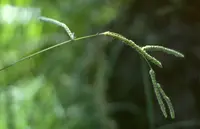
Recognize dallisgrass by its tight basal clumps, flat leaf blades, and seedheads made of 3 to 7 fingerlike branches spaced along a central stem.

Mature plants usually reach 1 to 5 feet (30 cm to 1.5 m) tall, with each branch lined in two rows of small oval spikelets.

Paspalum dilatatum Identification

Confirm What Plant You Have

Use a clear photo to confirm what plant you have.

Clear images work best. Avoid photos taken too close or too far away

Check the plant’s clumping form and seedhead shape first.

  • Grows as a dense, upright clump rather than a creeping mat.
  • Flowering stems usually rise 1 to 5 feet (0.3 to 1.5 m) above the leaves.
  • Seedheads have 3 to 7 narrow branches spaced along one central stem.
  • Small paired spikelets line the branches in neat rows, giving a dotted look.
  • Leaf blades are flat, long, and fairly broad for a lawn grass, often 4 to 12 inches (10 to 30 cm) long.

A mature seedhead is often the fastest visual clue.

Dallisgrass shows several visible stage changes that can help confirm identification in the field.

  • Seedling: Seedlings appear as narrow grass blades in a small tuft, with soft flat leaves and no tall flowering stems or finger-like seedhead branches.
  • Young plant: The plant forms a denser basal clump with broader drooping leaves, while stems remain mostly vegetative and the crown is still compact.
  • Mature plant: Mature plants become coarse, strongly tufted bunchgrasses, often reaching 2 to 5 feet (0.6 to 1.5 m) tall with taller culms rising above the leaf clump.
  • Flowering stage: Flowering stems carry 3 to 7 narrow racemes spaced along the upper stem, creating the characteristic open, fingered seedhead absent earlier.

In late spring to summer, Paspalum dilatatum is easiest to recognize when tall flowering stems rise above the foliage. The seedheads show several narrow, finger-like branches spaced along the upper stem. After frost, top growth often turns straw-colored or brown and may lie flat. In colder areas, winter leaves can die back enough that only dried clumps and old seed stalks remain visible.

Several coarse pasture grasses can be mistaken for dallisgrass at a glance.

bahiagrass(Paspalum notatum)

Often confused because both form clumps with broad blades and paired seed branches. Bahiagrass usually has 2 V-shaped racemes, while Paspalum dilatatum commonly has 3-7 along one stem.

barnyardgrass(Echinochloa crus-galli)

Similar in young leafy growth and coarse texture. Barnyardgrass lacks the hairy leaf base seen on dallisgrass and its seedhead is a dense, branched panicle rather than separate finger-like racemes.

johnsongrass(Sorghum halepense)

Can look similar as a tall, robust grass. Johnsongrass has a large open panicle 6-24 inches (15-60 cm) long, not several narrow racemes, and leaves show a more distinct white midrib.

Paspalum dilatatum is native to southern South America, including parts of Argentina, Uruguay, southern Brazil, and Paraguay. It naturally occurs in open grasslands, pastures, roadsides, and other disturbed grassy places. That setting helps with identification because this species is often encountered as a coarse pasture grass in lowland, temperate to subtropical landscapes rather than in shade, wetlands, or dry rocky sites.

Not Sure About the ID?

Use Botan to identify or confirm the plant from a photo, which can help avoid mix-ups with similar-looking species.

FAQ

The quickest clue is the seedhead: usually 3 to 7 narrow branches spaced along a central stem, each lined with paired spikelets. For identifying dallisgrass, also check the coarse, clumping growth and broad leaf blades.

More Plant Identification Guides

Know Your Plant Better

Identify it from a photo with Botan, then get plant details, care information, and common problems for that species.

Botan app identifying a plant from a photo
Plant Pot Sizes: How to Choose the Right Plant Container

7 min read · 20 Aug 2026

Plant Pot Sizes: How to Choose the Right Plant Container

Plant pot sizes can be confusing because the number on the label only tells you part of the required information. A container may look spacious but actually be too shallow. So, how to choose pot size for plant species?

Beginner Guides
Plant Pot Sizes: How to Choose the Right Plant Container
Planting Grass Seed in Summer – What Works and What Fails

7 min read · 6 Aug 2026

Planting Grass Seed in Summer – What Works and What Fails

Summer seeding succeeds when the grass type suits the season, and the soil stays moist. Find out how to prepare the seedbed and choose a safe window for planting.

Plant Care
Planting Grass Seed in Summer – What Works and What Fails
20 Funny Plant Names That Make You Laugh

8 min read · 16 Oct 2026

20 Funny Plant Names That Make You Laugh

Some plants carry names that sound like jokes. This guide explains the origins of 20 funny plant names. You will also see which of these plants you can grow at home.

Plant Recommendations
20 Funny Plant Names That Make You Laugh