


purple deadnettle Identification (Lamium purpureum)

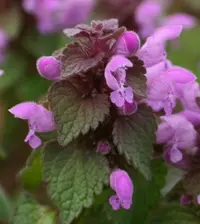
To recognize purple deadnettle, look for opposite, heart- to triangular-shaped leaves with rounded teeth on square stems, forming a low, branching plant usually under 12 inches (30 cm) tall.

The small pink to purple tubular flowers cluster tightly in the upper leaf axils, just below the top leaves.

Lamium purpureum Identification

Scan to Confirm purple deadnettle

Check your plant ID by uploading a clear photo to Botan.

Clear images work best. Avoid photos taken too close or too far away

Check the plant’s low, soft-stemmed form and clustered flowers first.

  • Square stems branch from the base and usually stay under 12 inches (30 cm) tall.
  • Leaves grow in opposite pairs, are broadly triangular to heart-shaped, and have bluntly scalloped edges.
  • Upper leaves are crowded near the stem tips and often show a reddish-purple flush.
  • Small tubular flowers sit in tight whorls at the upper leaf nodes, with a hooded upper lip and a 3-lobed lower lip.

Look for several of these traits together before deciding.

Purple deadnettle shows clear visual shifts from low seedling rosettes to flowering, branched stems.

  • Seedling: Starts as a tiny basal rosette with opposite round to kidney-shaped leaves on long stalks; stems are short, and upper leaves are not yet crowded.
  • Young plant: Begins producing square, ascending stems and paired leaves along the stem; newer leaves become more triangular and toothed than the first rounded leaves.
  • Mature plant: Forms a low, branched mound about 4-12 inches (10-30 cm) tall, with upper leaves packed near stem tips and often flushed purple.
  • Flowering stage: Top leaf pairs tighten into a compact cluster around small tubular pink-purple flowers, which sit in whorls at upper nodes rather than singly.

Purple deadnettle is often easiest to spot from late winter into spring, when its upper leaves turn distinctly purple and small pink-purple flowers become obvious near the stem tips. In warmer periods it may keep flowering, but the purple top growth and clustered flowers are the clearest seasonal identification clues.

Several mint-family weeds are often mistaken for purple deadnettle.

henbit(Lamium amplexicaule)

Both have square stems and small pink-purple flowers. Henbit’s upper leaves clasp the stem and are rounder; Lamium purpureum has short leaf stalks and more pointed upper leaves.

ground ivy(Glechoma hederacea)

Both are low, creeping, and have scalloped leaves. Ground ivy has kidney-shaped leaves on long stalks and usually trails from nodes; purple deadnettle is more upright, with leaves paired tightly near the stem tip.

red deadnettle(Lamium confertum)

Very close in color and flower shape. Red deadnettle is usually shorter and denser, with flowers crowded in tighter whorls and upper leaves less sharply triangular.

Lamium purpureum is native to Europe, western Asia, and North Africa. It is most often found in disturbed ground such as gardens, field edges, roadsides, vacant lots, and open woodland margins. That setting helps with identification because this species commonly appears as a weed in low, human-disturbed places rather than in wetlands, deep shade, or dry rocky slopes. Finding it in cultivated soil or along paths can narrow the options.

Not Sure About the ID?

Use Botan to identify or confirm the plant from a photo, helping avoid mix-ups with similar-looking plants.

FAQ

The small tubular flowers cluster in tight whorls at the upper leaf nodes, especially near the stem tip. They sit above paired leaves on square stems, a useful detail for Lamium purpureum identification.

More Plant Identification Guides

Identify It. Learn More About It.

Use Botan to identify a plant from a photo, then review plant details, care information, and common problems.

Botan app identifying a plant from a photo
12 Most Wanted Rare Houseplants to Grow at Home

6 min read · 21 Sept 2026

12 Most Wanted Rare Houseplants to Grow at Home

Rare houseplants can turn an ordinary corner in your apartment into a living botanical collection. This guide covers 12 most admired picks, what makes them special, and how to grow them successfully at home.

Plant Recommendations

12 Most Wanted Rare Houseplants to Grow at Home
Can Plants Grow With Artificial Light?

6 min read · 15 Sept 2026

Can Plants Grow With Artificial Light?

Plants can grow under artificial light when the setup provides a suitable spectrum, enough intensity, and sufficient daily exposure. This guide explains how artificial lighting compares with sunlight, which options work indoors, and how to match a setup to houseplants.

Plant Care
Can Plants Grow With Artificial Light?
Top 15 Plants That Don’t Need Sunlight

8 min read · 17 Sept 2026

Top 15 Plants That Don’t Need Sunlight

Some plants thrive in dim rooms, shaded corners, and places with indirect light. In this guide, you’ll explore the top 15 species best suited to low-light conditions and how to care for them.

Plant Recommendations
Top 15 Plants That Don’t Need Sunlight