


Skullcap Identification (Scutellaria indica)

Recognize Scutellaria indica by its opposite, ovate to lance-shaped leaves on square stems and its upright, clumping habit. Plants stay relatively low, with paired leaves spaced along slender stems.

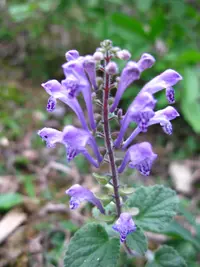
The flowers are distinctly two-lipped and borne in short terminal spikes, with a small shield-like calyx at the base that is characteristic of skullcaps.

Scutellaria indica Identification

Identify Your Plant with Botan

Upload a plant photo and check the identification in seconds.

Clear images work best. Avoid photos taken too close or too far away

Check Scutellaria indica for these easy visual traits.

  • Stems are upright and usually square in cross-section, often branching near the upper part.
  • Leaves grow in opposite pairs along the stem, not singly or in whorls.
  • Leaf blades are ovate to broadly lance-shaped, with pointed tips and clearly toothed margins.
  • Leaves are often about 1 to 3 inches (2.5 to 7.5 cm) long, on short stalks.
  • Flowers are two-lipped and tubular, borne in small clusters from the upper leaf axils.

The paired leaves and small two-lipped flowers are especially useful for a quick check.

Scutellaria indica shows several visible shifts in form that can help confirm identification.

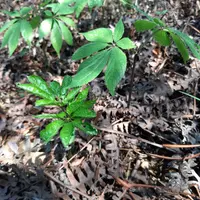
  • Young plant: Young plants form a low clump of opposite leaves on slender green stems, with limited branching and a compact outline close to the ground.
  • Mature plant: Mature plants stand more upright, often 8-20 inches (20-50 cm) tall, with clearer stem separation, longer internodes, and a looser, branched habit.
  • Flowering stage: At flowering, terminal and upper leaf-axil spikes become obvious, carrying small two-lipped purple to violet flowers above the leafy stems.
  • Fruiting stage: After flowering, the showy corollas drop away and the calyx remains visible, enclosing developing nutlets and making the spike look drier and more segmented.

In summer to early fall, Scutellaria indica is easiest to recognize when the stems carry small purple to violet flowers. The flowers make the plant much more noticeable than in its leafy stage. After flowering, the dry seed capsules remain briefly visible. In winter, the aboveground parts often die back, so seasonal identification is limited.

A few mint-family wildflowers can be mistaken for Scutellaria indica at a glance.

Japanese hedge-nettle(Stachys japonica)

Often confused because both are upright herbs with opposite, toothed leaves and small purple flowers. Stachys has flowers in dense whorls along the stem, while Scutellaria indica usually bears more paired, two-lipped flowers from the upper leaf axils.

self-heal(Prunella vulgaris)

Confusion happens when only leaves are noticed, since both have opposite leaves and purple flowers. Self-heal has a short, dense, head-like flower spike; Scutellaria indica has spaced flowers, not a compact head.

Scutellaria indica is native to eastern Asia, including Japan, Korea, China, and Taiwan. That range helps separate it from similar skullcaps in North America when a plant is found naturalized or growing outside cultivation. In the wild it is typically found in open woodland, forest margins, grassy slopes, and disturbed ground. Seeing it in light shade or partly open sites, rather than in wetlands or deep forest, can help narrow identification.

Confirm It from a Photo

Use Botan to identify or verify the plant from an image so you can avoid mix-ups with similar species.

FAQ

Leaves are opposite, appearing in pairs at each node along the stem. This paired arrangement is useful for identifying Skullcap, especially when checked with the square stems and mint-family flower structure.

More Plant Identification Guides

Find Out What Plant It Is

Identify it from a photo with Botan, then see plant details, care information, and common problems for that species.

Botan app identifying a plant from a photo
12 Best Plants for Bathroom That Thrive in Humid Conditions

9 min read · 29 Sept 2026

12 Best Plants for Bathroom That Thrive in Humid Conditions

Discover the 12 best plants for bathroom spaces. Each pick comes with its own advantages, plus light, humidity, watering, and placement tips. Take a look and match the plant to your specific bathroom.

Plant Recommendations
12 Best Plants for Bathroom That Thrive in Humid Conditions
Dill Companion Plants – What to Grow Next to Dill

9 min read · 17 Jul 2026

Dill Companion Plants – What to Grow Next to Dill

Dill is an easy-to-grow plant that gets along well with many vegetables. This guide describes 15 plants that can be planted alongside it, a few to avoid, and mistakes that can quietly sabotage the entire process.

Plant Recommendations
Dill Companion Plants – What to Grow Next to Dill
Frozen vs Fresh Vegetable Nutrients: Which Option Is Healthier?

6 min read · 8 Sept 2026

Frozen vs Fresh Vegetable Nutrients: Which Option Is Healthier?

Frozen and fresh vegetables are nutritionally comparable: frozen produce often retains vitamins just as well as fresh and may sometimes contain more. Here’s how blanching and storage affect nutrients—and when to choose each.

Plant Recommendations
Frozen vs Fresh Vegetable Nutrients: Which Option Is Healthier?