



Fireweed Identification (Epilobium angustifolium)

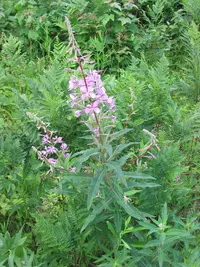
Recognize Fireweed by its tall, unbranched stems, narrow lance-shaped leaves arranged alternately, and a long terminal flower spike with four-petaled pink to magenta blooms.

Plants often stand 2 to 6 feet (0.6 to 1.8 m) tall, and the leaves show a clear pale midrib with slightly rolled edges.

Epilobium angustifolium Identification

Identify Your Plant with Botan

Upload a clear photo to check your plant identification with Botan.

Clear images work best. Avoid photos taken too close or too far away

Check the plant’s tall, narrow form and leaf pattern first.

  • Stems are upright and mostly unbranched, often forming clumps, usually 2-6 feet (0.6-1.8 m) tall.
  • Leaves are narrow and lance-shaped, about 2-8 inches (5-20 cm) long, with smooth edges and many arranged alternately up the stem.
  • Flowers have 4 pink to rose-purple petals and sit in a long terminal spike at the top of the stem.
  • Seed pods are long, slim capsules that stand out clearly after flowering.

If visible, the four-petaled flowers and narrow alternate leaves are especially useful checks.

Fireweed shows clear stage-by-stage changes in height, leaf arrangement, flowers, and seed capsules.

  • Young plant: Early shoots form a simple upright stem with narrow, alternate leaves; plants stay compact, without the tall flowering spike seen later.
  • Mature plant: Before bloom, the stem is taller and unbranched, lined with many willow-like leaves that create a narrow, vertical outline.
  • Flowering stage: The upper stem carries a long terminal raceme, a flower cluster, with bright pink to purple four-petaled flowers about 1 inch (2.5 cm) across.
  • Fruiting stage: Flowers are replaced by long, slender capsules that split open, releasing many silky-haired seeds from the same upper spike.

In spring, Fireweed emerges as upright reddish to green shoots with narrow leaves that quickly line the stems. By midsummer, tall spikes of bright pink to purple flowers become the clearest field mark. After flowering, long slender seed capsules replace the blooms. In late summer to fall, these split open to release silky white seed fluff, giving patches a pale, fuzzy look before the stems dry down.

A few tall pink-flowered wild plants are regularly mistaken for Fireweed.

purple loosestrife(Lythrum salicaria)

Often confused because both are upright and carry many rosy-purple flowers in long spikes. Purple loosestrife has 4-6 petals and a dense, wand-like flower spike. Epilobium angustifolium has 4 petals with a more open raceme, and its narrow leaves are usually alternate.

great willowherb(Epilobium hirsutum)

This is a realistic mix-up because it is another tall willowherb with pink 4-petaled flowers. Great willowherb usually has broader, hairy leaves and noticeably hairy stems. Epilobium angustifolium is typically smoother and has much narrower leaves.

Native across much of the temperate and boreal Northern Hemisphere, including much of North America, Europe, and northern Asia. In North America it is especially widespread across Canada and the northern and western United States. Habitat is a strong clue. Epilobium angustifolium is common in open, disturbed places such as recent burns, clearings, roadsides, streambanks, and montane meadows, often in cooler regions. Finding it in post-fire sites can help narrow the identification.

Confirm It from a Photo

Use Botan to identify or confirm the plant from a photo, which helps reduce mix-ups before you label or compare it.

FAQ

Leaves are usually alternate along the stem, not opposite or whorled. They are narrowly lance-shaped and often spiral slightly, a useful detail when identifying Fireweed before the flowers fully open.

More Plant Identification Guides

Know What Plant You Have

Identify it from a photo with Botan, then review plant details, care information, and common problems for that species.

Botan app identifying a plant from a photo
How to Increase Humidity for Plants – 8 Simple Ways That Work

8 min read · 14 Aug 2026

How to Increase Humidity for Plants – 8 Simple Ways That Work

Dry indoor air stresses a lot of houseplants. You usually notice it first in the browning leaf tips. This guide describes 8 simple ways to raise the moisture around your plants, from humidifiers to pebble trays.

Plant Care

How to Increase Humidity for Plants – 8 Simple Ways That Work
What Do Plants Need to Grow – 5 Things Every Greenery Can't Live Without

8 min read · 31 Jul 2026

What Do Plants Need to Grow – 5 Things Every Greenery Can't Live Without

To keep plants healthy and thriving, provide the right balance of light, humidity, nutrients, airflow, and quality soil. This guide covers the essentials of year-round plant care.

Beginner Guides
What Do Plants Need to Grow – 5 Things Every Greenery Can't Live Without
How Fast Does Bamboo Grow Per Day, Month, and Year

10 min read · 7 Jul 2026

How Fast Does Bamboo Grow Per Day, Month, and Year

Bamboo grows extremely fast: some species can reach 5-6 m in just 3-4 months under the right conditions. This guide explains how much bamboo can grow per day, week, and year, and what affects its growth rate.

Plant Recommendations
How Fast Does Bamboo Grow Per Day, Month, and Year