


giant hogweed Identification (Heracleum mantegazzianum)

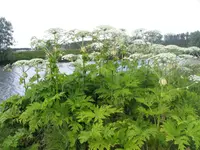
Recognize giant hogweed by its towering height, often 8 to 14 feet (2.4 to 4.3 m), huge deeply cut leaves, and broad flat-topped clusters of small white flowers.

The hollow green stems are thick, usually 2 to 4 inches (5 to 10 cm) across, with purple blotches and coarse white hairs.

Heracleum mantegazzianum Identification

Identify Your Plant with Botan

Upload a plant photo and check the identification in seconds.

Clear images work best. Avoid photos taken too close or too far away

Check the whole plant first, then confirm the main visible structures.

  • Very tall, stout plant, often 8 to 14 feet (2.4 to 4.3 m) high.
  • Leaves are huge, deeply cut, and sharply lobed, often 3 to 5 feet (0.9 to 1.5 m) across.
  • Leaf stalk bases form broad, inflated sheaths where they wrap around the stem.
  • Stems are thick, hollow, ridged, and marked with purple blotches and coarse white hairs.
  • Flower heads are broad, flat-topped umbels, often 1.5 to 2.5 feet (45 to 76 cm) across, made of many small white flowers.

Avoid touching sap while checking visible features.

Giant hogweed shows clear stage-to-stage changes that are useful for visual identification.

  • Seedling: Seedlings form a low rosette with simple to shallowly lobed first leaves, unlike the deeply cut, coarse foliage seen later.
  • Young plant: Young plants stay as a basal rosette, but leaves become much larger, sharply divided, and rough-textured, with long stalks and a broader spread.
  • Flowering stage: A flowering plant sends up a thick, hollow, ridged stem and reaches about 8-15 feet (2.4-4.6 m), topped by broad, flat-topped white umbels.
  • Fruiting stage: After flowering, the umbrella-like clusters hold many flattened oval fruits, while petals drop and the tall stem usually remains upright and conspicuous.

In spring, giant hogweed quickly forms a massive mound of coarse, deeply cut leaves. By early summer, towering hollow stems carry huge flat-topped white flower clusters, which are among the clearest seasonal clues. After flowering, the heads turn to broad clusters of dry, flat seeds. In winter, the leafy top growth dies back, often leaving little or no obvious above-ground structure.

Several tall white-umbel plants are mistaken for giant hogweed.

Cow parsnip(Heracleum maximum)

Similar white flower umbels and coarse leaves. Usually shorter, often 4 to 10 feet (1.2 to 3 m), with broader, less sharply cut leaf lobes and smaller flower clusters.

Wild parsnip(Pastinaca sativa)

Can share yellow-green grooved stems and big umbels. Flowers are yellow, not white, and the leaves are divided into many separate leaflets rather than huge lobed blades.

Poison hemlock(Conium maculatum)

Tall, white-flowered umbels can confuse at a distance. Leaves are finely fernlike, not massive and lobed, and stems are smooth with purple blotches instead of bristly.

Native to the western Caucasus, Heracleum mantegazzianum occurs naturally in mountain and subalpine areas of northeastern Turkey, Georgia, and nearby parts of the Caucasus. It is typically found in moist meadows, forest edges, streambanks, roadsides, and disturbed ground. Habitat can help narrow identification because this species is most often encountered in open, damp, nutrient-rich sites rather than dry uplands or deep shade.

  • Phototoxic sap: Sap from stems, leaves, and flowers can cause severe skin burns after sunlight exposure in humans. This is a skin-contact risk, not just an irritation.
  • Eyes and pets: Sap in the eyes can cause serious injury in humans. Pets are also at risk from skin or mouth contact with sap and plant parts.

Confirm It from a Photo

Use Botan to identify or verify the plant from an image, helping avoid mix-ups with similar-looking species.

FAQ

Yes. The stem is thick, hollow, ridged, and usually green with prominent purple blotches and coarse white hairs. Mature stems can reach about 2 to 4 inches (5 to 10 cm) across, a strong clue in giant hogweed identification.

More Plant Identification Guides

One Photo. More About Your Plant.

Identify a plant from a photo with Botan, then get plant details, care information, and safety notes specific to that species.

Botan app identifying a plant from a photo
Can Plants Grow With Artificial Light?

6 min read · 15 Sept 2026

Can Plants Grow With Artificial Light?

Plants can grow under artificial light when the setup provides a suitable spectrum, enough intensity, and sufficient daily exposure. This guide explains how artificial lighting compares with sunlight, which options work indoors, and how to match a setup to houseplants.

Plant Care
Can Plants Grow With Artificial Light?
How Long Can Flowers Go Without Water? Everything You Need to Know

6 min read · 10 Jul 2026

How Long Can Flowers Go Without Water? Everything You Need to Know

Flowers can survive without water anywhere from 1-2 hours to several months, depending on the plant type, species, and growing conditions. Some strong-looking flowers are drought-sensitive, while delicate-looking plants may tolerate long dry periods surprisingly well.

Plant Care
How Long Can Flowers Go Without Water? Everything You Need to Know
Dill Companion Plants – What to Grow Next to Dill

9 min read · 17 Jul 2026

Dill Companion Plants – What to Grow Next to Dill

Dill is an easy-to-grow plant that gets along well with many vegetables. This guide describes 15 plants that can be planted alongside it, a few to avoid, and mistakes that can quietly sabotage the entire process.

Plant Recommendations
Dill Companion Plants – What to Grow Next to Dill