giant hogweed Care (Heracleum mantegazzianum)

Also known as: Mantegazzi's Cow-Parsnip, Cartwheel Flower
giant hogweed

About giant hogweed

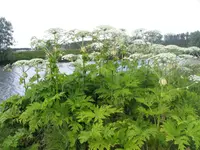
Giant hogweed, Heracleum mantegazzianum, is a very large, short-lived perennial in the carrot family, grown mainly for its dramatic foliage and towering flower heads. It forms tall, hollow, ridged stems with purple blotches, huge jagged leaves, and broad white flower clusters held above the foliage.

The species is native to the Caucasus region and southwest Asia but has naturalized in parts of Europe and North America, often along rivers, roadsides, and disturbed ground. It grows vigorously, self-seeds freely, and can become invasive, which makes how to care for giant hogweed a specialized topic best left to professionals.

The plant prefers full sun, moist soil, and cool to mild summer climates, but its serious safety and environmental concerns outweigh any ornamental value in most gardens.

Main Plant Requirements

Care Difficulty

Hard Care

Light Preference

Full Sun

Water Requirements

Regular Water

Temperature Preference

Cold Hardy

Hardiness Zone

3–8

Soil Texture

Loamy, Silty, Organic-rich

Soil pH

Slightly acidic (6.5–7.0), Neutral (7.0)

Soil Drainage

Moist but well-drained

Fertilization

Minimal (feed rarely)

Get Personalized Care Plan

Scan your plant to receive care tips personalized for your specific plant

Available on iOS and Android

How to Care for the giant hogweed

This species prefers strong outdoor light but not intense, all-day midsummer exposure.

  • Provide 6–8 hours of sun, ideally with morning sun and light afternoon shade, as giant hogweed can scorch under prolonged, high-intensity midday sun.
  • Site plants in open, unshaded positions with only light tree cover; dense shade reduces vigor, weakens stems, and leads to sparse flowering.
  • In hot summers, use partial shade or neighboring vegetation to filter light from 11 a.m.–3 p.m., reducing leaf burn and moisture stress.

This plant favors consistently moist, cool soil without prolonged waterlogging.

  • Aim for soil that stays evenly damp to 5–8 cm depth; rewater when the surface just begins to lose its sheen but is not yet cracking or pulling from roots.
  • In spring and early summer, increase watering during dry spells so large leaves do not wilt or yellow at the edges, a common sign of drought stress in Heracleum mantegazzianum.
  • Use deep, infrequent soakings on free-draining, organic-rich soil; persistent puddling, foul odor, or blackened stems indicate overwatering and poor drainage.

This hardy perennial tolerates a wide temperature range but grows most vigorously in cool to mild conditions.

  • Optimal active growth occurs around 60–75°F (16–24°C), with strong foliage development in cool, moist summers.
  • The plant survives winter down to about 5°F (−15°C) in the ground; top growth dies back with frost, but roots overwinter and resprout in spring.
  • Heat above 86°F (30°C), especially with dry soil, leads to leaf scorch and stress, so consistent moisture and partial shade help limit damage during hot spells.

Humidity is not a major factor for Heracleum mantegazzianum in outdoor conditions.

This species prefers deep, moist, fertile ground with high organic content.

  • Use a loamy, humus-rich soil that retains moisture yet allows slow drainage to prevent waterlogging.
  • Aim for slightly acidic to neutral pH, roughly 6.0–7.0, to support vigorous root and leaf growth.
  • Incorporate compost or well-rotted manure to increase organic matter, structure, and water-holding capacity.
  • Avoid compacted, very sandy, or drought-prone soils, and break up subsoil to improve aeration and root penetration.

This species is not suitable for container growing due to its size, invasive habit, and hazardous sap.

This vigorous species usually thrives in ordinary soil and needs only minimal feeding in cultivation.

  • Use a light application of compost or a balanced slow-release fertilizer (around 10-10-10) in early spring if growth appears weak.
  • Apply at most 1–2 times during the growing season; excessive nutrients increase invasive spread and plant size.
  • Dilute liquid feeds to 1/2 strength and water before and after to reduce root burn risk.
  • Avoid fertilizing in late fall and winter when growth is dormant.

Pruning Heracleum mantegazzianum is mainly about safe removal and containment rather than shaping.

  • Cut flowering stems at the base just after flowering but before seeds set, using long-handled loppers or a saw.
  • Remove dead, damaged, or crossing stems in late winter or very early spring to simplify safe handling.
  • Bag and dispose of all flower heads and seed material in household waste, never in compost.
  • Wear full protective clothing, including gloves and eye protection, to avoid sap contact when cutting.

This plant is rarely kept in containers; management focuses on careful transplanting or removal from soil.

  • If grown in a pot, consider transplanting outdoors or into a controlled area once roots circle the container or growth stalls.
  • Carry out any transplanting in early spring or fall, when temperatures are mild and soil is evenly moist.
  • Lift with as much root ball as possible, minimize root disturbance, and water thoroughly afterward to limit stress.
  • Because growing giant hogweed poses safety and legal concerns in many regions, many gardeners instead focus on safe eradication.

Intentional propagation of this species is strongly discouraged due to its invasive and hazardous nature.

  • Seeds are the main reproductive method; they germinate best in cool conditions after natural winter chilling (cold stratification).
  • Flowering stems can produce large numbers of seeds, which remain viable in soil for several years.
  • Avoid collecting or sowing seed; instead, cut and destroy immature flower heads before seeds harden.
  • Follow local regulations, as in many areas it is illegal to distribute or deliberately grow Heracleum mantegazzianum.

Established plants are very cold hardy and usually need little deliberate winter care.

  • Roots tolerate freezing conditions typical of temperate climates, with crowns surviving under snow or light frost.
  • In exposed sites, a thin mulch layer (2–5 cm) of leaf mold or bark over the root zone can reduce heaving in freeze–thaw cycles.
  • For any container-grown specimens, move pots to a sheltered, unheated area to prevent root damage from repeated deep freezes.

Care Tips

Strict protective gear

Always wear waterproof gloves, long sleeves, eye protection, and closed shoes when handling this plant, and wash exposed skin, clothing, and tools with soap and water immediately after any contact to reduce risk from the sap.

Dedicated tool set

Assign a specific set of sharp spades, loppers, and knives only for this species and disinfect blades with 70% alcohol or a 10% bleach solution after use to prevent sap spread and accidental transfer to other work areas.

Systematic root depletion

For safer long‑term control, repeatedly cut flower umbels before seed set and sever the root 10–15 cm below soil level several times per season to exhaust the root system instead of relying on a single removal attempt.

Controlled waste handling

Place all cut material directly into heavy-duty plastic bags or sealable containers, avoid shredding or composting, and send the waste to municipal or approved green-waste facilities according to local regulations for caring for giant hogweed.

Seed bank management

Monitor the site for at least 7–10 years, removing new seedlings each spring with a hoe or by hand (with full protection) before they reach 4–6 leaves, since the soil seed bank remains viable for many seasons.

Everything About giant hogweed

Common Pests and Diseases

Leaf spot fungi

This disease causes irregular brown to dark olive spots on the large leaves, often with a yellow halo and papery centers that can tear. Symptoms include premature leaf decline and reduced vigor in dense, moist stands.

Solution

Remove and destroy heavily spotted leaves to reduce inoculum, and avoid overhead irrigation so foliage dries quickly. Improve spacing and airflow around plants; in severe or persistent cases, apply a targeted foliar fungicide labeled for leaf spot on Apiaceae, following local regulations for invasive Heracleum mantegazzianum plant care.

Powdery mildew

This disease appears as white to gray powdery patches on upper leaf surfaces, petioles, and sometimes flower stalks, especially in crowded, humid stands. Symptoms include distorted growth and gradual yellowing and drying of affected tissue.

Solution

Increase airflow by thinning dense patches and removing heavily infected leaves. Where permitted, apply a sulfur or potassium bicarbonate fungicide at first sign of mildew, and avoid excessive nitrogen that encourages soft, susceptible growth.

Aphids

These insects cluster on young stems, undersides of leaves, and flower stalks, sucking sap and excreting sticky honeydew that can attract sooty mold. This pest can cause leaf curling, distortion, and reduced flowering.

Solution

Dislodge colonies with a firm stream of water and prune out heavily infested shoots. Encourage natural predators such as lady beetles, and if needed use an insecticidal soap or horticultural oil, ensuring thorough coverage of leaf undersides and tender growth.

Giant hogweed rust

This disease, caused by Puccinia spp., produces orange to brown pustules on leaves and stems that release rust-colored spores. Symptoms include yellowing, premature leaf collapse, and weakened flowering stalks.

Solution

Remove and dispose of infected leaves before pustules rupture to limit spore spread, and avoid working in stands when foliage is wet. In areas where management rather than eradication is practiced, maintain better spacing and monitor regularly; systemic fungicides are rarely justified and should only be used according to local invasive-species guidance.

Umbel blight

This disease affects flower umbels, causing browning, shriveling, and failure of seeds to develop, often starting from a few infected florets. Symptoms include dark lesions at the base of flower stalks and collapse of whole umbel sections.

Solution

Cut and destroy blighted umbels as soon as symptoms appear to reduce spread to neighboring plants and seed heads. Avoid overhead watering near flowering plants and keep the canopy drier by reducing stand density and removing senescent, shaded foliage that traps moisture.

Interesting Facts

Potent phototoxic sap

Its sap contains furanocoumarins, chemicals that make human skin extremely sensitive to UV light and can cause severe burns and long-lasting dark scars after sun exposure.

Record-sized flower umbels

Mature plants can produce a single flowering structure over 80 cm across, made of many smaller umbels, making it one of the largest inflorescences among temperate-zone herbaceous plants.

Explosive seed production

A single plant can produce tens of thousands of seeds that remain viable in the soil for several years, which strongly contributes to its rapid spread along rivers, roadsides, and disturbed ground.

Botan icon

Did you know?

In several European countries and parts of North America, this species is listed on invasive species legislation, which can require landowners to control or eradicate it and restricts its sale, transport, or deliberate planting due to public health and ecological risks.

FAQs about giant hogweed

Yes. Sap from this species contains furanocoumarins, chemicals that make skin extremely sensitive to sunlight. Contact plus UV exposure can cause severe burns, blisters, and long-lasting dark scars. Protective clothing and eye protection are essential when handling.

Grow Healthy Plants with Botan Care

Keep your plants happy and healthy with plant identification, disease detection, and easy care guidance.

Botan plant care app — identify plants on mobile

Explore More Plants