

spicebush Identification (Calycanthus occidentalis)

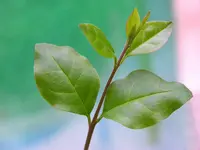
Recognize Calycanthus occidentalis by its opposite, oval leaves on smooth green stems and its many-stemmed shrub form.

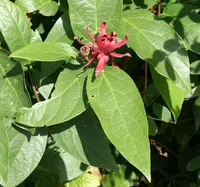
The flowers are solitary, dark red to maroon, and star-like, with many narrow strap-shaped tepals, usually about 2 to 3 inches (5 to 8 cm) across.

Calycanthus occidentalis Identification

Check Your Plant ID

Upload a plant photo and check the identification in seconds.

Clear images work best. Avoid photos taken too close or too far away

Check the shrub’s leaf pairs, flower shape, and seed pod form.

  • Usually a multi-stem shrub with arching branches, often 6-12 feet (1.8-3.7 m) tall.
  • Leaves are simple, opposite, oval to elliptic, with smooth edges and pointed tips.
  • Leaf blades are often 2-6 inches (5-15 cm) long and sit on short stalks.
  • Flowers are solitary, cup-shaped, and many-petaled, with narrow straplike segments in deep red to maroon.
  • Fruit forms a rounded, urnlike seed head that stays clustered at the stem tip.

On Calycanthus occidentalis, the opposite leaves and dark, many-segmented flowers are especially useful together.

Calycanthus occidentalis shows clear visual shifts from sparse juvenile shoots to flower and fruit display.

  • Young plant: Young plants form a few upright green stems with opposite leaves, giving a narrow, open outline rather than the broad, many-stemmed shrub of maturity.
  • Mature plant: Mature plants become a rounded, suckering shrub about 6 to 12 feet (1.8 to 3.7 m) tall, with dense branching and noticeably larger, broader leaves.
  • Flowering stage: Flowers appear singly along the leafy stems, dark red to maroon, with many narrow petal-like segments that create a starry, layered look.
  • Fruiting stage: After flowering, the blossom is replaced by a rounded, urn-like seed capsule that stays visible on the stem and contrasts with the earlier open flower.

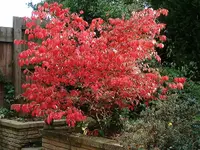
In spring, Calycanthus occidentalis leafs out with fresh green foliage, and its reddish to maroon flowers become visible from late spring into early summer. The blooms are easy to spot against the leaves and are one of the clearest seasonal clues. By fall, the leaves often turn yellow before dropping. After leaf fall, the shrub shows bare, opposite branching and a dormant outline that can still help with recognition.

A few shrubs can be mistaken for Calycanthus occidentalis at a glance.

Carolina allspice(Calycanthus floridus)

Often confused because both are deciduous shrubs with opposite leaves and dark red, strap-petaled flowers. C. floridus usually has smaller flowers, about 1 1/2 to 2 inches (4 to 5 cm) across, while western sweetshrub is often 2 to 3 inches (5 to 8 cm).

Chinese sweetshrub(Calycanthus chinensis)

Similar shrub form and broad leaves can mislead. The clearest difference is the flower: C. chinensis has white outer tepals with a burgundy center, not solid wine-red flowers. Its blooms are also more cup-shaped and magnolia-like.

Calycanthus occidentalis is native to California, mainly in the Sierra Nevada foothills, Coast Ranges, and parts of the Klamath region. Its range is useful because this species is largely confined to California in the wild. It typically grows along streambanks, in canyons, and in moist woodland margins, often in chaparral or foothill woodland settings. Finding a deciduous sweetshrub in shaded, seasonally moist sites within that California range helps narrow the identification.

  • Poisonous plant parts: Calycanthus occidentalis contains toxic compounds. Seeds are the main concern, and other parts may also be harmful if eaten. The risk is ingestion by humans and pets.
  • Pet risk: Dogs and cats can be affected if they chew or swallow plant material, especially seeds. Keep fallen fruit and seeds out of reach.

Confirm It from a Photo

Upload a clear image to Botan to identify the plant or verify your guess before you label it incorrectly.

FAQ

The quickest clue is the large, solitary, wine-red flowers with many narrow petal-like parts in late spring, paired with opposite, deciduous leaves on a multi-stemmed shrub. That combination supports spicebush identification.

More Plant Identification Guides

Identify the Plant and Get Its Profile

Use Botan to identify it from a photo, then review plant details, care information, and common problems for that species.

Botan app identifying a plant from a photo
Plants That Repel Mosquitoes – 10 Effective Choices

8 min read · 6 Jul 2026

Plants That Repel Mosquitoes – 10 Effective Choices

Plants that repel mosquitoes can help mask human scent naturally and make outdoor spaces more comfortable. Explore the most effective options, their benefits and drawbacks, and choose the right plant for your space.

Plant Recommendations
Plants That Repel Mosquitoes – 10 Effective Choices
How Often to Water Fruit Trees

7 min read · 11 Aug 2026

How Often to Water Fruit Trees

Irrigation needs change as roots establish and weather shifts. This guide gives practical starting intervals, explains how soil and tree type change them, and shows how to recognize both excess moisture and drought stress.

Plant Care
How Often to Water Fruit Trees
Plants That Repel Bugs – 20 Effective Options

12 min read · 16 Jul 2026

Plants That Repel Bugs – 20 Effective Options

Mosquitoes on the patio? Gnats in the kitchen? Some plants keep them away with the scent of their own leaves. Here are 20 that deal with mosquitoes, flies, aphids, and more, plus where to put them so they help.

Plant Recommendations
Plants That Repel Bugs – 20 Effective Options