


spicebush Identification (Lindera benzoin)

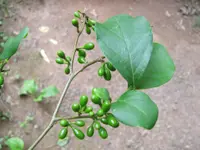
Recognize spicebush by its simple, alternate leaves, usually 3-6 inches (8-15 cm) long, widest above the middle with smooth edges and a short pointed tip. It forms a multi-stemmed shrub or small tree.

Another strong clue is the small yellow flowers held in tight clusters at the leaf axils, where each leaf joins the stem.

Lindera benzoin Identification

Identify Your Plant with Botan

Upload a clear image to check whether your plant ID is correct.

Clear images work best. Avoid photos taken too close or too far away

Use these visible traits to check for Lindera benzoin.

  • A multi-stemmed deciduous shrub, often broader than tall, usually around 6-12 feet (1.8-3.7 m) high.
  • Leaves are simple and alternate, oval to oblong, with smooth edges and a pointed tip.
  • Most leaves are about 3-6 inches (8-15 cm) long and show pale undersides.
  • Small yellow flowers appear in tight clusters along bare twigs, with each flower having 6 petal-like parts.
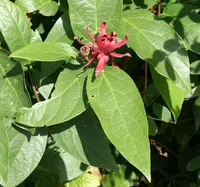
  • Fruits are bright red, oval drupes borne singly or in small groups on short stalks.

Crush a leaf only if needed; the visual structure usually gives enough clues first.

Lindera benzoin shows useful visual shifts from early shoots to flowering and fruiting branches.

  • Young plant: Young plants are slender, lightly branched shrubs with smooth greenish to brown stems and relatively few alternate leaves, giving a narrow, open outline.
  • Mature plant: Mature plants form a broader, many-stemmed shrub, often 6-12 feet (1.8-3.7 m) tall, with denser branching and a rounded crown.
  • Flowering stage: Before leaves expand fully, short side twigs carry small yellow flower clusters close to bare stems, making branch structure more visible than later.
  • Fruiting stage: On female plants, bright red oval drupes replace flowers and sit singly or in small groups along twigs beneath the leaves.

In early spring, Lindera benzoin often stands out before leaf-out with small yellow flowers clustered along bare twigs. After flowering, soft green leaves emerge and give the shrub a fuller outline. By late summer into fall, female plants may show bright red drupes, while the leaves turn clear yellow before dropping. In winter, the plant is leafless, so its twig structure and buds are easier to see.

A few native shrubs can be mistaken for spicebush at a glance.

sassafras(Sassafras albidum)

Both have greenish-yellow spring flowers and aromatic leaves. Sassafras usually has mitten-shaped or three-lobed leaves on young growth, while Lindera benzoin has simple, unlobed oval leaves.

northern spicebush(Lindera melissifolia)

This close relative shares yellow flowers and red fruits. It is usually distinguished by leaves often with three main veins from the base and a paler, sometimes slightly glaucous underside.

common witchhazel(Hamamelis virginiana)

Both are understory shrubs with broad leaves. Witchhazel leaves have coarse, uneven teeth and an asymmetrical base; Lindera benzoin leaves are smooth-edged and more even at the base.

Lindera benzoin is native to eastern North America, from southern Ontario and the northeastern and midwestern United States south to Florida and Texas. That range helps separate it from similar shrubs outside the East and Southeast. In the wild it is most often found in moist deciduous woods, streambanks, floodplains, and swamp margins, usually in partial shade. Finding it in rich, damp woodland understory is a useful identification clue, especially when several shrub species look similar.

Check Your Plant ID

Use Botan to identify or confirm a plant from a photo, helping avoid mix-ups with similar species.

FAQ

Yes. For how to identify spicebush without fruit, check the alternate leaves, entire margins, pale undersides, and the strong spicy scent released when a leaf or twig is crushed. Early spring brings small yellow flower clusters before leaves expand.

Everything About spicebush

More Plant Identification Guides

Find the Plant. Get the Details.

Identify a plant from a photo with Botan, then review species-specific care information, safety notes, and common problems.

Botan app identifying a plant from a photo
Plants That Repel Mosquitoes – 10 Effective Choices

8 min read · 6 Jul 2026

Plants That Repel Mosquitoes – 10 Effective Choices

Plants that repel mosquitoes can help mask human scent naturally and make outdoor spaces more comfortable. Explore the most effective options, their benefits and drawbacks, and choose the right plant for your space.

Plant Recommendations
Plants That Repel Mosquitoes – 10 Effective Choices
20 Funny Plant Names That Make You Laugh

8 min read · 16 Oct 2026

20 Funny Plant Names That Make You Laugh

Some plants carry names that sound like jokes. This guide explains the origins of 20 funny plant names. You will also see which of these plants you can grow at home.

Plant Recommendations
20 Funny Plant Names That Make You Laugh
Top 5 Best Indoor Plants for Air Quality

5 min read · 11 Sept 2026

Top 5 Best Indoor Plants for Air Quality

Indoor plants can make a room feel fresher thanks to their air-purifying qualities. Here are 5 of the most suitable choices for your routine and living space.

Plant Recommendations
Top 5 Best Indoor Plants for Air Quality