
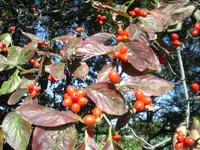

Burning bush Identification (Euonymus alatus)

To recognize Burning bush, look first for corky wings along the young stems, usually forming two to four narrow ridges. Leaves are simple, opposite, and elliptic to oval, typically 1 to 3 inches (2.5 to 7.5 cm) long.

It usually grows as a dense, many-branched shrub with arching stems.

Euonymus alatus Identification

Check Your Plant with Botan

Not sure about your plant ID? Upload a photo and check it with Botan.

Clear images work best. Avoid photos taken too close or too far away

Check the shrub’s outline, stems, leaves, and fruit for a quick match.

  • Usually grows as a dense, many-branched shrub with a broad, rounded to vase-like shape.
  • Young twigs often show 2 to 4 narrow corky wings running lengthwise along the stems.
  • Leaves are simple and opposite, set in pairs, and are usually about 1 to 3 inches (2.5 to 7.5 cm) long.
  • Leaf blades are oval to elliptic with short points and fine, even teeth along the edges.
  • Fruits are small, dangling capsules that split to show orange-red seeds.

The corky winged stems are often the fastest visual clue.

Euonymus alatus shows useful stage-by-stage differences in stems, branching, flowers, and fruit.

  • Young plant: Young plants are upright and narrow, with green twigs showing early corky wings and opposite leaves about 1-3 inches (2.5-7.5 cm) long.
  • Mature plant: Mature shrubs are broader and denser, with many arching branches and much more pronounced corky stem wings that stand out on older gray-brown wood.
  • Flowering stage: Small yellow-green flowers appear in little clusters at the leaf axils, adding a finer, less structural look than the strongly winged stems.
  • Fruiting stage: Fruits become pinkish to reddish capsules that split open to reveal orange seeds, creating a distinctive spotted effect against the opposite leaves.

Burning bush has several named selections that are easy to separate by size and foliage color.

  • 'Compactus': Smaller than the typical form, usually maturing around 8 to 10 feet tall (2.4 to 3 m) with a dense, rounded outline.
  • 'Rudy Haag': A dwarf selection that often stays about 3 to 5 feet tall (0.9 to 1.5 m), making it much shorter and tighter in habit.
  • 'Monstrosus': Twigs are irregularly corky and contorted, with exaggerated winged ridges that look more knobby than on the typical form.
  • 'Aureus': Leaves emerge yellow to yellow-green rather than plain green, giving the shrub a noticeably lighter look through the growing season.

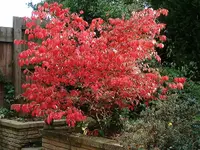
In spring, Burning bush leafs out with opposite, oval green leaves. Small greenish flowers may be visible in late spring to early summer, though they are usually not the main field mark. The strongest seasonal clue comes in fall, when the foliage turns bright red. After leaf drop, the corky winged ridges along the stems stand out clearly through winter.

A few shrubs are regularly mistaken for Burning bush.

Winged strawberry bush(Euonymus americanus)

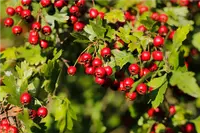
Both are Euonymus shrubs with opposite leaves and pink-red fall color. Winged strawberry bush usually lacks the broad corky stem wings and bears warty, bright pink fruit capsules; Euonymus alatus has flatter winged stems and smoother pink capsules that split to show orange seeds.

Wintercreeper(Euonymus fortunei)

Young upright shoots can resemble juvenile plants because both have opposite leaves and green stems. Wintercreeper is usually a vine or groundcover, with smaller leaves often under 2 inches (5 cm), and it does not develop the prominent corky wings typical of mature stems.

Euonymus alatus is native to northeastern Asia, including China, Korea, Japan, and far eastern Russia. In the wild it occurs in open woods, forest edges, thickets, and scrubby slopes, often in lowland to foothill landscapes. This context can help with identification because it is typically a shrub of temperate woodland margins rather than wetlands, deserts, or deep shade forest interiors. Finding it in edge habitats can support an ID when other traits already point to Euonymus alatus.

  • Poisonous parts: Berries, seeds, leaves, and bark of Euonymus alatus are poisonous if eaten by humans and pets. Ingestion can cause stomach upset and other poisoning symptoms.
  • Highest risk point: The fruit is often the main concern because the capsules open to show bright orange-red seeds, which can attract children and pets. This is an ingestion risk, not a skin-contact issue.

Does Your Plant Match?

Use Botan to compare a photo and help identify or confirm the plant before you label it or make decisions.

FAQ

The clearest feature is the corky wings on young stems. These narrow ridges run lengthwise along the twigs and, with the opposite leaves and bright red fall color, make Burning bush identification much easier.

Everything About Burning bush

More Plant Identification Guides

Know What Plant You Have

Identify it from a photo with Botan, then review plant details, care information, and common problems for that species.

Botan app identifying a plant from a photo
What Do Plants Need to Grow – 5 Things Every Greenery Can't Live Without

8 min read · 31 Jul 2026

What Do Plants Need to Grow – 5 Things Every Greenery Can't Live Without

To keep plants healthy and thriving, provide the right balance of light, humidity, nutrients, airflow, and quality soil. This guide covers the essentials of year-round plant care.

Beginner Guides
What Do Plants Need to Grow – 5 Things Every Greenery Can't Live Without
How to Mist Plants – Proper Technique and Common Mistakes

7 min read · 30 Jul 2026

How to Mist Plants – Proper Technique and Common Mistakes

Find out when misting works well and when to avoid it. Here, you’ll find detailed information about compatible and incompatible species, tips on how often to mist plants and do it correctly, and some great alternatives for raising humidity.

Beginner Guides
How to Mist Plants – Proper Technique and Common Mistakes
Best Fertilizer for Grass in Summer: How to Choose the Right One

6 min read · 18 Aug 2026

Best Fertilizer for Grass in Summer: How to Choose the Right One

The right fertilizer in summer can make a lawn thrive. The wrong one can damage it. Here, you’ll learn the best NPK ratios by grass type, when and how to apply your formula, and how to recognize the signs of over- or under-fertilizing.

Plant Care
Best Fertilizer for Grass in Summer: How to Choose the Right One