

chokecherry Identification (Prunus virginiana)

Recognize chokecherry by its narrow, elongated flower clusters, simple alternate leaves with a pointed tip and finely toothed edges, and its multi-stemmed shrub to small tree form, usually 10 to 20 feet (3 to 6 m) tall.

Twigs are slender, and leaves are typically 2 to 5 inches (5 to 13 cm) long.

Prunus virginiana Identification

Scan to Confirm chokecherry

Upload a clear photo to check your plant identification with Botan.

Clear images work best. Avoid photos taken too close or too far away

Check the overall form and leaf-and-flower details of Prunus virginiana.

  • Usually a large shrub or small tree with several stems, often 12 to 30 feet (3.7 to 9.1 m) tall.
  • Leaves are alternate, simple, and oval to oblong, about 2 to 5 inches (5 to 13 cm) long, with finely toothed edges.
  • Flowers are small, white, and 5-petaled, packed along narrow, drooping clusters.
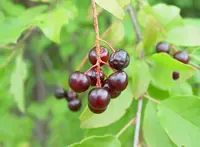
  • Fruits hang in clusters as round drupes, turning dark red to nearly black when mature.

Look for the combination of alternate toothed leaves, drooping flower clusters, and clustered dark fruits.

Prunus virginiana shows clear visual shifts from sprouting stems to flowering and fruiting branches.

  • Young plant: Often appears as a thicket-forming shrub with many upright stems, rather than a single trunk; leaves are narrower and the branching framework is still sparse.
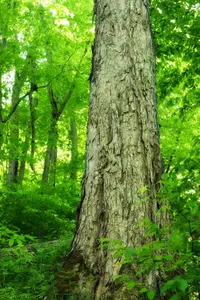
  • Mature plant: Usually becomes a large shrub or small tree, about 20-30 feet (6-9 m) tall, with a denser crown and more distinct trunk structure.
  • Flowering stage: Branches carry many narrow, drooping flower clusters; the white five-petaled flowers line the racemes, making the plant look more feathery than leafy.
  • Fruiting stage: The same hanging clusters turn into strings of small round drupes, shifting attention from flowers to densely packed dark fruits along the branch tips.

In spring, chokecherry leafs out with fresh green leaves and soon shows many narrow, drooping clusters of small white flowers. By late summer, those clusters hold dark red to nearly black fruits, which are often one of the easiest seasonal clues. In fall, the leaves turn yellow to orange-red before dropping. After leaf drop, the plant is easier to recognize by its bare twigs, rounded buds, and dark bark.

Several shrubs and small trees can be mistaken for chokecherry at a glance.

black cherry(Prunus serotina)

Similar leaves and drooping flower clusters. Black cherry is usually a taller tree with shinier leaves and flower stalks mostly hairless; chokecherry often suckers into thickets.

pin cherry(Prunus pensylvanica)

Also has white spring flowers and red-to-dark cherries. Pin cherry fruits are usually on longer individual stalks, not dense elongated clusters, and bark shows conspicuous horizontal lenticels.

European bird cherry(Prunus padus)

Very similar flower and fruit racemes. European bird cherry typically has more strongly foul-smelling crushed leaves and often denser flower clusters with shorter stalks.

Prunus virginiana is native across much of Canada and the northern and western United States, extending south into parts of the central U.S. Its broad native range means geography alone is not enough, but it is a strong clue in temperate North America. It is most often found along woodland edges, streambanks, open woods, thickets, and fencerows. Finding it in these moist to moderately dry edge habitats helps separate it from less common Prunus species in the same region.

  • Toxic parts: Leaves, bark, twigs, and seeds contain cyanogenic compounds. When chewed or wilted, they can release cyanide. This is an ingestion risk for humans and pets.
  • Fruit caution: The fleshy fruit is not the main hazard, but the pit contains the toxic seed. Swallowing whole pits is less concerning than chewing or crushing them.

Does Your Plant Match?

Use Botan to compare a photo and help confirm the plant, which can save time before you label or buy it.

FAQ

The clearest feature is its long, drooping clusters of small white flowers, followed later by hanging clusters of dark red to black cherries. That combination is central to chokecherry identification in season.

More Plant Identification Guides

Find Out What Plant It Is

Identify it from a photo with Botan, then review plant details, care information, and common problems matched to the result.

Botan app identifying a plant from a photo
Plant Pot Sizes: How to Choose the Right Plant Container

7 min read · 20 Aug 2026

Plant Pot Sizes: How to Choose the Right Plant Container

Plant pot sizes can be confusing because the number on the label only tells you part of the required information. A container may look spacious but actually be too shallow. So, how to choose pot size for plant species?

Beginner Guides

Plant Pot Sizes: How to Choose the Right Plant Container
Best Bedroom Plants – Top 10 to Grow in Your Space

8 min read · 8 Jul 2026

Best Bedroom Plants – Top 10 to Grow in Your Space

Discover the top 10 houseplants that are suitable for growing in your bedroom. Compare their light and water needs, pet safety, and benefits. Find out where best to place greenery in your relaxation space and what species to avoid.

Plant Recommendations
Best Bedroom Plants – Top 10 to Grow in Your Space
Frozen vs Fresh Vegetable Nutrients: Which Option Is Healthier?

6 min read · 8 Sept 2026

Frozen vs Fresh Vegetable Nutrients: Which Option Is Healthier?

Frozen and fresh vegetables are nutritionally comparable: frozen produce often retains vitamins just as well as fresh and may sometimes contain more. Here’s how blanching and storage affect nutrients—and when to choose each.

Plant Recommendations
Frozen vs Fresh Vegetable Nutrients: Which Option Is Healthier?