Substrate selection
Use only clean, kiln-dried or properly pressure-treated softwood test blocks if you are growing wet rot for study, as contaminated or previously decayed wood will give unreliable results and favor competing fungi.

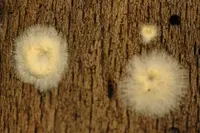
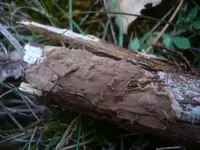
Wet rot, caused by the fungus Coniophora puteana, is not a traditional houseplant but a wood-decaying organism that colonizes damp structural timber. It forms flat, brown to olive fruiting bodies with a patchy, crust-like appearance, often hidden in dark, poorly ventilated spaces.
This fungus occurs naturally on dead wood in cool, moist environments, but can also appear in buildings with persistent moisture problems. It spreads through wood and nearby materials when conditions stay humid. For anyone wanting to understand how to care for wet rot in a controlled study setting, it generally favours low light, constant moisture, and wood-based substrates, but it is usually something to prevent rather than cultivate.

Care Difficulty
Moderate Care

Light Preference
Partial Shade

Water Requirements
Keep Soil Moist

Temperature Preference
Cool Climate

Hardiness Zone
Unknown

Soil Texture
Loamy, Organic-rich

Soil pH
Slightly acidic (6.5–7.0)

Soil Drainage
Moist but well-drained

Fertilization
Minimal (feed rarely)
Scan your plant to receive care tips personalized for your specific plant
Available on iOS and Android
Coniophora puteana, the fungus associated with wet rot, thrives in consistently shaded, humid environments rather than direct sun.
This wood-decay fungus develops where moisture stays high and persistent rather than through intentional watering.
Stable, moderate temperatures combined with damp wood strongly favor this decay fungus.
This wood-decay fungus does not have conventional humidity needs like a houseplant but thrives only in persistently damp building timber.
In buildings, Coniophora puteana colonizes damp timber rather than soil, but similar conditions can occur in buried or soil-contact wood.
This species is not suitable or desirable for container growing, as it is a structural wood-destroying fungus rather than an ornamental or horticultural organism.
Coniophora puteana is a wood-decaying fungus and does not benefit from conventional fertilizing in managed settings.
Pruning is not a standard horticultural practice for Coniophora puteana because it is a decay fungus rather than an ornamental plant.
Transplanting is generally unnecessary for this wood-rotting fungus and is mainly relevant in research or controlled culture work.
Propagation of Coniophora puteana is typically restricted to scientific, diagnostic, or industrial contexts rather than home culture.
Winter care for this outdoor wood-decay fungus is generally unnecessary because it tolerates natural seasonal temperature shifts well.

Plant Health Check
Not sure what's wrong with your plant? Check your plant's health inside the app.
This fungus is a classic brown-rot species that preferentially digests cellulose and hemicellulose in softwood, leaving a brittle, brown, cube-cracked residue of mostly modified lignin.
It most often attacks building timbers of coniferous origin such as pine and spruce, especially where wood is in contact with damp masonry or soil and stays at high moisture levels.
It develops most actively in persistently damp wood at about 30–40% moisture content and moderate temperatures around 20–26°C, conditions commonly found in poorly ventilated basements, crawl spaces, and behind leaking plumbing.

This species was historically known as one of the principal culprits of structural timber failure in European and later North American buildings, and its biology has been studied in depth by building mycologists as a model organism for understanding the mechanics and chemistry of wood decay in the built environment.
Growth is relatively fast when wood stays moist, often spreading several cm per month within damp structural timber. It does not form leaves or stems, but a flat, patchy fruiting body along the wood surface.
Keep your plants happy and healthy with plant identification, disease detection, and easy care guidance.