Use breathable containers
When setting up a culture, use shallow, ventilated plastic boxes or lidded trays with small air holes so fresh air exchange reduces mold buildup without letting the substrate dry out too quickly.

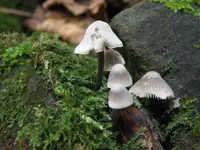
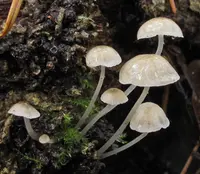
Angel's bonnet, Mycena arcangeliana, is a small saprophytic mushroom, not a typical houseplant. It grows on decaying hardwood, especially ash logs and stumps. Caps are bell-shaped, pale to yellow-brown, with slender, fragile stems and crowded gills that give it a delicate, translucent look. This fungus appears mainly in cool, damp seasons in temperate woodlands across parts of Europe and North America. Because it depends on rotting wood and stable moisture, it is not easy to cultivate indoors or in gardens. Enthusiasts who care for angel's bonnet usually focus on recreating shaded, humid, woodland-like conditions around well-decayed wood.

Care Difficulty
Hard Care

Light Preference
Shade

Water Requirements
Keep Soil Moist

Temperature Preference
Cool Climate

Hardiness Zone
Unknown

Soil Texture
Loamy, Silty, Organic-rich

Soil pH
Acidic (5.5–6.5), Slightly acidic (6.5–7.0)

Soil Drainage
Moist but well-drained

Fertilization
Minimal (feed rarely)
Scan your plant to receive care tips personalized for your specific plant
Available on iOS and Android
This woodland fungus prefers low light similar to a shaded forest floor.
This species depends on consistently moist, but not waterlogged, decaying organic material.
This fungus thrives in cool, temperate conditions similar to a shaded forest in spring or autumn.
This fungus needs consistently high humidity to fruit reliably in cultivation.
Provide a moist, airy, organic substrate rather than conventional mineral soil.
This species can be grown in containers as a specialty fungal project rather than a conventional potted plant.
This wood-decaying fungus gains nutrients from its substrate and normally does not need supplemental fertilizer in cultivation or observation setups.
Mycena arcangeliana does not require pruning; spent fruiting bodies naturally collapse and decompose, completing their life cycle without human intervention.
In culture, this fungus is managed by refreshing substrate rather than classic repotting, since the mycelium grows through wood or other organic material.
Propagation of Mycena arcangeliana is done through spores or by transferring live mycelium rather than typical plant methods such as cuttings or division.
In outdoor, naturalized situations, this fungus is cold hardy in temperate climates and needs no specific winter care beyond preserving its woody substrate.

Plant Health Check
Not sure what's wrong with your plant? Check your plant's health inside the app.
When crushed or bruised, the fruiting bodies release a noticeable garlic-like odor, which helps distinguish this fungus from many other small, pale Mycena species in mixed woodlands.
This saprotrophic fungus most often fruits on fallen branches, twigs, and stumps of ash (Fraxinus) and sometimes sycamore and beech, reflecting a clear substrate preference within temperate European forests.
The cap is typically covered by a distinct slimy layer when moist, a trait linked to the genus section Mycena sect. Fragilipedes and useful for separating it from visually similar but drier-capped species.

Microscopic examination shows that this species has characteristic spindle-shaped cheilocystidia and amyloid spores (staining bluish-black in iodine-based reagents), features that mycologists rely on to confirm identification when macroscopic traits are ambiguous.
This mushroom is not recommended for eating. It is considered inedible and potentially harmful if consumed, especially for children and pets. Contact with intact fruiting bodies is usually harmless, but ingestion can cause gastrointestinal upset.
Keep your plants happy and healthy with plant identification, disease detection, and easy care guidance.