
Arrowhead Identification (Sagittaria sagittifolia)

To recognize Sagittaria sagittifolia, look first for basal leaves shaped like arrowheads, with two pointed rear lobes and a longer central tip, usually on long stalks rising from the waterline.

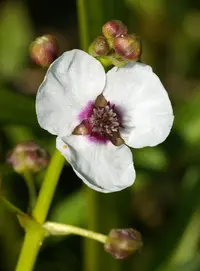
It also forms leafless flowering stems that carry whorls of three-petaled white flowers, often with a dark purple center.

Sagittaria sagittifolia Identification

Check Your Plant ID

Upload a plant photo and check the identification in seconds.

Clear images work best. Avoid photos taken too close or too far away

Use these visible traits to check for Sagittaria sagittifolia.

  • Leaves are arrow-shaped, with one pointed tip and two spreading basal lobes.
  • Leaf blades usually stand above the water on long, upright stalks rising from the base.
  • Flowering stems carry whorls of white, three-petaled flowers, often with a darker center.
  • Leaves commonly reach about 4-12 inches (10-30 cm) long, with a broad, flat blade.

Check several leaves and flowers together, since shape and flower structure are the clearest visual clues.

Sagittaria sagittifolia shows clear leaf and reproductive changes that help separate growth stages.

  • Juvenile plant: Early growth often shows narrow submerged or floating leaves rather than the familiar arrow-shaped blades, giving the plant a simpler, straplike outline.
  • Mature plant: Arrowhead develops upright aerial leaves with distinct basal lobes and longer stalks, forming a clump about 1-3 feet (30-90 cm) tall.
  • Flowering stage: Flowering stems rise above the leaves and carry spaced whorls of white, three-petaled flowers, making the plant look taller and more openly tiered.
  • Fruiting stage: After flowering, the showy petals drop and each flower position becomes a compact rounded cluster of developing fruits, replacing the cleaner floral outline.

In spring, Arrowhead sends up fresh arrow-shaped leaves from underwater growth, making patches reappear around pond and ditch margins. Flowering stems become noticeable in summer, rising above the leaves with spaced whorls of white flowers. By late summer into fall, the flowers are replaced by clusters of small fruits. As cold weather arrives, the above-water leaves and stems die back, and the plant can disappear from view.

Several aquatic arrowheads can be mistaken for Arrowhead at a glance.

American arrowhead(Sagittaria latifolia)

Often confused because both have arrow-shaped leaves and white three-petaled flowers. Sagittaria latifolia usually has broader leaf lobes and a more robust look, while Sagittaria sagittifolia often shows narrower, cleaner-pointed blades.

Delta arrowhead(Sagittaria platyphylla)

Confusion happens when plants are seen only in leaf. Sagittaria platyphylla usually has plain straplike to weakly lobed leaves, not the distinctly arrow-shaped blades typical of Sagittaria sagittifolia.

Sagittaria sagittifolia is native across much of Europe and temperate Asia. Its natural range includes lowland regions from western Europe east through parts of Siberia to East Asia. It grows in shallow freshwater wetlands, including pond margins, slow streams, ditches, canals, and marshy edges. Finding it rooted in still or gently moving water helps separate it from similar arrowhead-leaved plants of drier ground or brackish coastal sites.

Scan. Check. Confirm.

Use Botan to identify or verify a plant from a photo when you want a quicker, more confident next step.

FAQ

Yes. For how to identify Arrowhead without flowers, check the emergent arrow-shaped leaves with two backward-pointing basal lobes and long stalks rising from shallow water or mud. Flowering stems make confirmation easier, but mature leaves are often distinctive.

More Plant Identification Guides

Find the Plant. Get the Details.

Identify a plant from a photo with Botan, then review its profile, care information, and common problems.

Botan app identifying a plant from a photo
What Plants Don't Like Epsom Salt?

11 min read · 29 Jul 2026

What Plants Don't Like Epsom Salt?

Learn which plants can be seriously damaged by Epsom salt and which will thrive on it. We’ll explain when and how to use it properly, provide tips for indoor & outdoor plants — read on and enjoy a healthy garden.

Plant Care
What Plants Don't Like Epsom Salt?
How Long Can Flowers Go Without Water? Everything You Need to Know

6 min read · 10 Jul 2026

How Long Can Flowers Go Without Water? Everything You Need to Know

Flowers can survive without water anywhere from 1-2 hours to several months, depending on the plant type, species, and growing conditions. Some strong-looking flowers are drought-sensitive, while delicate-looking plants may tolerate long dry periods surprisingly well.

Plant Care
How Long Can Flowers Go Without Water? Everything You Need to Know
How to Increase Humidity for Plants – 8 Simple Ways That Work

8 min read · 14 Aug 2026

How to Increase Humidity for Plants – 8 Simple Ways That Work

Dry indoor air stresses a lot of houseplants. You usually notice it first in the browning leaf tips. This guide describes 8 simple ways to raise the moisture around your plants, from humidifiers to pebble trays.

Plant Care
How to Increase Humidity for Plants – 8 Simple Ways That Work