
dill Identification (Anethum graveolens)

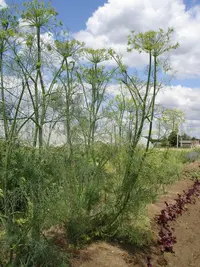
Recognize dill by its finely divided, threadlike leaves arranged alternately on smooth, hollow stems, usually forming a single upright plant about 2 to 4 feet (0.6 to 1.2 m) tall.

At the top of the stems, look for flat-topped umbrella-like clusters of small yellow flowers, a strong first-glance marker for Anethum graveolens.

Anethum graveolens Identification

Check Your Plant ID

Use a clear photo to confirm what plant you have.

Clear images work best. Avoid photos taken too close or too far away

Use these visible traits to check Anethum graveolens at a glance.

  • Leaves are very finely divided into soft, threadlike segments, giving a feathery outline.
  • The plant grows upright and airy, often reaching about 2 to 4 feet (0.6 to 1.2 m) tall.
  • Stems are slender, smooth, and hollow-looking, with leaves spaced along the stem rather than forming a dense clump.
  • Flower heads are flat-topped umbels made of many tiny yellow flowers.
  • Seeds are flat, oval, and ridged, usually about 1/8 to 1/4 inch (3 to 6 mm) long.

Check several traits together, especially the feathery leaves and yellow umbels.

Anethum graveolens shows clear visual shifts from threadlike foliage to umbels and dry seed.

  • Seedling: Seedlings start with narrow, simple first leaves, then quickly produce the first finely divided true leaves, much less feathery than later foliage.
  • Young plant: The plant forms a soft, airy clump of blue-green, threadlike leaves on slender green stems, usually under 12 inches (30 cm) tall.
  • Flowering stage: Upper stems elongate and branch, ending in flat-topped umbels of many tiny yellow flowers that change the plant from leafy to openly layered.
  • Fruiting stage: After flowering, the umbels hold flattened oval seeds that turn tan-brown and hang on stiffened, drying stalks; lower foliage often looks sparser.

Several named forms of dill are separated mainly by plant height, leaf density, and flowering habit.

  • 'Bouquet': Taller than the typical form, often 2-3 feet (0.6-0.9 m), with long stems and large flat umbels held well above the foliage.
  • 'Fernleaf': Noticeably dwarf, usually about 18 inches (45 cm) tall, with very dense, finely divided leaves that give a fuller, bushier outline.
  • 'Dukat': Shows heavier, thicker foliage than typical plants, with broader-looking leaf segments and a denser clump before flowering.

In spring, dill quickly shows soft, feathery blue-green leaves. By early to mid-summer, flat-topped umbels of small yellow flowers rise above the foliage, creating a clear seasonal ID feature. After flowering, the plant carries flat, oval seed clusters that turn tan as they mature. Once seed set finishes, foliage yellows and the whole plant often dries down.

A few feathery umbel plants are often mistaken for dill.

fennel(Foeniculum vulgare)

Confused because both have fine, threadlike leaves and yellow umbrella-like flower clusters. Fennel is usually much taller, often 3-6 feet (0.9-1.8 m), and its foliage is denser and more plume-like.

dogfennel(Eupatorium capillifolium)

Confused at the leafy stage because both look airy and finely divided. Dogfennel has upright, much-branched stems and later makes small white flower heads, not yellow umbels.

coriander(Coriandrum sativum)

Can resemble Anethum graveolens after it bolts, when upper leaves become finely divided. Its lower leaves are broad and lobed, and the flower clusters are white or pale pink rather than yellow.

Anethum graveolens is native from the eastern Mediterranean through western and central Asia. In the wild it is associated with open, disturbed ground rather than forest or wetland habitats. It is most often linked with field margins, roadsides, waste places, and dry grassland. That setting helps with identification because a dill-like annual found self-sown in sunny disturbed sites across this broad region is more likely to be Anethum graveolens than a woodland or marsh umbel.

  • Hazardous look-alikes: Anethum graveolens has fine, feathery leaves that can be confused with poison hemlock or water hemlock, both highly poisonous to humans and pets if eaten. A key check is the smell: dill foliage has a clear aromatic scent, while poison hemlock does not.
  • Skin contact: Handling leaves or sap can cause mild skin irritation or light-sensitive rash in some people, especially after sun exposure.

Not Sure About the ID?

Use Botan to compare a photo and help confirm the plant, which can save time before you label it or look up details.

FAQ

The quickest dill identification cue is the fine, threadlike blue-green foliage paired with a clean aromatic scent when rubbed. Mature plants also carry flat-topped yellow flower clusters called umbels, a common carrot-family feature.

More Plant Identification Guides

Know Your Plant Better

Identify it from a photo with Botan, then review plant details, care information, and common problems for that species.

Botan app identifying a plant from a photo
Plants That Repel Bugs – 20 Effective Options

12 min read · 16 Jul 2026

Plants That Repel Bugs – 20 Effective Options

Mosquitoes on the patio? Gnats in the kitchen? Some plants keep them away with the scent of their own leaves. Here are 20 that deal with mosquitoes, flies, aphids, and more, plus where to put them so they help.

Plant Recommendations
Plants That Repel Bugs – 20 Effective Options
Thorny Plants: A Comprehensive Guide

10 min read · 25 Aug 2026

Thorny Plants: A Comprehensive Guide

Many plants defend themselves with sharp thorns. This guide explores over 20 examples among flowers, shrubs, trees, and vines. You'll learn what each plant looks like, why it grows thorns, and how to quickly identify them.

Plant Recommendations
Thorny Plants: A Comprehensive Guide
Plant Pot Sizes: How to Choose the Right Plant Container

7 min read · 20 Aug 2026

Plant Pot Sizes: How to Choose the Right Plant Container

Plant pot sizes can be confusing because the number on the label only tells you part of the required information. A container may look spacious but actually be too shallow. So, how to choose pot size for plant species?

Beginner Guides
Plant Pot Sizes: How to Choose the Right Plant Container