
holy basil Identification (Ocimum tenuiflorum)

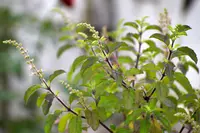
Recognize holy basil by its opposite pairs of oval, softly toothed leaves on square, branching stems, usually on a compact shrub-like plant about 1 to 3 feet tall (30 to 90 cm).

The flowers are small and two-lipped, held in upright terminal spikes with spaced whorls along the stem tip.

Ocimum tenuiflorum Identification

Check Your Plant ID

Upload a clear image to check whether your plant ID is correct.

Clear images work best. Avoid photos taken too close or too far away

Check the leaf arrangement, stem shape, and flower spikes of Ocimum tenuiflorum.

  • Leaves grow in opposite pairs on the stem and are oval to egg-shaped with coarse toothed edges.
  • Leaf blades are usually about 1 to 2 inches (2.5 to 5 cm) long and often show a pointed tip.
  • Stems are clearly square in cross section, a common mint-family trait, and usually branch freely.
  • Small tubular flowers sit in spaced whorls along upright terminal spikes, giving the inflorescence a layered look.

Crush a leaf only if needed; visual structure is usually enough for a first check.

Ocimum tenuiflorum shows clear visual shifts from compact seedlings to flowering, seed-setting stems.

  • Seedling: Seedlings show paired first leaves on a short stem; early true leaves are small, softly hairy, and already opposite, unlike the denser branching later.
  • Young plant: The plant forms a small, bushy clump with several branching, square stems and broader ovate leaves, often 1-2 inches (2.5-5 cm) long.
  • Flowering stage: Upright stem tips extend into narrow flower spikes, so the plant looks taller and less rounded; tiny pale flowers open in spaced whorls along the spike.
  • Fruiting stage: After flowering, the spikes persist but carry small calyces holding developing nutlets, giving the stems a drier, more angular, beadlike appearance.

In warm seasons, Ocimum tenuiflorum is easiest to recognize when upright flower spikes appear above the foliage, usually from summer into fall. The small blossoms are often purple to pinkish or white, depending on the plant. As flowering progresses, the spikes lengthen and develop tiny dry fruits that persist briefly after bloom, adding a more slender, seed-bearing look to the plant.

A few basils are often mistaken for holy basil.

sweet basil(Ocimum basilicum)

Confusion happens because both are aromatic basils with opposite leaves and short flower spikes. Sweet basil usually has broader, smoother, brighter green leaves and less hairy stems; Ocimum tenuiflorum more often shows finer leaf teeth and noticeably hairy stems.

African blue basil(Ocimum kilimandscharicum × Ocimum basilicum)

It can resemble it through purple-tinged stems and basil-like flower spikes. African blue basil is typically taller, with larger leaves and stronger purple coloring on stems and leaf veins; Ocimum tenuiflorum is usually smaller and more softly hairy.

Ocimum tenuiflorum is native to the Indian subcontinent and nearby parts of tropical Asia. It occurs in open, disturbed places such as field edges, roadsides, village margins, and waste ground rather than closed forest. That setting helps with identification because a self-seeding basil-like plant found around settlements in South Asia is more likely to be O. tenuiflorum than a woodland herb or a species tied to wetlands, coasts, or alpine sites.

Scan. Check. Confirm.

Use Botan to identify or verify a plant from a photo, helping avoid mix-ups before labeling, buying, or sharing it.

FAQ

The quickest check is scent and stem shape. Crush a leaf for a strong clove-like basil aroma, then look for opposite leaves on square, often slightly hairy stems, a classic mint family pattern.

More Plant Identification Guides

Scan Your Plant. Get the Details.

Use Botan to identify a plant from a photo, then view plant details, care information, and common problems for that species.

Botan app identifying a plant from a photo
Best Fertilizer for Grass in Summer: How to Choose the Right One

6 min read · 18 Aug 2026

Best Fertilizer for Grass in Summer: How to Choose the Right One

The right fertilizer in summer can make a lawn thrive. The wrong one can damage it. Here, you’ll learn the best NPK ratios by grass type, when and how to apply your formula, and how to recognize the signs of over- or under-fertilizing.

Plant Care
Best Fertilizer for Grass in Summer: How to Choose the Right One
12 Best Plants That Repel Spiders For Your Home and Garden

8 min read · 24 Jul 2026

12 Best Plants That Repel Spiders For Your Home and Garden

Spiders constantly appear in places you don't want them. A few common plants can help repel them using scent alone. Here are 12 options suitable for both indoors and outdoors, plus care tips for each.

Plant Recommendations
12 Best Plants That Repel Spiders For Your Home and Garden
How Long Can Flowers Go Without Water? Everything You Need to Know

6 min read · 10 Jul 2026

How Long Can Flowers Go Without Water? Everything You Need to Know

Flowers can survive without water anywhere from 1-2 hours to several months, depending on the plant type, species, and growing conditions. Some strong-looking flowers are drought-sensitive, while delicate-looking plants may tolerate long dry periods surprisingly well.

Plant Care
How Long Can Flowers Go Without Water? Everything You Need to Know