

Blue vervain Identification (Verbena hastata)

To recognize Blue vervain, look for tall, square stems lined with opposite, narrow lance-shaped leaves with coarse teeth.

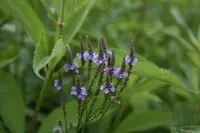
At the stem tips, several slim flower spikes rise together like a candelabra. Each spike is packed with tiny blue-violet flowers, and the whole plant often stands 3 to 6 feet (0.9 to 1.8 m) tall.

Verbena hastata Identification

Check Your Plant with Botan

Upload a plant photo and check the identification in seconds.

Clear images work best. Avoid photos taken too close or too far away

Check the flower spikes, leaf arrangement, and stem shape on Verbena hastata.

  • Upright stems usually branch near the top into several narrow, wand-like flower spikes.
  • Leaves grow in opposite pairs, sometimes in whorls of three, along the stem.
  • Leaves are lance-shaped, sharply toothed, and often about 3-6 inches (8-15 cm) long.
  • Stems are square in cross section, giving the plant a four-angled look.
  • Tiny flowers sit densely along the spikes, opening from the bottom upward.

Square stems plus paired toothed leaves and clustered spikes are the quickest visual match.

Verbena hastata shows clear visual shifts from early leaf growth to fruiting spikes.

  • Young plant: Early plants form an upright clump of opposite, narrow lance-shaped leaves with coarse teeth; stems are still simple, before the tall candelabra-like branching appears.
  • Mature plant: By maturity, the plant stands 3-6 feet (0.9-1.8 m) tall with square stems and a narrower, vertical outline from many upper branches.
  • Flowering stage: The top of each branch carries slender, wand-like spikes packed with tiny blue-violet flowers that open progressively, while lower leaves remain much larger than the flower clusters.
  • Fruiting stage: After bloom, the spikes stay narrow but turn duller as small dry fruits replace the flowers, giving the branch tips a more granular texture.

In spring, Blue vervain emerges with opposite, lance-shaped leaves along upright stems. By early to mid-summer, the plant becomes much easier to recognize as narrow, branched flower spikes rise above the foliage. Through summer into early fall, the spikes open in small bands of purple-violet flowers from the bottom upward. After flowering, the stems remain upright with slender, spent spikes that often stay visible as the plant dries back.

A few wet-meadow species can be mistaken for Blue vervain at a glance.

hoary vervain(Verbena stricta)

Both have upright stems with narrow flower spikes. Hoary vervain has densely hairy, gray-green leaves and stems, while Verbena hastata is usually greener and less hairy. Its leaves are also broader and more strongly toothed.

Virginia waterleaf(Hydrophyllum virginianum)

The flower spikes can suggest vervain from a distance. The clearest check is the foliage: Virginia waterleaf has deeply lobed or divided leaves, not long lance-shaped opposite leaves. Its flowers are also more open and bell-like, not tight spike clusters.

Verbena hastata is native to much of the eastern and central United States and southern Canada. Range can help narrow ID when a similar plant appears well outside this broad native area. It is most often found in wet places: marshes, wet meadows, streambanks, ditches, pond edges, and low ground. Finding it in consistently moist to shallowly flooded sites is a useful field clue.

Confirm It from a Photo

Use Botan to identify or verify your plant from a photo, helping avoid mix-ups with similar species.

FAQ

Its most distinctive feature is the set of narrow, upright flower spikes, often branched like a candelabra. Tiny blue-violet flowers open in rings along each spike, while opposite, toothed leaves line the square stem.

More Plant Identification Guides

Find the Plant. Get the Details.

Identify a plant from a photo with Botan, then review species-specific plant details, care information, and common problems.

Botan app identifying a plant from a photo
Planting Grass Seed in Summer – What Works and What Fails

7 min read · 6 Aug 2026

Planting Grass Seed in Summer – What Works and What Fails

Summer seeding succeeds when the grass type suits the season, and the soil stays moist. Find out how to prepare the seedbed and choose a safe window for planting.

Plant Care
Planting Grass Seed in Summer – What Works and What Fails
How to Tell if a Plant Is Dead

6 min read · 19 Aug 2026

How to Tell if a Plant Is Dead

A plant can lose its leaves, stop growing, or collapse and still remain alive. A closer look at the stems, roots, bulbs, and tubers can show whether the plant still has a chance to recover.

Beginner Guides
How to Tell if a Plant Is Dead
8 Glow-in-the-Dark Plants and Fungi That Really Exist

8 min read · 6 Nov 2026

8 Glow-in-the-Dark Plants and Fungi That Really Exist

Plants that glow in the dusk really exist. Some of them produce their own light, while others need UV exposure or special treatments. Explore eight fascinating examples, including glowing petunias, bioluminescent mushrooms, fluorescent flowers, and experimental succulents.

Plant Recommendations
8 Glow-in-the-Dark Plants and Fungi That Really Exist