

Himalayan balsam Identification (Impatiens glandulifera)

To recognize Himalayan balsam, look for tall, hollow, jointed stems and leaves borne in opposite pairs or whorls of three. The leaves are narrow, lance-shaped, and sharply toothed.

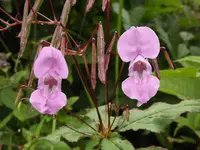
Flowers are hooded and orchid-like, usually about 1 to 2 inches (2.5 to 5 cm) across, with a distinct curved nectar spur projecting behind.

Impatiens glandulifera Identification

Scan to Confirm Himalayan balsam

Use a clear photo to confirm what plant you have.

Clear images work best. Avoid photos taken too close or too far away

Check the plant’s height, leaves, flowers, and seed pods.

  • An upright annual, often 3-7 feet (0.9-2.1 m) tall, with thick, hollow, smooth stems.
  • Leaves are long and narrow, usually 4-9 inches (10-23 cm), with sharp teeth and pointed tips.
  • Leaves commonly appear in whorls of three, or sometimes opposite, along the stem.
  • Flowers are helmet-shaped and pink to purple, with a curved nectar spur projecting behind.
  • Seed pods are slender and club-shaped, hanging from the flowers and clearly segmented.

If flowers and whorled leaves are both present, identification is usually much easier.

This species shows clear visual shifts from low seedling to tall, flowered, pod-bearing plant.

  • Seedling: Seedlings are low and soft-stemmed, with simple first leaves before the later whorled or opposite pattern becomes obvious.
  • Young plant: Young plants form upright, hollow, watery stems and longer lance-shaped leaves, with the paired or whorled arrangement now clearly visible.
  • Flowering stage: Plants are often 3-6 feet (0.9-1.8 m) tall, carrying helmet-shaped pink to purple flowers in loose clusters from upper leaf axils.
  • Fruiting stage: After flowering, narrow green seed capsules replace the blooms, hanging from the same upper nodes and becoming the plant's most distinctive feature.

In spring and early summer, Impatiens glandulifera quickly forms tall, watery stems with fresh green lance-shaped leaves in opposite or whorled sets, creating a dense, upright patch. From mid to late summer, showy pink to purple hooded flowers become the clearest clue. By late summer into fall, slender seed capsules are visible; after they ripen and burst, frost leaves the plant collapsed and blackened rather than woody.

A few tall, pink-flowered plants are regularly mistaken for Himalayan balsam.

jewelweed(Impatiens capensis)

Both are annual balsams with watery stems and explosive seed pods. Jewelweed usually has orange, spotted flowers and hangs them singly from thin stalks; it also stays much shorter, often 2–5 feet (0.6–1.5 m), while Impatiens glandulifera has larger pink to purple flowers in clusters.

policeman’s helmet(Impatiens balfourii)

This species can resemble it because both have pinkish helmet-shaped flowers and similar leaves. I. balfourii is usually smaller, often under 5 feet (1.5 m), and its flowers are distinctly two-toned, typically pale pink to white with darker pink.

Impatiens glandulifera is native to the western Himalaya, from northern Pakistan through northern India to Nepal. In its native range it occurs along streams, riverbanks, wet woodland edges, and damp mountain valleys, often at roughly 6,000-10,000 feet (1,800-3,000 m). That setting helps with identification because this species is strongly associated with moist, disturbed watersides and shaded to partly open valley habitats, rather than dry ground or truly alpine sites.

Scan. Check. Confirm.

Use Botan to identify or verify a plant from a photo, helping avoid mix-ups with similar-looking species.

FAQ

The flowers are helmet-shaped with a long curved spur at the back, usually pink to purple and sometimes white. They hang in loose clusters and are about 1 to 1.5 inches (2.5 to 4 cm) long.

More Plant Identification Guides

Scan Your Plant. Get the Details.

Identify a plant from a photo with Botan, then review plant details, care information, and common problems.

Botan app identifying a plant from a photo
12 Best Cold-Hardy Vegetables for Cold Weather

7 min read · 13 Oct 2026

12 Best Cold-Hardy Vegetables for Cold Weather

Cold-hardy vegetables can keep a garden productive through chilly fall, winter, and early spring weather. This guide covers 12 reliable crops, their frost tolerance, and practical growing tips for better cold-season harvests.

Plant Recommendations
12 Best Cold-Hardy Vegetables for Cold Weather
12 Best Landscaping Trees for Your Garden

8 min read · 6 Oct 2026

12 Best Landscaping Trees for Your Garden

Choosing the landscape tree depends on what your garden needs most. These 12 options include compact flowering specimens, colorful deciduous trees, shade varieties, and evergreens suitable for screening and year-round structure.

Plant Recommendations
12 Best Landscaping Trees for Your Garden
How to Bottom Water Plants: Complete Guide

6 min read · 13 Jul 2026

How to Bottom Water Plants: Complete Guide

Bottom watering helps soil absorb moisture evenly and keeps foliage dry, reducing the risk of missed dry spots or root problems. Place the pot in a tray of water for a short time, then let it drain well.

Plant Care
How to Bottom Water Plants: Complete Guide