Early staking support
Install slender stakes or a discreet plant ring when shoots reach 15–20 cm so the tall stems stay upright in wind and heavy rain without breaking.

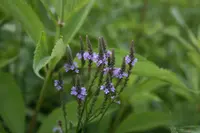
Blue vervain (Verbena hastata) is a hardy, upright perennial wildflower native to North America. It commonly grows in moist meadows, ditches, and stream edges. Plants form tall, slender clumps with narrow leaves and branched spikes of small purple-blue flowers that open gradually from bottom to top. This gives a long bloom period that supports many pollinators. Blue vervain tolerates cold climates and occasional short-term wet soils but resents drying out completely. It prefers full sun, consistent moisture, and reasonably fertile, well-drained soil. Once established, it is relatively low-maintenance, though not ideal for very dry or compacted sites, which helps guide how to care for Blue vervain.

Care Difficulty
Moderate Care

Light Preference
Full Sun

Water Requirements
Keep Soil Moist

Temperature Preference
Cold Hardy

Hardiness Zone
3–8

Soil Texture
Loamy, Clay, Organic-rich

Soil pH
Acidic (5.5–6.5), Slightly acidic (6.5–7.0)

Soil Drainage
Moist but well-drained

Fertilization
Minimal (feed rarely)
Scan your plant to receive care tips personalized for your specific plant
Available on iOS and Android
This species is a sun-loving wetland perennial that flowers best with strong light exposure.
This plant prefers consistently moist soil, especially during active growth and flowering.
This hardy perennial tolerates a wide temperature range once established in the landscape.
Humidity is rarely a concern for Verbena hastata in typical outdoor conditions.
Verbena hastata prefers moist, well-drained, organically enriched soil that still holds some water.
This species can grow in containers if the pot is large and moisture-retentive yet well-drained.
This native perennial usually needs minimal feeding in garden soil but benefits from light support in poor or container media when caring for Blue vervain.
Pruning supports denser growth and longer flowering on Verbena hastata.
This species is more often transplanted in beds than repotted long term in containers.
Verbena hastata is commonly propagated from seed, with division as a secondary option.
This hardy perennial tolerates typical winters in much of its range and needs only modest attention.

Plant Health Check
Not sure what's wrong with your plant? Check your plant's health inside the app.
Blue vervain has tall, narrow flower spikes whose small tubular blossoms are especially accessible to long-tongued bees and certain butterfly species, making it an important nectar source in wet meadow pollinator networks.
This species naturally occurs along streams, ditches, and in moist prairies, showing a strong preference for consistently damp soils compared with many other verbenas that favor drier, more disturbed sites.
Seeds of Blue vervain typically require a period of cold, moist stratification, an adaptation that times germination to spring conditions after exposure to winter temperatures in temperate climates.

Indigenous groups in North America historically recognized Blue vervain as a distinct wetland and meadow indicator plant, using its presence in the landscape to help identify reliably moist sites for certain traditional land uses and seasonal activities.
Poor flowering often results from too much shade, nutrient-poor or very dry soil, or plants that are still immature. Deadheading faded spikes and avoiding heavy nitrogen fertilizers also supports stronger bloom production in the next flowering cycle.
Keep your plants happy and healthy with plant identification, disease detection, and easy care guidance.