
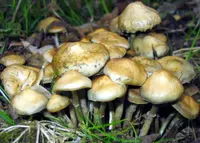
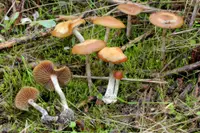
liberty cap Identification (Psilocybe semilanceata)

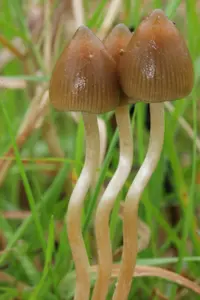
To recognize liberty cap, look first for the small, sharply conical to bell-shaped cap with a distinct pointed nipple, usually about 0.5 to 1 inch (1.2 to 2.5 cm) across.

It also has a long, slender stem that is noticeably taller than the cap is wide, and crowded dark gills attached beneath the cap.

Psilocybe semilanceata Identification

Scan to Confirm liberty cap

Upload a plant photo and check the identification in seconds.

Clear images work best. Avoid photos taken too close or too far away

Check Psilocybe semilanceata for a small, sharply pointed cap and a slim stem.

  • Cap is conical to bell-shaped with a distinct nipple-like point at the top.
  • Cap is usually about 0.5-1 inch (1.2-2.5 cm) across and often looks taller than wide.
  • Margin often stays slightly inrolled, especially on younger-looking specimens, not flat and broad.
  • Stem is long, thin, and pale, usually about 2-4 inches (5-10 cm) tall with no ring.
  • Gills sit close together under the cap and attach upward to the stem.

Use several features together, since size alone is not reliable.

Psilocybe semilanceata shows useful visual shifts as the fruiting body expands and ages.

  • Young plant: Very young fruiting bodies are narrow and closed, with a sharply pointed cap, slim stem, and the margin still curved inward over the gills.
  • Mature plant: At maturity, the cap expands to about 0.5-1 inch (1.2-2.5 cm) wide but keeps a distinct nipple-like umbo, while the stem appears longer and more flexuous.
  • Fruiting stage: Fully developed specimens show clearly exposed dark gills beneath the cap and a more open profile, unlike younger stages where the underside stays partly concealed.

Liberty cap is mainly a late-season find. Fruiting bodies usually appear from late summer into fall, especially in cool, damp weather, when the small conical caps and slender stems become visible above grass. Outside the fruiting period, there is often little to see. This species does not leave woody stems, leaves, or persistent fruiting structures that help with identification in winter or spring.

Several small grassland mushrooms can be mistaken for liberty cap.

dunce cap(Conocybe apala)

Similar size and bell shape in grass. It is paler, more fragile, and lacks the distinct pointed nipple and tough, elastic stem.

haymaker's mushroom(Panaeolina foenisecii)

Often grows in lawns and can look similar when young. Its cap is broader and usually lacks a sharp umbo; gills turn dark mottled brown.

mottlegill(Panaeolus papilionaceus)

A small brown grassland mushroom with a sometimes pointed cap. It is usually larger, with ragged white veil fragments on the cap margin.

Psilocybe semilanceata is widely recorded across temperate parts of Europe and also occurs in parts of North America. For identification, geography helps most when paired with habitat rather than used alone. It is typically found in unimproved or semi-natural grassland, especially damp pastures, meadows, and lawns, often among grasses in acidic to neutral soils. It does not usually grow from wood. Finding it in open grassy ground, rather than woodland or mulch beds, helps narrow the identification.

  • Psychoactive compounds: The fruiting body contains psilocybin and related compounds. This is an ingestion risk for humans and pets because it can cause poisoning and marked changes in behavior and perception.
  • High misidentification risk: Wrong identification is a serious hazard. Small brown grassland mushrooms can be confused with Galerina species, which are dangerously poisonous. A key visible difference is that Psilocybe semilanceata usually has a pointed cap with a distinct nipple-like tip.

Confirm It from a Photo

Botan can compare your photo and help identify or confirm the species, which is useful when details are hard to judge in person.

FAQ

The clearest feature is the sharply pointed papilla, a nipple-like tip, on a slender conical to bell-shaped cap. The cap is often sticky when moist and shows a darker band near the margin.

More Plant Identification Guides

Find the Plant. Get the Details.

Use Botan to identify it from a photo, then see plant details, safety notes, and common problems for that species.

Botan app identifying a plant from a photo
Plant Pot Sizes: How to Choose the Right Plant Container

7 min read · 20 Aug 2026

Plant Pot Sizes: How to Choose the Right Plant Container

Plant pot sizes can be confusing because the number on the label only tells you part of the required information. A container may look spacious but actually be too shallow. So, how to choose pot size for plant species?

Beginner Guides
Plant Pot Sizes: How to Choose the Right Plant Container
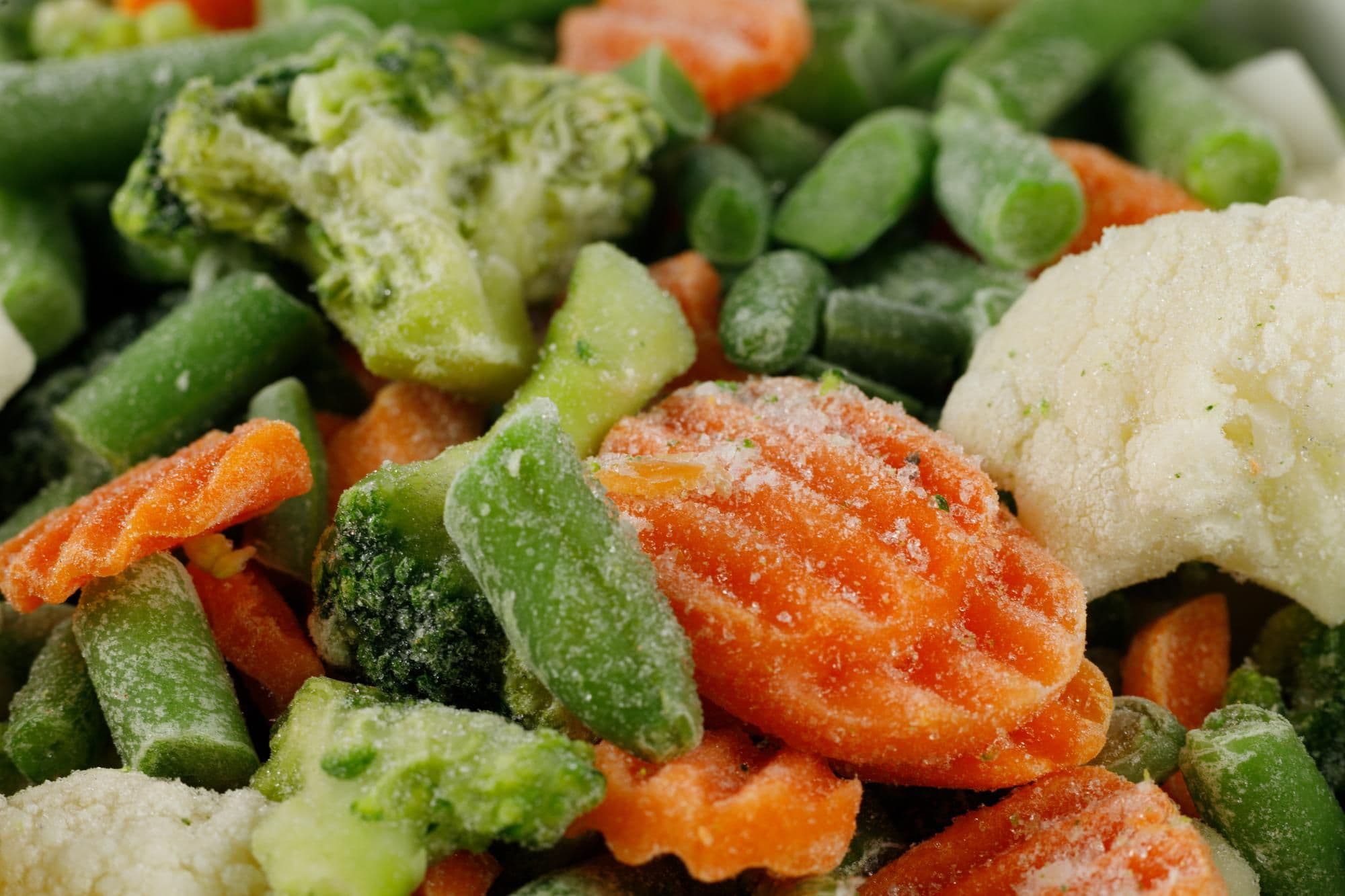
Frozen vs Fresh Vegetable Nutrients: Which Option Is Healthier?

6 min read · 8 Sept 2026

Frozen vs Fresh Vegetable Nutrients: Which Option Is Healthier?

Frozen and fresh vegetables are nutritionally comparable: frozen produce often retains vitamins just as well as fresh and may sometimes contain more. Here’s how blanching and storage affect nutrients—and when to choose each.

Plant Recommendations
Frozen vs Fresh Vegetable Nutrients: Which Option Is Healthier?
What Plants Don't Like Epsom Salt?

11 min read · 29 Jul 2026

What Plants Don't Like Epsom Salt?

Learn which plants can be seriously damaged by Epsom salt and which will thrive on it. We’ll explain when and how to use it properly, provide tips for indoor & outdoor plants — read on and enjoy a healthy garden.

Plant Care
What Plants Don't Like Epsom Salt?