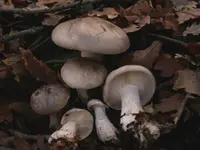
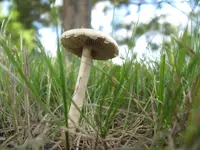
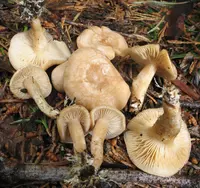
Use hardwood substrate
For reliable flushes, prepare a substrate of pasteurized hardwood sawdust or chips mixed with a small amount of wheat bran, as this species performs better on nutrient-moderate woody material than on rich composts.

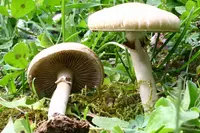
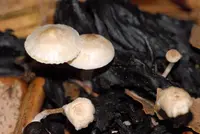
Spring fieldcap, Agrocybe praecox, is a small, short-lived mushroom rather than a leafy houseplant. It typically forms tan to light brown caps with slender stems, often appearing in dense clusters. This species commonly shows up in wood chip beds, lawns, and garden borders, especially in spring and early summer in temperate regions.
It usually thrives in nutrient-rich, disturbed soils with steady moisture and partial shade. Gardeners often notice it as a natural decomposer that breaks down organic mulch. Anyone who wants to care for Spring Fieldcap mainly needs to understand its preference for cool, moist conditions and plenty of woody or organic debris to feed on.

Care Difficulty
Moderate Care

Light Preference
Partial Shade

Water Requirements
Keep Soil Moist

Temperature Preference
Cool Climate

Hardiness Zone
Unknown

Soil Texture
Loamy, Silty, Organic-rich

Soil pH
Slightly acidic (6.5–7.0), Neutral (7.0)

Soil Drainage
Moist but well-drained

Fertilization
Minimal (feed rarely)
Scan your plant to receive care tips personalized for your specific plant
Available on iOS and Android
This spring-fruiting woodland mushroom prefers soft, indirect light rather than strong, drying sun.
This fungus needs consistently moist, not waterlogged, substrate to form healthy fruiting bodies.
This species fruits best in cool to mild conditions typical of late spring.
Humidity has little impact on Agrocybe praecox, which focuses more on moisture in its substrate than in the surrounding air.
Agrocybe praecox fruits best in consistently moist, loose, organic-rich substrate rather than standard garden soil.
This species is suitable for container growing when provided with a deep, organic-rich substrate layer.
This wild, wood-inhabiting fungus gains nutrients from decaying organic matter and usually needs no additional fertilizer.
Pruning is not applied to Agrocybe praecox, since it is a short-lived mushroom fruiting from hidden mycelium in soil or wood.
Transplanting focuses on moving colonized substrate rather than handling individual mushrooms, which are only the fruiting bodies.
Propagation of this species is specialized and typically handled by experienced mushroom growers rather than casual gardeners.
This outdoor fungus is generally cold hardy and needs no specific winter care in typical temperate climates.

Plant Health Check
Not sure what's wrong with your plant? Check your plant's health inside the app.
This species fruits mainly in late spring to early summer, often disappearing from the same site once temperatures rise and soils dry, which is why it is considered an early-season mushroom in temperate regions.
It is strongly associated with disturbed, nutrient-rich substrates such as garden mulch, woodchip beds, and path edges in urban parks, where it helps decompose woody debris and recycle nutrients.
Microscopically it has smooth, brown, ellipsoid spores with a prominent germ pore, a combination used by mycologists to separate it from similar spring-fruiting brown mushrooms.
This mushroom group is sometimes described as conditionally edible, but accurate identification is difficult and there are similar toxic species. For non-experts, it is safest to treat it as inedible and avoid consumption.
Keep your plants happy and healthy with plant identification, disease detection, and easy care guidance.