Host selection
Establish cultures only on well-colonized, mature Russula or Lactarius fruiting bodies, since young or decaying hosts collapse too fast for Asterophora parasitica to complete its life cycle.

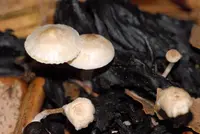
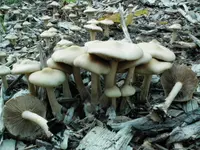
Silky piggyback, Asterophora parasitica, is not a leafy houseplant but a small parasitic fungus that grows on old, decaying mushrooms, especially Russula and Lactarius species. It forms compact, pale gray to whitish caps with a powdery surface made of chlamydospores, which are thick-walled survival spores.
This fungus appears in cool, moist forests, mainly in temperate regions of Europe and North America, and is seen in late summer to autumn. It is difficult to maintain in cultivation because it depends on a host mushroom, so attempts to care for Silky Piggyback at home are rarely successful.
In nature, it prefers shaded forest floors with consistent moisture and abundant decaying mushroom material, rather than soil in the usual gardening sense.

Care Difficulty
Hard Care

Light Preference
Shade

Water Requirements
Keep Soil Moist

Temperature Preference
Cool Climate

Hardiness Zone
Unknown

Soil Texture
Organic-rich, Peaty

Soil pH
Strongly acidic (4.5–5.5)

Soil Drainage
Moist but well-drained

Fertilization
Minimal (feed rarely)
Scan your plant to receive care tips personalized for your specific plant
Available on iOS and Android
This fungus prefers low, forest-floor light that mimics its natural conifer log habitat.
Watering focuses on keeping the decaying wood or substrate evenly moist, not saturated.
This species thrives in cool, stable woodland temperatures on decaying mushrooms and conifer wood.
This fungus prefers consistently moist, high-humidity conditions rather than typical indoor air levels.
This mushroom does not grow in conventional soil but on decaying mushrooms of Russula or Lactarius species.
This species is not well suited to standard container growing, since it depends on specific host mushrooms rather than potting media.
This parasitic fungus grows on decaying mushrooms and typically needs no supplemental fertilizer in cultivation.
Pruning is not applicable for Asterophora parasitica, as it is a small, short-lived parasitic fungus on other mushrooms rather than a structural plant.
Transplanting this fungus is rarely practical, as it depends on specific host mushrooms and decaying wood habitats.
Propagation of Asterophora parasitica is specialized and generally left to experienced mycologists rather than home growers.
Specific winter care is usually unnecessary because this fungus appears opportunistically on decaying mushrooms in suitable seasons and then disappears.

Plant Health Check
Not sure what's wrong with your plant? Check your plant's health inside the app.
This fungus grows almost exclusively on old, decaying fruiting bodies of Russula and Lactarius mushrooms, using their tissues as its main source of nutrients rather than decomposing wood or leaf litter directly.
Mature caps often become covered in a dense, pale, powdery layer of spores, giving them a frosted or dusty appearance that is distinctive among small, cap-forming fungi.
It typically appears late in the life cycle of its host mushrooms, so fruitbodies are often found only briefly and in small numbers, which makes field encounters relatively uncommon despite a wide geographic range.

Genetic and morphological studies indicate that this species is so specialized on its mushroom hosts that it is placed in a very small genus, with only one or two closely related species known worldwide.
This fungus cannot be grown like a typical houseplant. It develops only outdoors on decaying, older mushrooms, especially Russula or Lactarius species. Without the correct host fungi and forest-like conditions, cultivation attempts almost always fail.
Keep your plants happy and healthy with plant identification, disease detection, and easy care guidance.