Russell's Bolete Care (Aureoboletus russellii)

Also known as: pitted bolete
Russell's Bolete

About Russell's Bolete

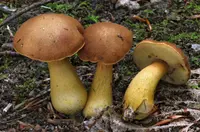
Aureoboletus russellii, commonly called Russell's bolete, is a mycorrhizal mushroom, not a typical houseplant. It forms a partnership with tree roots, especially oaks and other hardwoods. The fungus appears as a thick-stemmed bolete with a brown to reddish cap and yellow pores instead of gills.

This species naturally occurs in forests of eastern North America, usually emerging from soil rich in leaf litter near mature trees. It is not practical to grow indoors in pots, since it depends on living tree hosts and specific soil fungi communities.

For anyone interested in how to care for Russell's Bolete in a garden context, the focus is on maintaining healthy host trees, undisturbed soil, and consistent woodland moisture conditions.

Main Plant Requirements

Care Difficulty

Moderate Care

Light Preference

Partial Shade

Water Requirements

Regular Water

Temperature Preference

Cool Climate

Hardiness Zone

Unknown

Soil Texture

Loamy, Sandy, Organic-rich

Soil pH

Acidic (5.5–6.5)

Soil Drainage

Moist but well-drained

Fertilization

Minimal (feed rarely)

Get Personalized Care Plan

Scan your plant to receive care tips personalized for your specific plant

Available on iOS and Android

How to Care for the Russell's Bolete

This ectomycorrhizal fungus prefers woodland light conditions rather than open, exposed sun.

  • Site Russell's Bolete under deciduous trees where it receives dappled or filtered light for 2–4 hours per day, especially gentle morning sun.
  • Avoid full, open afternoon sun; intense exposure can dry the upper soil layer, overheat tree roots, and limit fruiting body formation.
  • Ensure partial shade (tree canopy, shrub layer, or north/east-facing woodland edge) through summer; some additional light in early spring and fall is acceptable as canopies thin.

This species depends on consistently moist, not saturated, woodland soil around its host tree roots.

  • Aim for soil that stays evenly moist in the top 3–5 cm; if this layer feels dry and loose, recent rainfall or supplemental irrigation is needed.
  • Prioritize excellent drainage with leaf litter and loose mineral soil; standing water, sour smell, or slimy mycelium indicate overwatering and root stress.
  • In dry, hot periods, increase watering frequency near the drip line of host oaks or pines, while in cool, rainy seasons rely mostly on natural precipitation to prevent waterlogging of Aureoboletus russellii.

This fungus thrives in mild to warm woodland conditions and is sensitive to hard frost and prolonged heat.

  • Optimal fruiting typically occurs around 60–75°F (16–24°C), with mycelial growth continuing over a broader range when soil stays cool and moist.
  • It tolerates brief drops to about 32°F (0°C), but repeated hard freezes can damage developing fruiting bodies and limit seasonal appearance.
  • Sustained heat above 85°F (29°C), especially with dry soil, suppresses fruiting; shaded canopy, mulch, and soil moisture help buffer temperature swings through summer and fall.

This ectomycorrhizal fungus prefers consistently moist air but remains tolerant of moderate fluctuations outdoors.

  • Aim for ambient humidity around 60–80% in shaded, sheltered sites to support stable fruiting.
  • Dry, hot winds can desiccate caps and pores; use windbreaks or low understory vegetation to buffer exposure.
  • Low humidity stress shows as cracking, toughening, and rapid shriveling of caps; mulch and regular soil moisture help moderate local humidity near the mycelium.

This species develops best in undisturbed, well-aerated forest-type soil rather than artificial potting mixes.

  • Provide a loose, humus-rich, loamy substrate with abundant leaf litter or decomposed wood to mimic natural oak woodland conditions for Aureoboletus russellii.
  • Ensure drainage is free but not fast-draining like pure sand; soil should stay evenly moist without forming puddles after rain or irrigation.
  • Target a slightly acidic pH around 5.0–6.5, typical of oak forests, by incorporating pine needles, oak leaf mold, or peat-free acidic organic matter.
  • Avoid compacted clay, waterlogged low spots, or heavily fertilized garden soil, which can reduce oxygen in the root zone and disrupt mycorrhizal formation.

This species is generally unsuitable for long-term container growing, because its ectomycorrhizal partnership with tree roots requires a broad, natural soil environment.

This mycorrhizal fungus generally relies on its tree partners and soil life, so direct fertilizing of Russell's Bolete is rarely necessary.

Aureoboletus russellii does not require pruning, but fruiting bodies can be tidied for appearance and hygiene.

  • Remove old, decaying, or insect-damaged mushrooms during dry weather to limit mold and pests.
  • Cut fruiting bodies at the base with a clean knife rather than pulling to avoid disturbing underlying mycelium.
  • Leave healthy mushrooms in place if spore spread and population maintenance are desired.
  • Dispose of removed material away from beds to reduce disease carryover.

This fungus grows in symbiosis with tree roots, so management focuses on transplanting host trees or soil rather than typical repotting.

  • Only consider moving soil when young host trees in containers show roots circling or slow growth in exhausted substrate.
  • Transplant in early spring or early fall, when temperatures are mild and moisture is steady.
  • Shift trees and associated soil into a slightly larger hole or pot, keeping the root ball intact to preserve mycelium.
  • Water gently after transplanting and shade for a few days to reduce root stress and disturbance of fungal partners.

Practical propagation of Aureoboletus russellii for home growers is difficult and not commonly attempted.

Once established with suitable host trees, this species is naturally cold hardy in its range and generally needs no special winter care.

Care Tips

Encourage Mycorrhizal Partners

Plant or maintain compatible host trees such as oaks and related hardwoods nearby, since this bolete relies on a mycorrhizal relationship with living roots and will not fruit well in isolated, treeless beds.

Preserve Leaf Litter

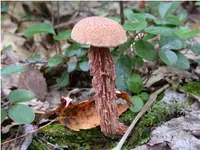
Allow a stable layer of leaf litter and small twigs to accumulate over the soil, which protects fungal mycelium from drying, buffers temperature, and provides a natural microhabitat for fruiting.

Minimize Soil Disturbance

Avoid deep digging, rototilling, or frequent raking in the fruiting area so the underground mycelial network remains intact and can continue producing mushrooms year after year.

Gentle Harvest Technique

Twist and lift fruiting bodies at the base or cut them cleanly at ground level with a knife, then lightly press the soil back in place to limit damage to the mycelium and promote future flushes when growing Russell's Bolete.

Limit Chemical Inputs

Do not apply synthetic fungicides and use herbicides or high-salt fertilizers only at a distance from the patch, since these products can suppress or kill the fungus even when nearby plants appear unaffected.

Common Pests and Diseases

Fungal mycelial rot

This disease affects the underground mycelium and fruiting bodies, leading to soft, water-soaked tissue that collapses quickly. Symptoms include distorted or aborted mushrooms that fail to expand fully.

Solution

Remove and discard all affected fruiting bodies and any obviously colonized substrate, then improve drainage and reduce excess moisture around the host tree’s root zone. Avoid heavy soil compaction and standing water, and space or thin surrounding vegetation to increase airflow and reduce prolonged surface wetness, which supports Aureoboletus russellii care in managed landscapes.

Slug and snail feeding

These pests chew irregular holes in the soft mushroom caps and stems, often leaving slime trails on or near the fruiting bodies. This pest activity is most intense in damp, shaded conditions.

Solution

Hand-pick slugs and snails during the evening or early morning and remove hiding places such as dense debris or boards in the immediate area. If damage is heavy, use iron phosphate slug baits placed away from children and pets, and maintain slightly drier surface conditions without letting the host tree roots dry out.

Fungus gnat larvae

These insects lay eggs in damp organic matter, and the larvae tunnel through developing fruiting bodies, causing internal browning and collapse. Symptoms include soft, discolored stems and caps that may appear waterlogged from the inside.

Solution

Reduce excess surface moisture and saturated organic debris where mushrooms form, and use fine-mesh covers over small cultivated areas to limit adult gnat access. In controlled settings, apply a biological control such as Bacillus thuringiensis israelensis (BTI) to moist substrates according to label directions to target larvae without harming the tree.

Interesting Facts

Sticky golden pores

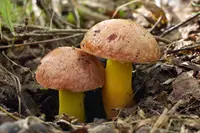
Mature fruiting bodies often show bright yellow to orange, sticky pore surfaces instead of gills, which can trap fine debris and spores from other fungi. This viscid texture is especially noticeable in humid weather and helps distinguish it from many other boletes in mixed forests.

Oak specialist partner

This bolete forms ectomycorrhizal partnerships with oaks, most often with red oak species, exchanging mineral nutrients and water from the soil for sugars from the tree. Its presence can be an indicator of established, relatively undisturbed oak-dominated woodland.

Changing cap colors

The cap typically starts yellowish to yellow-brown and can develop pinkish, reddish, or olive tones with age and weathering. This color variability has caused confusion in the field and contributed to past taxonomic re-evaluations in the group.

Botan icon

Did you know?

The species is notable for its unusually gelatinous to viscid cap cuticle and pore layer, which can remain conspicuously slimy long after many other boletes in the same habitat have dried, making it easier to recognize in the field during extended dry-down periods.

FAQs about Russell's Bolete

This bolete is generally regarded as an edible species, but quality varies and it can become slimy when cooked. Always cook thoroughly, avoid very old or decaying specimens, and never eat wild fungi without expert identification.

Grow Healthy Plants with Botan Care

Keep your plants happy and healthy with plant identification, disease detection, and easy care guidance.

Botan plant care app — identify plants on mobile

Explore More Plants