Wind-conditioning saplings
Plant young trees in a moderately exposed spot or gradually reduce windbreak protection so trunks and roots strengthen naturally instead of staking long term.

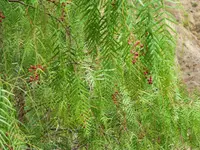
Peruvian peppertree (Schinus molle) is an evergreen tree known for its graceful, weeping branches and clusters of small pink pepper-like berries. It typically forms a wide, airy canopy with finely divided, aromatic leaves.
This species is native to arid and semi-arid regions of South America but is now widely planted in warm, dry climates around the world. It grows quickly and tolerates poor, rocky soils, drought, and high heat, which makes it relatively easy to establish in suitable regions.
Those who want to know how to care for Peruvian peppertree should note that it prefers full sun, well-drained soil, and low to moderate moisture once established.

Care Difficulty
Easy Care

Light Preference
Full Sun

Water Requirements
Low Water

Temperature Preference
Warm Climate

Hardiness Zone
8–11

Soil Texture
Sandy, Loamy, Rocky

Soil pH
Slightly acidic (6.5–7.0), Slightly alkaline (7.0–7.5)

Soil Drainage
Well-drained

Fertilization
Minimal (feed rarely)
Scan your plant to receive care tips personalized for your specific plant
Available on iOS and Android
This drought-tolerant tree prefers bright, open sites with long daily sun exposure.
This species is highly drought-tolerant once established and needs careful, infrequent watering.
This tree prefers warm, dry climates and tolerates a wide temperature range once established.
This species tolerates dry air well, so humidity is rarely a concern for Peruvian peppertree.
Schinus molle prefers lean, fast-draining mineral soils that do not stay wet.
This species is technically suitable for large, outdoor containers but only while young due to its eventual size.
This drought-tolerant Peruvian peppertree needs only light feeding in reasonably fertile soil.
Pruning Schinus molle helps maintain structure, clearance, and safe branch attachment.
This species is usually grown in the ground, so focus on careful transplanting rather than frequent repotting.
Schinus molle is commonly propagated from seed and semi-hardwood cuttings.
Mature trees are fairly frost tolerant but young Schinus molle benefit from simple winter precautions.

Plant Health Check
Not sure what's wrong with your plant? Check your plant's health inside the app.
This species is native to arid Andean regions of Peru and Bolivia, where it often establishes on disturbed, dry sites and acts as a pioneer tree that stabilizes soil and creates shade for other plants.
The leaves and fruits contain aromatic compounds and phenolic chemicals that make the tree strongly scented and help deter many herbivores and some insect pests.
Its dried fruits are commonly sold as pink peppercorns and used as a spice, even though the plant is unrelated to true pepper Piper nigrum and the flavor comes from different secondary metabolites.

Archaeological evidence from coastal Peru shows that this tree was cultivated and ritually used by pre-Inca cultures such as the Nazca, including for fermented beverages and as an offering, indicating a long history of human association that continues today in regions growing Peruvian peppertree.
In many warm, frost-free regions this species is considered invasive. It self-seeds readily, spreads by birds, and can outcompete natives. Always check local regulations and avoid planting near natural areas or waterways.
Keep your plants happy and healthy with plant identification, disease detection, and easy care guidance.