Early structural training
Select a single strong leader and 3–4 well-spaced scaffold branches in the first 2–3 years, removing steep, narrow crotch branches to build a framework that can safely carry heavy fruit later.

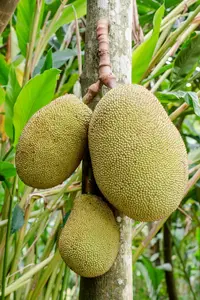
Jackfruit, Artocarpus heterophyllus, is a large evergreen fruit tree from tropical South and Southeast Asia. It is best known for its huge, spiky fruits that grow directly from the trunk and main branches.
The tree has glossy green leaves and a dense canopy, forming a broad, rounded crown in warm climates. In suitable outdoor conditions it can reach impressive heights and becomes a long-lived landscape tree.
Jackfruit prefers warm temperatures, high humidity, and well-drained, fertile soil, so it is usually grown outdoors in tropical or frost-free regions. Its need for consistent warmth and space makes it challenging in cooler areas, so gardeners often research how to care for Jackfruit before planting.

Care Difficulty
Moderate Care

Light Preference
Full Sun

Water Requirements
Regular Water

Temperature Preference
Tropical / Frost Sensitive

Hardiness Zone
10–12

Soil Texture
Sandy, Loamy, Organic-rich

Soil pH
Acidic (5.5–6.5), Slightly acidic (6.5–7.0)

Soil Drainage
Moist but well-drained

Fertilization
Minimal (feed rarely)
Scan your plant to receive care tips personalized for your specific plant
Available on iOS and Android
Artocarpus heterophyllus is a tropical tree that needs strong, consistent light to grow and fruit well.
This species prefers evenly moist, well‑drained soil and reacts quickly to prolonged drought or waterlogging.
This tropical tree needs warm, frost‑free conditions for reliable growth and fruiting.
This species prefers warm, moderately humid air but adapts if moisture needs are monitored.
Artocarpus heterophyllus needs deep, aerated, well-draining soil that still holds some moisture.
This tree can be grown in large containers for some years, but needs careful pot management due to its size potential.
Nutrient-rich but well-drained soil supports strong growth and fruiting in Jackfruit.
Pruning Artocarpus heterophyllus helps manage size, light penetration, and fruiting wood quality.
Young Artocarpus heterophyllus trees often start in containers, then move to a permanent ground position.
Propagation of Artocarpus heterophyllus is most commonly done from seeds, with layering or grafting used for selected varieties.
Artocarpus heterophyllus is a frost-sensitive tropical tree that needs careful management in cool climates.

Plant Health Check
Not sure what's wrong with your plant? Check your plant's health inside the app.
Jackfruit produces the largest known tree-borne fruits, which can exceed 30 kg and contain hundreds of tightly packed, starchy to sweet bulbs around a fibrous core.
In its native South and Southeast Asia, jackfruit functions as a multipurpose agroforestry tree, providing dense timber, edible fruit, seeds, and latex while also offering shade and soil stabilization on small farms.
The sap of jackfruit contains a sticky white latex rich in polyisoprene and other compounds, which has been traditionally used as an adhesive and to help protect wounded plant tissues from pests and pathogens.

The jackfruit tree can begin fruiting in as little as 3–4 years from seed and then continue to produce crops for several decades, with mature trees often carrying flowers and fruits at different stages on the trunk and major branches at the same time.
Browning leaves usually come from low humidity, drought stress, salt buildup from fertilizer, or sunburn on newly exposed foliage. Check soil moisture, flush excess salts occasionally, and protect tender leaves from sudden exposure to intense direct sun.
Keep your plants happy and healthy with plant identification, disease detection, and easy care guidance.