Root sucker management
Inspect the area around the tree several times per year and promptly cut off unwanted root suckers at ground level to prevent the clone from spreading into lawns, beds, or neighboring properties.

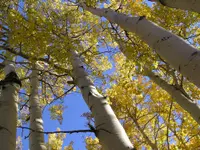
Quaking aspen, Populus tremuloides, is a fast-growing deciduous tree known for its fluttering, round leaves on flat leaf stalks that move in the slightest breeze. It forms smooth, pale trunks with black scars and often grows in large, connected colonies through root suckers.
This species is native to North America and is common in cool, upland forests, mountain slopes, and open woodland edges. It prefers full sun, cool climates, and moist but well-drained soils.
Due to its rapid growth and extensive root system, it is easy to establish in the right climate but can be challenging to manage in small spaces, which shapes how to care for quaking aspen.

Care Difficulty
Moderate Care

Light Preference
Full Sun

Water Requirements
Regular Water

Temperature Preference
Cold Hardy

Hardiness Zone
1–7

Soil Texture
Sandy, Loamy, Silty

Soil pH
Acidic (5.5–6.5), Slightly acidic (6.5–7.0)

Soil Drainage
Moist but well-drained

Fertilization
Minimal (feed rarely)
Scan your plant to receive care tips personalized for your specific plant
Available on iOS and Android
This species is a sun-loving tree that also tolerates some light shade, especially in warmer regions.
This tree prefers evenly moist, cool soil but reacts poorly to both prolonged drought and standing water.
This cold-hardy species is adapted to cool to moderately warm climates with pronounced seasonal shifts.
This species tolerates a wide humidity range and usually does not need special air moisture control outdoors.
Populus tremuloides prefers cool, moist, well‑structured mineral soils with consistent drainage.
This species is generally unsuitable for long‑term container growing due to its vigorous root system and eventual size.
Populus tremuloides usually grows well in average soil, but light feeding can support young or stressed trees.
Pruning Populus tremuloides focuses on safety and structure rather than heavy shaping.
Young aspen are sometimes grown in containers, but Populus tremuloides is usually moved to open ground quickly.
Quaking aspen is most commonly propagated from root suckers rather than from seed.
This species is very cold hardy and generally needs minimal winter care once established in the landscape.

Plant Health Check
Not sure what's wrong with your plant? Check your plant's health inside the app.
Many stands are single genetic clones that spread through root suckers, forming what looks like a forest of separate trees but is actually one interconnected organism sharing a common root system.
This species is one of the most widespread tree species in North America, thriving from low elevations up to subalpine zones where few other broadleaf trees can survive cold and short growing seasons.
The flattened leaf stalks (petioles) cause leaves to twist and pivot in very light wind, producing the characteristic trembling and rustling sound that inspired the name quaking aspen.
Some quaking aspen clones, such as the well-known Pando in Utah, are considered among the largest and possibly oldest living organisms on Earth, with a single root-connected colony estimated to cover dozens of acres and persist for thousands of years.
Brown leaves usually result from drought stress, hot drying winds, or leaf scorch after sudden heat. Compacted or waterlogged soil can also damage roots. Check soil moisture, improve drainage, and mulch lightly to stabilize root conditions.
Keep your plants happy and healthy with plant identification, disease detection, and easy care guidance.