Accurate species ID
Confirm identification using multiple traits such as cap color, gill attachment, spore print, and smell before harvesting, since Clitocybe nebularis can be confused with toxic look-alikes.


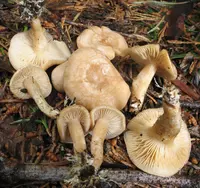
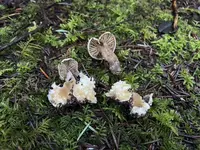
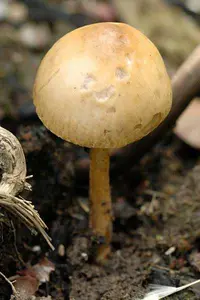
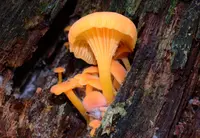
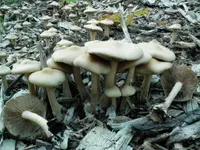
Cloudy clitocybe, Clitocybe nebularis, is a temperate woodland mushroom rather than a leafy houseplant. It forms dense clusters of grey to light brown caps with pale, crowded gills and a short, sturdy stem. In nature it commonly appears in late autumn in mixed forests, often along paths and at woodland edges.
This species is generally considered difficult for beginners to cultivate at home because it has specific substrate and environmental needs that are not fully standardized. It prefers cool, moist, well-ventilated conditions and organic-rich material similar to forest litter. Anyone wanting to care for Cloudy Clitocybe should treat it as a specialty fungus project rather than a routine indoor crop.

Care Difficulty
Moderate Care

Light Preference
Partial Shade

Water Requirements
Keep Soil Moist

Temperature Preference
Cool Climate

Hardiness Zone
Unknown

Soil Texture
Loamy, Silty, Organic-rich

Soil pH
Acidic (5.5–6.5), Slightly acidic (6.5–7.0)

Soil Drainage
Moist but well-drained

Fertilization
Minimal (feed rarely)
Scan your plant to receive care tips personalized for your specific plant
Available on iOS and Android
This woodland mushroom prefers low to moderate light that mimics a shaded forest floor.
This species needs consistently moist, not waterlogged, conditions in its substrate to form healthy fruiting bodies.
This fungus thrives in cool, mild conditions typical of autumn woodlands.
This saprotrophic mushroom prefers consistently moist air but adapts moderately to varied outdoor humidity.
This woodland decomposer thrives in loose, organic-rich, well-aerated substrate rather than standard potting soil.
This species is challenging but possible to cultivate in containers when mimicking a stable, cool forest-floor environment.
This wild fungus does not need routine fertilization; enriching the substrate is usually enough for Clitocybe nebularis.
Pruning is not applicable to Clitocybe nebularis, since it is a fungus that fruits and then decomposes naturally.
Transplanting focuses on moving colonized substrate or mycelium rather than an intact root system in this fungus.
Propagation of this fungus relies on spores or transfer of living mycelium rather than conventional plant methods.
Clitocybe nebularis is generally cold hardy in temperate climates and usually needs minimal winter care.

Plant Health Check
Not sure what's wrong with your plant? Check your plant's health inside the app.
The fruiting body develops a thick, cloud-gray cap that often becomes covered in a fine, powdery bloom as it ages, giving it a distinctive misty appearance compared with many other woodland mushrooms.
This species typically appears in large numbers in late autumn and early winter in temperate Europe, often forming dense, overlapping troops on leaf litter under broadleaf and mixed woodland.
Although historically eaten in some regions after thorough cooking, it is now widely regarded as inedible or even mildly toxic due to reports of gastrointestinal and possible neurological symptoms in some consumers.

Clitocybe nebularis often hosts specialized parasitic fungi, such as the pinkish gilled Lepiota-like species Volvariella surrecta, which can grow directly on its decaying caps and is rarely seen except when this host species is present.
Identification is difficult, and this species is controversial as food. It can cause gastrointestinal and neurological symptoms in some people. Many field guides classify it as inedible or poisonous. It is safest not to eat it at all.
Keep your plants happy and healthy with plant identification, disease detection, and easy care guidance.