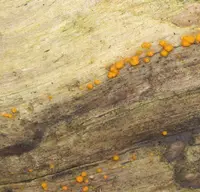
orange pore fungus Care (Favolaschia calocera)

Also known as: orange pore conch, orange Ping-Pong bat
orange pore fungus

About orange pore fungus

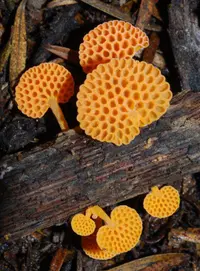
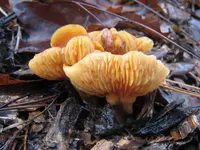
Orange pore fungus, Favolaschia calocera, is a saprophytic fungus that breaks down dead wood rather than a traditional green plant. It forms small, bright orange, fan-shaped caps with a distinctive surface full of large pores instead of gills. The fruiting bodies commonly appear in clusters on fallen branches and rotting logs.

This species is native to Madagascar but has spread to many subtropical and temperate regions, often behaving as an invasive organism on decaying wood. It is not a typical choice for home cultivation, and conditions that allow it to thrive are hard to reproduce indoors, so detailed guidance on how to care for orange pore fungus is limited.

Main Plant Requirements

Care Difficulty

Hard Care

Light Preference

Shade

Water Requirements

Keep Soil Moist

Temperature Preference

Tropical / Frost Sensitive

Hardiness Zone

Unknown

Soil Texture

Organic-rich, Peaty, Loamy

Soil pH

Acidic (5.5–6.5)

Soil Drainage

Moist but well-drained

Fertilization

Minimal (feed rarely)

Get Personalized Care Plan

Scan your plant to receive care tips personalized for your specific plant

Available on iOS and Android

How to Care for the orange pore fungus

Favolaschia calocera prefers stable, filtered forest light rather than direct, open sun.

  • Provide 2–4 hours of gentle morning sun or bright dappled light under shrubs or low tree canopy, avoiding harsh midday rays.
  • Tolerates partial to deep shade, but fruiting bodies of orange pore fungus form best where light is mottled rather than heavily obscured.
  • In summer, protect from strong afternoon sun to prevent drying and bleaching; in winter, increased exposure through bare branches is usually beneficial.

Favolaschia calocera grows on decaying wood and depends on consistently moist, not waterlogged, conditions.

  • Maintain wood or substrate evenly damp; surface should feel moist but not spongy or dripping when pressed by hand.
  • Increase moisture in warm, dry weather with more frequent misting or light soaking; reduce input during cool, wet periods to avoid standing water and anaerobic rot.
  • Watch for shriveling, pale fruiting bodies as a sign of drying, and for slimy, collapsing tissue or sour odor as evidence of overwatering.

This species prefers mild, frost-free conditions typical of sheltered forest habitats.

  • Aim for 60–77°F (16–25°C) for steady growth and reliable fruiting on decaying wood or similar substrates.
  • Short dips to about 50°F (10°C) are usually tolerated, but repeated exposure below 41°F (5°C) or hard frost can damage or halt Favolaschia calocera.
  • In hot spells above 82–86°F (28–30°C), provide extra shade and humidity, since prolonged heat and drying winds can quickly desiccate the host wood.

This saprophytic fungus needs consistently high humidity to form and maintain fruiting bodies.

  • Aim for 75–95% humidity around orange pore fungus, using a closed terrarium or covered tank setup if needed.
  • Watch for shriveling, pale or aborted pores, and drying caps as signs humidity is too low.
  • Increase humidity with frequent fine misting, moist but not waterlogged substrate, and limited air movement without fully sealing off fresh air.

Favolaschia calocera grows on decaying wood, so it requires a substrate that mimics rotting, moisture-retentive timber rather than mineral soil.

  • Use a base of well-soaked hardwood pieces, wood chips, or compressed sawdust blocks enriched with a small amount of decomposed leaf litter or compost.
  • Ensure the substrate drains slowly yet does not sit in standing water by allowing excess water to drip away after soaking logs or blocks.
  • Maintain a slightly acidic environment, roughly pH 5.0–6.5, by using mostly hardwood materials and avoiding alkaline amendments such as lime.
  • Improve aeration by loosely packing chips or drilling ventilation holes near the substrate zone so oxygen can reach the fungal mycelium without excessive drying.

This species can be grown in containers when logs or wood-based substrates are kept in a humid, protected microclimate.

  • Place wood-filled trays or tubs inside a larger humidity chamber so the container controls moisture loss rather than root space.
  • Raise the log or substrate block slightly above the container base with mesh or blocks to prevent constant contact with residual water.
  • Choose a sturdy, opaque container that limits light on the colonizing wood and reduces temperature swings that stress the mycelium.

Favolaschia calocera grown on logs or woody debris rarely needs additional fertilizer beyond natural substrate nutrients.

Favolaschia calocera does not benefit from structural pruning, but limited sanitation is sometimes useful.

  • Use small, sharp scissors or a clean knife to remove collapsed, moldy, or insect-damaged fruiting bodies at their base.
  • Carry out any cleaning during active growth so remaining mycelium recovers quickly in warm, moist conditions.
  • Avoid cutting into the underlying wood or substrate, since this can disrupt the fungal network and reduce future fruiting.

This fungus is usually grown on fixed substrates, so transplanting focuses on moving colonized wood or media rather than handling roots.

  • Consider transplanting when growth stalls, substrate is heavily decomposed, or contamination spreads across the surface.
  • Plan moves during mild, moist periods to limit desiccation of the colonized wood or sawdust blocks.
  • Shift the entire colonized piece onto fresh compatible wood or substrate without breaking it apart to avoid stressing the mycelium.
  • Keep the new site shaded and evenly moist for 1–2 weeks so the colony re-establishes and resumes fruiting.

Propagation of Favolaschia calocera is specialized and usually carried out by experienced growers rather than casual hobbyists.

  • Use spore prints or colonized dowel plugs placed into pre-drilled hardwood logs or sterilized sawdust blocks.
  • Inoculate during warm seasons and maintain 70–80°F, high humidity, and low light to support mycelium establishment.
  • Keep substrates clean, with good air exchange but minimal drafts, to reduce competing molds and bacteria.

Outdoor colonies of orange pore fungus generally need minimal winter care where conditions remain above hard frost.

  • In cool climates, site colonized logs in sheltered, shaded spots that stay slightly above freezing.
  • Avoid repeated freeze–thaw cycles by keeping substrates off bare, waterlogged ground.
  • Container or bag-grown cultures in very cold regions can be overwintered in a cool garage or shed just above 32°F.

Care Tips

Use clean hardwood

Inoculate only fresh, disease-free hardwood pieces or chips, since decayed or moldy wood strongly increases contamination risk and reduces successful colonization when growing orange pore fungus.

Control airflow precisely

Provide gentle but continuous air exchange around the culture to avoid carbon dioxide buildup, which can cause distorted pore surfaces and weak fruiting bodies.

Segment the substrate

Arrange wood pieces in small, separated clusters instead of one solid mass, so you can remove any contaminated portion quickly without discarding the entire culture.

Stage environmental shifts

Once mycelium has fully colonized the substrate, gradually introduce higher light and slightly increased airflow over several days to trigger fruiting without shocking the culture.

Monitor pore coloration

Regularly inspect the underside of caps for even, bright orange pores, since dull or patchy coloration can signal suboptimal humidity or early contamination that should be corrected promptly.

Common Pests and Diseases

Wood-decay competition

This disease reflects competition from other wood-decay fungi that colonize the same dead wood, reducing substrate available for Favolaschia calocera and sometimes overtaking it completely.

Solution

Remove and discard heavily overgrown or fully colonized wood and introduce fresh, clean hardwood pieces to maintain a stable resource. Keep logs or branches in a shaded, evenly moist environment with good airflow to favor stable Favolaschia calocera fruiting over aggressive competitors.

Green mold (Trichoderma)

This disease appears as fast-spreading, bright to dark green patches that overrun the orange pores and mycelium on the wood surface.

Solution

Cut away and discard any strongly contaminated wood sections and reduce excess moisture or standing water that favors Trichoderma growth. Improve airflow around the culture and, when possible, restart on fresh, clean wood kept evenly moist but not waterlogged to support healthier Favolaschia calocera care instructions.

Mite infestation

These insects are tiny, often barely visible, and can graze on fungal tissue, causing dull, scarred, or patchy pore surfaces and reduced spore production.

Solution

Gently rinse affected fruiting bodies and surrounding wood with a fine spray of clean water and increase ventilation to make conditions less favorable for mites. In persistent indoor setups, isolate the culture and use sticky traps nearby while avoiding chemical sprays directly on the fungus.

Fungus gnat larvae

This pest lives in and on moist wood, where larvae tunnel through fungal tissue and substrate, leading to deformed or prematurely collapsing fruiting bodies.

Solution

Allow the surface of the wood to dry slightly between mistings while keeping internal moisture adequate, reducing ideal conditions for larvae. Use yellow sticky traps to capture adult gnats and, if needed, apply a biological control such as Bacillus thuringiensis israelensis (Bti) to the surrounding moist medium, avoiding direct saturation of the fruiting bodies.

Bacterial blotch

This disease causes water-soaked, slimy, or darkened spots on pore surfaces, often developing where water droplets remain on the fungus for long periods.

Solution

Remove and discard severely affected fruiting bodies and avoid overhead misting that leaves standing droplets on the surface. Improve airflow, reduce crowding of wood pieces, and maintain moderate humidity so the fungus dries slightly between misting sessions without becoming fully dry and brittle.

Interesting Facts

Bright orange pore surface

This fungus forms small, fan-shaped caps with a vivid orange underside covered in large, round pores instead of gills, which is unusual among many common wood-decay fungi that typically have fine pores or gills.

Global invasive spread

Originally described from Madagascar, it has spread across tropical and subtropical regions and is now considered invasive in parts of New Zealand, Australia, Europe, and the Americas, where it colonizes disturbed forests and roadside wood.

Preference for disturbed wood

It strongly favors dead wood in disturbed habitats such as logging sites, trails, and roadsides, and is often one of the first wood-decay fungi to appear on freshly fallen sticks and branches.

Botan icon

Did you know?

Molecular studies using DNA sequencing have shown that populations first identified under this name in distant regions include several closely related lineages, suggesting that what is currently called Favolaschia calocera may represent a species complex rather than a single uniform species.

FAQs about orange pore fungus

This species spreads through spores and can colonize new woody substrates quickly in suitable humid climates. In some regions it behaves as an opportunistic colonizer, so monitor its spread and remove unwanted clusters before they dominate surfaces.

Grow Healthy Plants with Botan Care

Keep your plants happy and healthy with plant identification, disease detection, and easy care guidance.

Botan plant care app — identify plants on mobile

Explore More Plants