Use suitable substrates
Grow colonies on well-decayed hardwood pieces kept in a shaded, ventilated box or terrarium, avoiding fresh resinous conifer wood that slows development and may leach inhibitory compounds.

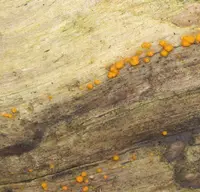
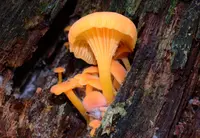
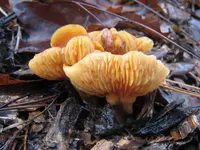
Jelly spot fungus, Dacrymyces stillatus, is a small, gelatinous wood-decay fungus rather than a traditional indoor plant. It forms soft, orange to yellow, blob-like patches that appear on dead or decaying wood, often after rainy weather. The fruiting bodies can merge into irregular, cushiony masses that dry and shrink in dry conditions, then swell again when moisture returns.
This species occurs widely in temperate regions, including North America and Europe, wherever rotting hardwood is present. It is not commonly cultivated, but those who care for Jelly Spot Fungus should provide consistently damp, shaded conditions and plenty of decaying wood as a substrate.

Care Difficulty
Moderate Care

Light Preference
Shade

Water Requirements
Keep Soil Moist

Temperature Preference
Cool Climate

Hardiness Zone
Unknown

Soil Texture
Loamy, Silty, Organic-rich

Soil pH
Acidic (5.5–6.5), Slightly acidic (6.5–7.0)

Soil Drainage
Waterlogged tolerant

Fertilization
Minimal (feed rarely)
Scan your plant to receive care tips personalized for your specific plant
Available on iOS and Android
Dacrymyces stillatus develops best on decaying wood in cool, shaded forests with limited direct sun.
This wood-inhabiting fungus depends on consistently damp, not saturated, substrate rather than direct watering.
This species fruits most reliably in cool to mild temperatures on shaded, damp wood.
This wood-decay jelly fungus prefers consistently moist, humid conditions around 70–90% to fruit well.
Dacrymyces stillatus grows on dead wood rather than in mineral soil, so the key is preparing and managing the woody substrate.
This species is only moderately suitable for container growing because it relies on colonized wood rather than conventional potting media.
This wood-decay fungus grows on nutrient-rich dead wood and generally does not benefit from additional fertilizer.
Dacrymyces stillatus does not require classic pruning because it is a saprophytic fungus that fruits directly from decaying wood.
This species is usually left on its natural substrate, but limited relocation on wood is possible when needed.
Dacrymyces stillatus is generally not propagated intentionally, as it spreads naturally via spores on suitable dead wood.
This fungus is naturally cold hardy and typically needs no special winter care in outdoor settings.

Plant Health Check
Not sure what's wrong with your plant? Check your plant's health inside the app.
This species grows mainly on already dead or decaying wood, where it helps break down tough plant polymers such as cellulose, returning nutrients to forest soil.
The fruiting bodies can dry out and appear almost invisible, then rehydrate and become bright orange and jelly-like again when moisture returns, without forming a new structure.
It typically forms many small, separate but closely packed blobs rather than one large mass, giving the characteristic scattered “jelly spot” appearance on bark and logs.

Molecular studies have used this species as a reference taxon within the Dacrymycetes, helping mycologists clarify evolutionary relationships among jelly fungi that were once grouped mainly by outward appearance.
This wood-decaying fungus spreads by releasing microscopic spores from its jelly-like fruiting bodies. It colonizes dead, damp wood rather than living plants, so it is not considered aggressive or harmful in gardens or landscapes.
Keep your plants happy and healthy with plant identification, disease detection, and easy care guidance.