Use clean substrate
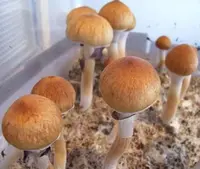
Prepare a sterile, well‑drained substrate such as pasteurized hardwood sawdust mixed with a small amount of well‑rinsed peat or coir to reduce competitor fungi before inoculation.

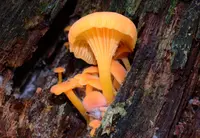
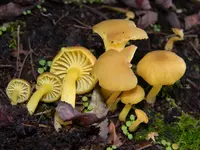
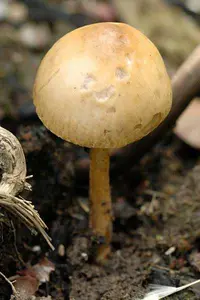
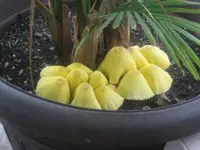
Orange Chrysomphalina (Chrysomphalina aurantiaca) is a small, brightly colored fungus rather than a leafy houseplant. It typically forms thin, orange to yellow caps with shallow, funnel-shaped centers and fine gills underneath. Caps often appear in loose groups, creating vivid patches on the forest floor.
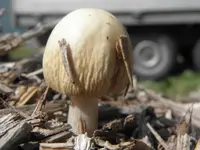
This species usually grows on mossy soil, decaying wood, or forest litter in coniferous and mixed woodlands of temperate regions. It is not commonly cultivated, so information on how to care for Orange Chrysomphalina is limited, and maintaining it outside its natural woodland conditions is generally challenging.
In nature, it prefers cool, moist, shaded habitats with organic-rich, well-drained substrates, reflecting its role in breaking down forest debris.

Care Difficulty
Moderate Care

Light Preference
Partial Shade

Water Requirements
Keep Soil Moist

Temperature Preference
Cool Climate

Hardiness Zone
Unknown

Soil Texture
Loamy, Silty, Organic-rich

Soil pH
Acidic (5.5–6.5)

Soil Drainage
Moist but well-drained

Fertilization
Minimal (feed rarely)
Scan your plant to receive care tips personalized for your specific plant
Available on iOS and Android
This fungus prefers cool, moist woodland light rather than intense open sun.
Chrysomphalina aurantiaca depends on consistently moist, not waterlogged, forest litter and soil.
This species fruits best in cool to mild conditions typical of temperate woodlands.
This fungus does not require managed air humidity under typical outdoor cultivation conditions.
This saprophytic fungus prefers moist, organic, well-aerated substrate rather than conventional potting soil.
This species is not well suited to conventional container culture beyond experimental or educational setups.
Chrysomphalina aurantiaca is a wild saprophytic fungus that usually does not need fertilization when grown in suitable woodland-style substrate.
Chrysomphalina aurantiaca does not require pruning, as individual mushrooms are short-lived and naturally replaced by new fruiting bodies.
For cultivation, focus on establishing fresh substrate rather than traditional repotting of Chrysomphalina aurantiaca.
Cultivation of Chrysomphalina aurantiaca is specialized and propagation is not typically attempted by home growers.
This fungus is naturally cold tolerant in temperate climates and usually needs no special winter care outdoors.

Plant Health Check
Not sure what's wrong with your plant? Check your plant's health inside the app.
This small agaric fungus forms bright orange to yellow, waxy caps that are often slightly depressed in the center, which helps distinguish it from similarly colored grassland fungi in the field.
It typically fruits on mossy, acidic soils in coniferous or mixed woodlands, often appearing among forest moss carpets rather than directly on wood or rich leaf litter.
In many parts of its range, this species fruits in late autumn to early winter, taking advantage of cool, moist conditions when many other mushrooms have already disappeared.

Molecular studies have led to the reclassification of this species from the genus Hygrocybe into Chrysomphalina, reflecting its distinct evolutionary lineage among brightly colored, waxy-capped fungi.
This species is considered an inedible, small woodland mushroom. It is not cultivated for food and may be difficult to identify correctly. For safety, it should not be eaten or used in cooking under any circumstances.
Keep your plants happy and healthy with plant identification, disease detection, and easy care guidance.