Use hardwood logs
Inoculate only freshly cut, disease-free hardwood logs about 10–20 cm thick, as this mimics the fungus’s natural habitat and supports more reliable long-term colonization.

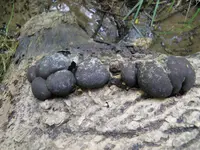
Cramp balls, or Daldinia concentrica, is a wood-decaying fungus rather than a leafy plant. It forms hard, rounded, black growths on dead or dying broadleaf wood, especially ash. When cut, the interior shows distinctive concentric rings.
This species is native to temperate regions and is commonly found in woodlands and hedgerows. It plays an important role in breaking down dead wood and recycling nutrients.
Because it is a saprophyte, meaning it feeds on dead organic matter, it cannot be grown like a typical houseplant. Gardeners who want to care for Cramp balls must provide suitable hardwood logs outdoors and accept that it establishes slowly and unpredictably.

Care Difficulty
Moderate Care

Light Preference
Partial Shade

Water Requirements
Keep Soil Moist

Temperature Preference
Cool Climate

Hardiness Zone
Unknown

Soil Texture
Loamy, Organic-rich

Soil pH
Slightly acidic (6.5–7.0)

Soil Drainage
Moist but well-drained

Fertilization
Minimal (feed rarely)
Scan your plant to receive care tips personalized for your specific plant
Available on iOS and Android
This wood-inhabiting fungus prefers low to moderate light similar to a shaded woodland floor.
This fungus lives on dead wood and depends on stable, moderate moisture rather than frequent surface watering.
This species thrives in cool to mild outdoor woodland-type temperatures.
This wood-inhabiting fungus does not need managed air humidity in garden or outdoor settings.
This fungus develops on dead or decaying hardwood rather than in conventional potting soil.
This species is not well suited to traditional container growing, as it relies on colonizing solid wood rather than free soil in pots.
Daldinia concentrica is a wood-decay fungus that gains nutrients from dead hardwood and does not benefit from added fertilizer.
Pruning is not a meaningful practice for Daldinia concentrica, as it fruits naturally on dead or dying wood and does not respond to shaping.
This species is not managed as a potted or garden plant; it develops on dead hardwood where transplanting is rarely successful or necessary.
Propagation of Daldinia concentrica is mainly of scientific interest and is not a routine horticultural practice.
No special winter care is required, as this fungus is naturally cold hardy and persists on dead wood through freezing conditions.

Plant Health Check
Not sure what's wrong with your plant? Check your plant's health inside the app.
When a mature fruiting body is cut open, its interior shows distinct black and brown concentric rings, each ring marking a separate growth phase thought to form across multiple seasons on the same piece of wood.
This species most often fruits on well-decayed ash wood in Europe and parts of North America, acting as a saprotroph that helps break down lignin-rich tissues in dead branches and logs.
Ripe fruiting bodies release clouds of dark spores that can resemble smoke when disturbed, as millions of microscopic spores are forcibly ejected from the tiny perithecia, the embedded spore-producing chambers.

The species name concentrica refers directly to the striking concentric zoning seen inside the fruiting bodies, which made this fungus a classic textbook example for illustrating layered growth patterns in wood-decaying ascomycetes.
This fungus is not considered edible. The fruiting bodies are extremely hard, dry, and lacking culinary value. It is generally treated as inedible and is not recommended for foraging or cooking.
Keep your plants happy and healthy with plant identification, disease detection, and easy care guidance.