Spore-friendly placement
Collect spore prints from mature caps placed on paper overnight, then lightly scatter the spores over similar moist, shaded leaf litter nearby to slowly expand your fruiting patch over several seasons.

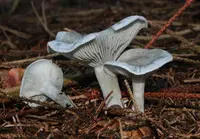
Aniseed funnel, Clitocybe odora, is an aromatic basidiomycete fungus, not a true plant, known for its strong anise or licorice scent. It typically forms small, funnel-shaped caps in shades of blue-green that fade with age, with pale gills running slightly down the stem.
This species is native to temperate forests of Europe and North America, where it grows on soil rich in decaying leaf litter, often in mixed or conifer woodlands. Its preference for cool, moist, shaded habitats makes it challenging to cultivate reliably, so most people do not attempt to care for Aniseed Funnel at home.
In nature it tends to appear in late summer to fall, sometimes in small groups or loose arcs, depending on local climate and organic matter levels.

Care Difficulty
Hard Care

Light Preference
Partial Shade

Water Requirements
Keep Soil Moist

Temperature Preference
Cool Climate

Hardiness Zone
Unknown

Soil Texture
Loamy, Silty, Organic-rich

Soil pH
Acidic (5.5–6.5), Slightly acidic (6.5–7.0)

Soil Drainage
Moist but well-drained

Fertilization
Minimal (feed rarely)
Scan your plant to receive care tips personalized for your specific plant
Available on iOS and Android
Clitocybe odora fruits best in cool, shaded woodland conditions with limited direct sun.
Clitocybe odora develops best in consistently moist, humus-rich woodland soil without waterlogging.
This woodland fungus prefers cool to mild conditions and is sensitive to extreme heat or hard frost.
This species is not suited to home cultivation, but if attempted, humidity should remain moderately high and stable.
Clitocybe odora is a woodland fungus, so the focus is on creating a moist, aerated, organic substrate rather than conventional plant soil.
This fungus is only marginally suitable for container culture and is usually grown experimentally rather than as a standard potted species.
Clitocybe odora is a woodland fungus that normally needs no fertilization when grown in suitable, humus-rich soil.
Clitocybe odora does not require pruning, as mushroom fruiting bodies are short-lived and naturally decompose.
This species is not suited to typical container culture; instead, focus on establishing suitable outdoor substrate for stable colonies.
For those interested in grow Clitocybe odora, focus on spreading mycelium rather than treating it like a conventional plant.
Clitocybe odora is naturally cold hardy in temperate climates and usually needs no special winter care outdoors.

Plant Health Check
Not sure what's wrong with your plant? Check your plant's health inside the app.
The fruiting bodies of this species release a distinct anise or licorice-like scent, which comes from volatile aromatic compounds in the mushroom tissue and is often noticeable even from a short distance.
Fresh caps are typically bluish‑green to blue‑gray, but they often fade toward pale gray or almost white as the mushroom ages or dries, which can make older specimens harder to recognize in the field.
This fungus often grows on soil among mosses in coniferous or mixed woodlands, so its presence can indicate cool, moist, and relatively undisturbed forest microhabitats.

Although it has a long history of being collected as an edible mushroom in some European regions, modern field guides frequently advise against eating it because several closely related Clitocybe species are dangerously toxic and can be confused with it, making identification risky for non‑experts.
This species is considered edible by many foragers, but identification mistakes with similar toxic fungi are common. Only very experienced mycologists should collect it for eating. When uncertain, avoid consumption entirely for safety.
Keep your plants happy and healthy with plant identification, disease detection, and easy care guidance.