Spore-friendly mulching
Apply a thin, loose layer of leaf litter or fine bark mulch over the colonized area so the fruiting bodies can push through easily while the underlying mycelium stays protected and moist.

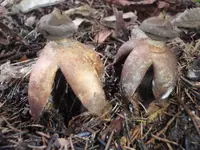
Arched earthstar, Geastrum fornicatum, is a small, star-shaped earthstar fungus rather than a leafy houseplant. It forms a round inner spore sac held above curved outer rays that spread on the soil surface, giving it an arched, sculptural look. This species occurs mostly in woodland soils, often in temperate regions, where it grows on decaying organic matter.
In cultivation it is uncommon and mainly of interest to fungal enthusiasts rather than typical home growers. It prefers undisturbed, humus-rich soil and stable, moist but not waterlogged conditions. Because it depends on specific soil fungi and decomposition processes, reliable how to care for Arched Earthstar guidance for home settings is limited.

Care Difficulty
Hard Care

Light Preference
Partial Shade

Water Requirements
Regular Water

Temperature Preference
Cool Climate

Hardiness Zone
Unknown

Soil Texture
Loamy, Sandy, Organic-rich

Soil pH
Acidic (5.5–6.5), Slightly acidic (6.5–7.0)

Soil Drainage
Moist but well-drained

Fertilization
Minimal (feed rarely)
Scan your plant to receive care tips personalized for your specific plant
Available on iOS and Android
This earthstar fungus prefers dappled woodland light rather than direct, open sun.
This saprophytic fungus relies on consistently moist but not saturated soil around its growing area.
This woodland fungus performs best in mild, temperate conditions without temperature extremes.
This fungus tolerates a broad humidity range and rarely needs special humidity management in cultivation.
Geastrum fornicatum develops best in loose, sharply drained, organic-rich substrates that mimic woodland or sandy forest-floor conditions.
This species is generally unsuitable for container growing and is better maintained in the ground or a semi-natural bed.
Geastrum fornicatum, or Arched Earthstar, is a saprophytic fungus that gains nutrients from decaying organic matter and usually needs no added fertilizer.
Geastrum fornicatum does not require pruning in the horticultural sense, but limited cleanup is useful for hygiene and observation.
This fungus is rarely grown in containers, so transplanting focuses on maintaining a stable, undisturbed substrate rather than classic repotting.
Geastrum fornicatum propagation relies on spore dispersal and careful habitat management rather than standard plant techniques.
This earthstar is naturally cold hardy in temperate climates and usually needs minimal winter care outdoors.

Plant Health Check
Not sure what's wrong with your plant? Check your plant's health inside the app.
The inner spore sac of this species sits on a distinct pedestal formed by a secondary inner layer, creating a two-tiered structure that is unusual among earthstars and helps distinguish it from related species.
It grows mainly in calcareous, nutrient-poor forest soils rich in calcium carbonate, often under conifers or mixed woodland, and is considered an indicator of relatively undisturbed, long-established habitats in parts of Europe.
Although distributed across Europe and parts of Asia and North America, it is rarely encountered and is red-listed or considered of conservation concern in several countries due to habitat loss and its naturally scattered populations.

This species was first described scientifically in the late 18th century and was long used by mycologists as a textbook example of an earthstar with a distinctive arching base, which inspired both its Latin species name fornicatum (arched or vaulted) and the common name arched earthstar.
This fungus performs best outdoors, in natural or simulated woodland conditions with leaf litter and decaying organic matter. Indoors it is difficult to maintain suitable moisture, substrate, and airflow, so long‑term cultivation inside is usually unreliable.
Keep your plants happy and healthy with plant identification, disease detection, and easy care guidance.