Select Proper Substrate
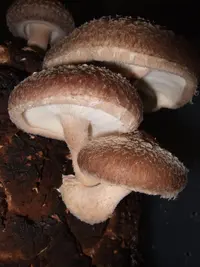
Use freshly cut, disease-free hardwood logs from oak, cherry, or beech, about 10–25 cm in diameter, and avoid softwoods or heavily decayed wood that break down too quickly and reduce yields.

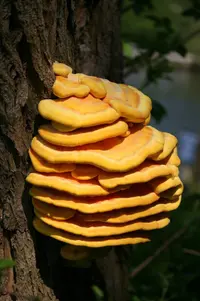
Chicken of the woods (Laetiporus sulphureus) is a wood-decay bracket fungus, not a typical leafy plant. It forms bright yellow to orange, shelf-like clusters on living or dead trees, especially oak. The thick, fleshy fruiting bodies have a smooth upper surface and a pale, porous underside.
In nature, it occurs across North America and Europe in woodlands, parks, and sometimes urban trees. It is considered challenging to cultivate predictably, since it relies on colonizing suitable wood and environmental conditions.
Those exploring how to care for chicken of the woods should know it prefers hardwood logs or stumps, stable moisture, and protected, shaded to semi-shaded locations.

Care Difficulty
Moderate Care

Light Preference
Partial Shade

Water Requirements
Keep Soil Moist

Temperature Preference
Cool Climate

Hardiness Zone
4–9

Soil Texture
Loamy, Silty, Organic-rich

Soil pH
Acidic (5.5–6.5), Slightly acidic (6.5–7.0)

Soil Drainage
Moist but well-drained

Fertilization
Minimal (feed rarely)
Scan your plant to receive care tips personalized for your specific plant
Available on iOS and Android
This wood-decay fungus prefers bright forest edges rather than deep shade or exposed open fields.
This species relies on moisture in the host wood and surrounding soil rather than direct watering.
This fungus fruits best in mild to warm conditions typical of late spring through early fall.
Humidity is rarely a limiting factor for Laetiporus sulphureus, which naturally fruits outdoors across a wide range of ambient conditions.
This wood-decay fungus relies on host trees rather than conventional soil, but site conditions around the stump or log still influence Laetiporus sulphureus establishment.
This species is only moderately suitable for container growing and is usually more reliable when cultivated on outdoor logs or stumps rather than in pots.
This wood-decay fungus grows on living or dead trees and usually gains enough nutrients from its host, so extra fertilizer is rarely needed when caring for chicken of the woods.
Laetiporus sulphureus is not pruned like a typical garden plant; management focuses on safe harvesting and removing old fruiting bodies when necessary.
This species is typically grown on logs or existing trees outdoors, so care focuses on relocating inoculated wood rather than classic repotting.
Reproducing Laetiporus sulphureus is possible but more technical than standard plant propagation and is usually done using spores or colonized substrate.
Outdoor colonies on hardy host trees usually overwinter without special attention, as the fungus survives within the wood rather than as exposed growths.

Plant Health Check
Not sure what's wrong with your plant? Check your plant's health inside the app.
The fruiting bodies contain carotenoid-like pigments that create the intense yellow to orange coloration and help distinguish it from many other bracket fungi in the wild.
This species most often colonizes living or dead hardwoods such as oak, cherry, and willow, causing a brown cubical heart rot that can structurally weaken large trees over time.
Each fruiting season it forms new overlapping shelves from the same infected wood, while the internal mycelium can persist for many years inside the host tree.

Molecular studies show that what was once called Laetiporus sulphureus in Europe and North America actually represents a complex of several closely related species, so specimens from different regions may look similar but be genetically distinct.
Yes, this fungus is considered a good edible when young, tender, and correctly identified. Always cook thoroughly, sample a small portion first, and avoid older, tough, or heavily bug-damaged brackets to reduce digestive upset risk.
Keep your plants happy and healthy with plant identification, disease detection, and easy care guidance.